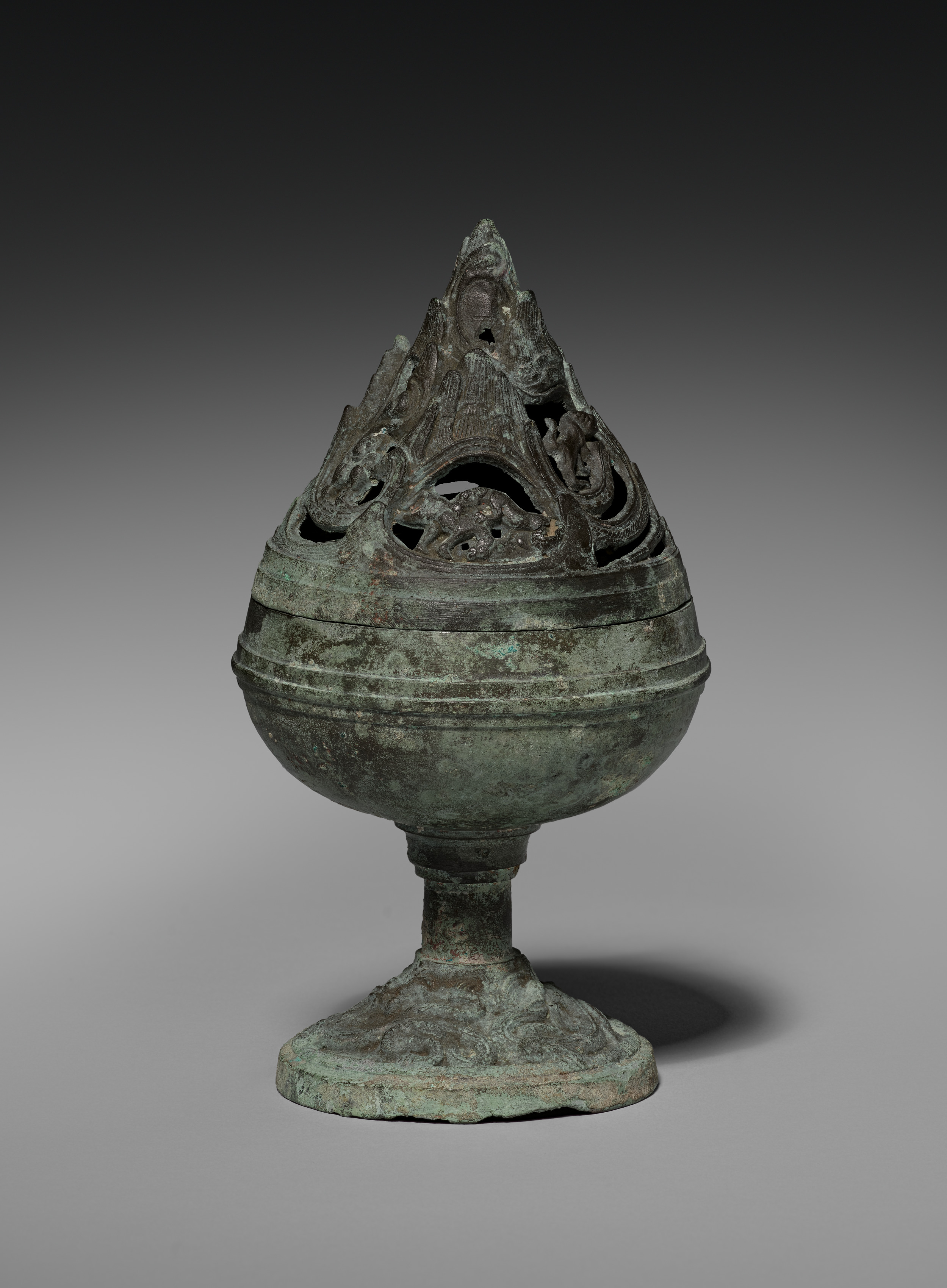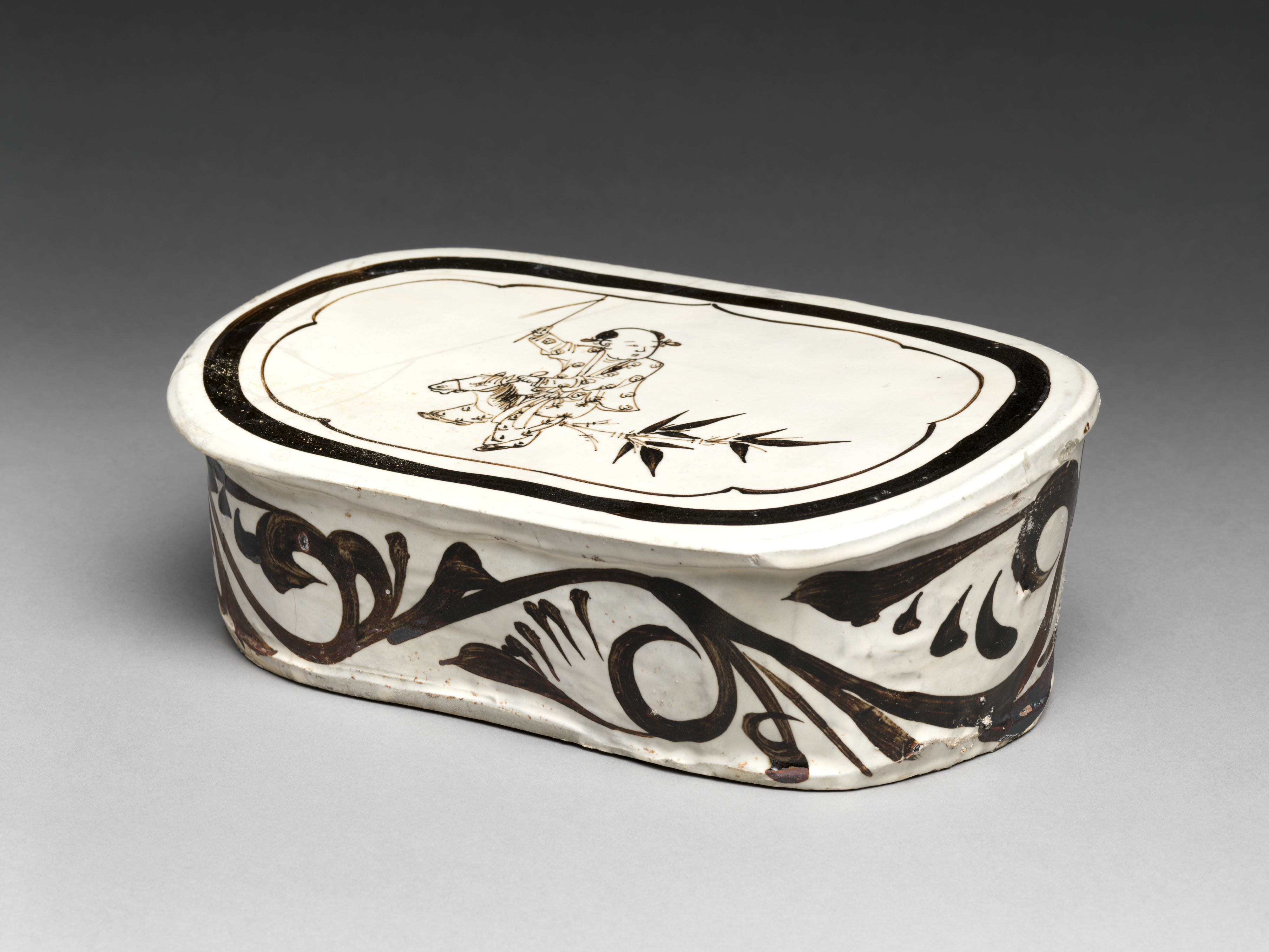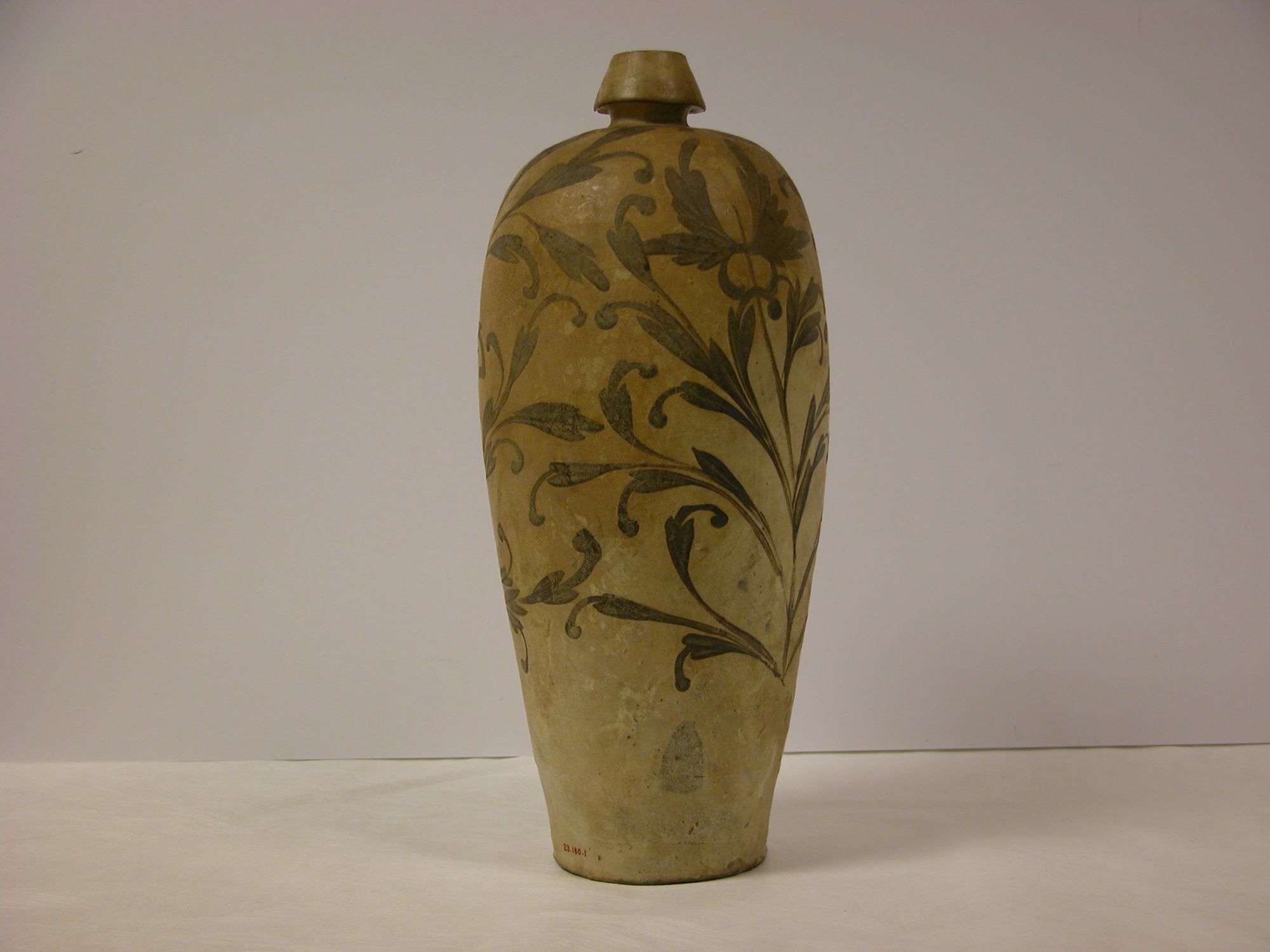
Behind the glass of a European display case, a vase with a short, narrow neck rests upon broad shoulders that taper in a regular slope down to a small foot. The label proposes, soberly: “Plum vase, Song dynasty.” The visitor recognizes the silhouette. They have seen it, no doubt, in other museums, on other labels, sometimes reproduced in contemporary ceramics — always standing alone, always commented on as an object of contemplation, sometimes with a flowering branch one imagines at its mouth.
Let us take up the object once more. Not to contradict it. To read it — to read it from what it says itself, rather than from the name that has been handed down to it.
The object, read without its name
A word first to name it. The plum vase, 梅瓶 méi píng — this is the modern term, the one used on European labels and in catalogues. But let us look at what it says, before looking at what has been said about it.
Its silhouette is singular. The opening measures between four and six centimetres: too narrow for any flowering branch from an ordinary garden to fit properly. The neck, short, barely extends this opening. Then the shoulder broadens abruptly, powerful, sometimes up to eighteen or twenty centimetres in diameter, before the wall descends, conical, toward a modest foot. The mass of the vase, its centre of gravity, lives at the top. This is not the quiet equilibrium of a bud vase.
This geometry is in no way ornamental. It is functional, and the function it traces is precise.
A mouth this narrow is made to be sealed — a wax disc, a folded paper, a leaf stopper. A shoulder this broad is made to hold volume, and to hold this volume without letting it slosh against the wall when the object is moved. A high centre of gravity is the inverse of what an ornamental vase seeks: it serves another gesture, that of a servant who passes a hand under the shoulder and tilts the mass laterally, without having to lift the whole vase, in order to pour. Narrow opening, sealing. Broad shoulder, capacity. High centre of gravity, service by the shoulder.
A wine jar.
The Song themselves understood this so well that they designed its service furniture. Tombs yield, beside these vases, four-footed square or rectangular bases, pierced with a central hole: the narrow foot of the meiping was set into it to keep the vase from tipping over during service. Some Southern Song examples, later, were delivered with a domed lid. Inverted on the table, this lid became a cup — and the vase, its lid set beside it, became a complete service. The piece does not merely stand: it extends into a table.
None of these traits can be explained by decorative function. None. The whole form — from the measure of the neck to the wooden base it requires — argues, detail after detail, in favour of a single function. The object is a wine vessel, and it does nothing to hide it.
What the Song called this object
The name meiping is not the original name. Under the Song, these vases bore other names — names that spoke of wine without indirection.
The earliest attested is 酒经 jiǔ jīng, literally “wine-measure vase.” A twelfth-century text, the 侯鲭录 Hóu qīng lù by the literatus 赵德麟 Zhào Délín, notes it explicitly: “Among the potters’ wares, there is a jiǔ jīng — it holds one dou, it is used to carry wine. When one offers an animal as a gift, one accompanies it with wine; one then inscribes one jīng of wine, sometimes as many as five.” The character 经 jīng, here, means neither “classic” in the scholastic sense nor “sutra”: it retains its primary meaning, that of a measure, a standard. The vase is named after what it contains and what it carries. Five jīng of wine: five of these vases.
The other name in use is 经瓶 jīng píng — the “standard vase” — derived directly from the previous term. This is the name that runs through Song and Jin documentation.
And then the object speaks for itself.
Under the Jin dynasty, the kilns of 磁州窑 cí zhōu yáo, in Hebei, produced meiping with white slip and black decoration in series. On the shoulder of several of them, the potter — or the calligrapher who assisted him — laid down in black characters explicit inscriptions: 清沽美酒 qīng gū měi jiǔ, “clear, pure, beautiful wine”; 醉乡酒海 zuì xiāng jiǔ hǎi, “sea of wine, land of intoxication.” The object does not merely suggest its function. It writes it.
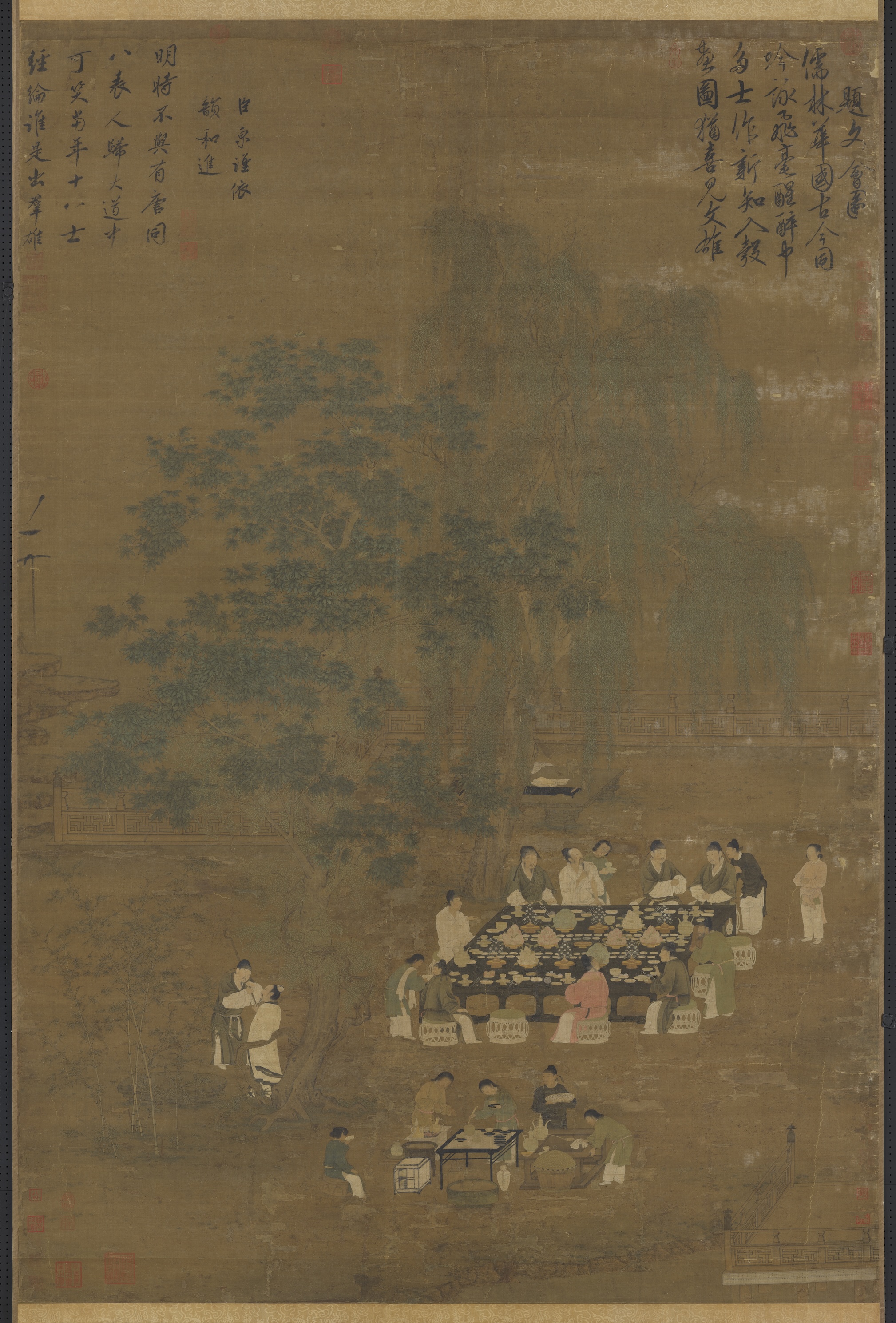
Song, Liao, and Jin iconography attests this elsewhere. The 饮宴图 yǐn yàn tú, “banquet scenes” found in funerary chambers, as well as the 文會圖 wén huì tú, “literary gatherings” painted at the Song court, show these vases set on tables, or held under the shoulder by a servant, or fitted into their wooden base, awaiting the next cup. One nuance, however, deserves mention: certain Liao tombs also show a meiping holding flowers. The function was never strictly binary. But wine dominates, by a wide margin, across the sources.
There remains the question of the modern name. Where does the name meiping, the “plum vase,” come from? From a late text, nearly a thousand years younger than the piece it claims to name.
At the turn of the twentieth century, in his 饮流斋说瓷 Yǐn liú zhāi shuō cí (published 1925), the literatus 许之衡 Xǔ Zhīhéng offers an aesthetic reading: “The méi píng, with its slender opening, short neck, extraordinarily broad shoulder… its opening is so narrow that it suits the slender bones of the plum tree; thus it is called plum vase.” A poetic reading, not a philological one. Xu Zhiheng does not describe a use: he describes a silhouette, and he likens the slenderness of the neck to a winter plum branch. The analogy held. The name meiping replaced jingping in modern Chinese usage, then crossed over to European labels.
The misunderstanding was not, then, born in the display cases of Paris or London. It was handed down. European museums inherited a late name, and they inherited it at a moment — the late nineteenth and early twentieth centuries — when China itself had largely lost, in practice, the banquet use it once described. The name arrived long after the use.
A piece, in Shanghai
A specific example looks back at us. The Shanghai Museum holds a Cizhou meiping from the twelfth or thirteenth century, Jin period, with white slip under transparent glaze. The decoration is minimal: the shoulder is divided into oval panels — 开光 kāi guāng, “windows” — and within one of those panels, in black characters laid down with a brush, the four signs we have already encountered.
“Clear, pure, beautiful wine.”
The calligraphic gesture is rapid, sure, almost commercial — far from cabinet calligraphy. The characters wrap around the shoulder like a permanent label, at eye level for whoever pours. The object announces what it contains, in the language of its time, on its own wall. No ambiguity is left to the twelfth-century user. And none, for that matter, is left to today’s reader who can decipher these four signs.
This piece is not isolated. The Cizhou storehouse corpus, and more broadly the kilns of Hebei and Henan in the same tradition, produced this type of inscription in series — clear wines, seas of intoxication, sometimes the single injunction of the word wine. The practice runs over two centuries. It persists beyond the Song: certain Longquan meiping, from Zhejiang kilns, engrave the same inscription in relief on the shoulder under the Yuan — no longer with a brush, this time, but in sculpted form. The technique changes. The function remains.
The Shanghai object, for its part, will never be labelled “plum vase” in the Chinese scientific libraries that describe it. For them, it is a meiping with a wine inscription — a modern name for an ancient use, but without the loss of meaning.
Asking the date of the name
This inquiry is not a settling of accounts with European museums. No one has been mistaken: each, in turn, has inherited a name and passed it on as received. The moment when China itself renamed the piece coincides roughly with the moment when Europe began to collect it. A late name circulated alongside the object, and no one had, at the time, reason to undo it.
What changes, if one knows, is less the object than our relation to it. Reading a piece means knowing which name one holds in hand, and from when that name dates. For a European reader, the lesson is not “drink your wine from a meiping”: it is, more simply, to ask for the date of the inheritance before accepting the meaning. Names travel. Uses, sometimes, do not follow.
Sources
Textual sources
- 赵德麟 (Zhào Délín), 《侯鲭录》 (Hóu qīng lù), twelfth century.
- 许之衡 (Xǔ Zhīhéng), 《饮流斋说瓷》 (Yǐn liú zhāi shuō cí), 1925.
Studies
- 冯先铭 (Féng Xiānmíng) (ed.), 《中国古陶瓷图典》 (Zhōngguó gǔ táocí túdiǎn) — “Illustrated dictionary of ancient Chinese ceramics.” General reference.
- 《龙泉窑青瓷》 (Lóngquán yáo qīngcí) — “Celadons of the Longquan kiln.” For the inscribed Yuan meiping.
- 《景德镇湖田窑址》 (Jǐngdézhèn Hútiányáo zhǐ) — “The Hutian kiln site at Jingdezhen.” For the morphological evolution of Ming meiping.
- 《皇帝的瓷器》 (Huángdì de cíqì) — “The emperor’s porcelain.” For the 内府 marks of the Yongle period (cf. marginal note).
Featured object
- The Metropolitan Museum of Art, New York, accession 23.180.1. Meiping vase with flowers, Cizhou ware, Jin dynasty, 12th–13th c. Open Access (CC0).
- National Palace Museum, Taipei. Wenhui tu (Literary Gathering), attributed to Emperor Huizong, Northern Song, early 12th c. NPM Open Data (CC-BY 4.0).
The name arrived long after the use.
MOSAÏNK · April 27, 2026