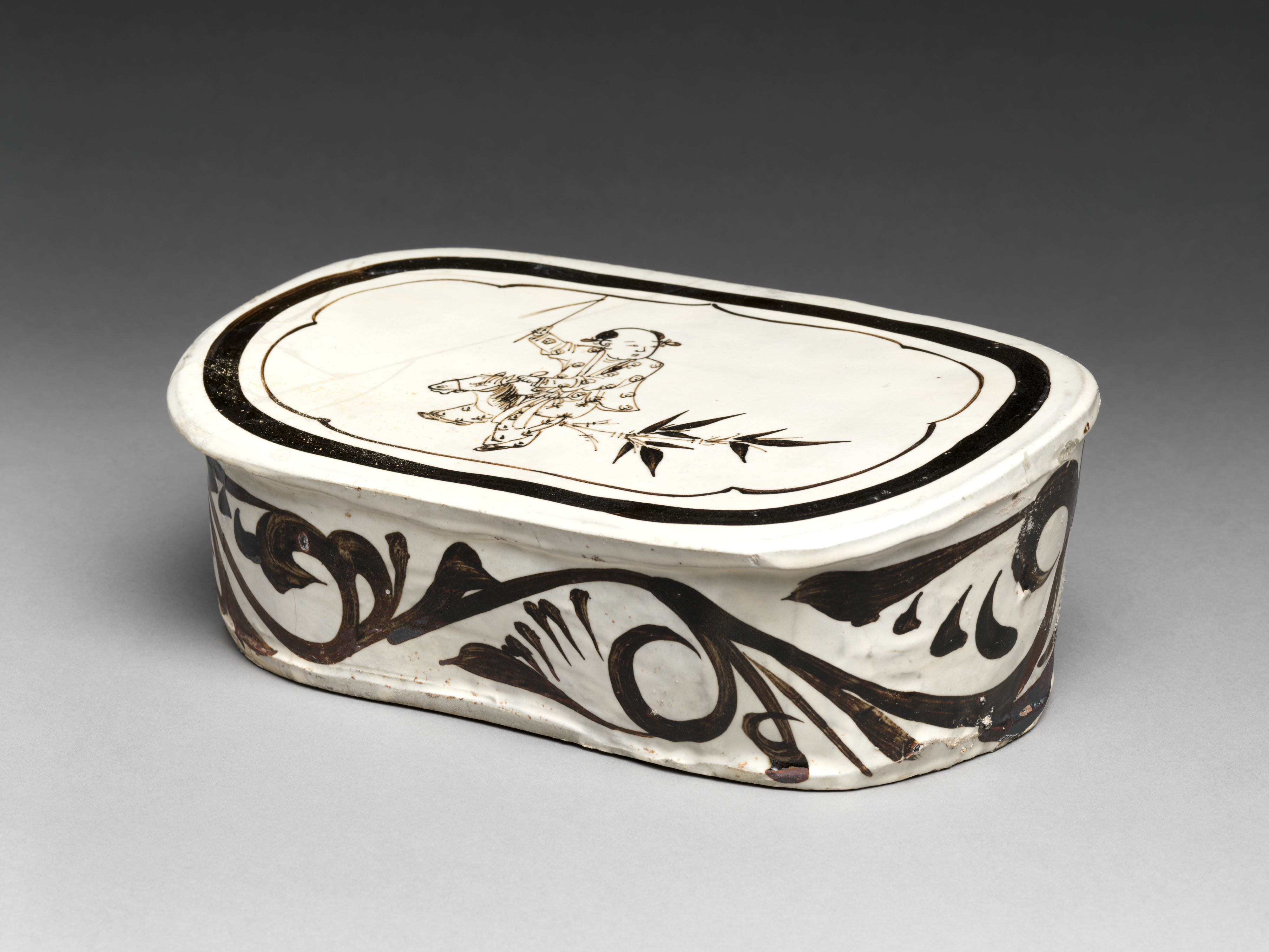
“Pillow, Song dynasty, Cizhou kiln, 12th–13th century” — the label’s notice is brief. Thirty-two centimetres long, twelve high. Under the glass, a parallelepiped of white porcelain, painted in black: two children holding a butterfly, stylized branches, perhaps a rooster in one corner.
The visitor stops. The phrase that comes, almost always: they slept on this?
The instinct is to look for softness — to look for it, not to find it, and to take the hardness for a strangeness. The gesture of surprise is the entry door. No judgment to pass, no Chinese yet to learn, no polemic yet to open — simply an object one does not know, and a presupposition one does not yet know one has. The displacement to make is small: undo the presupposition, and read the object at the level of the use that carried it.
The cushion is not a cushion
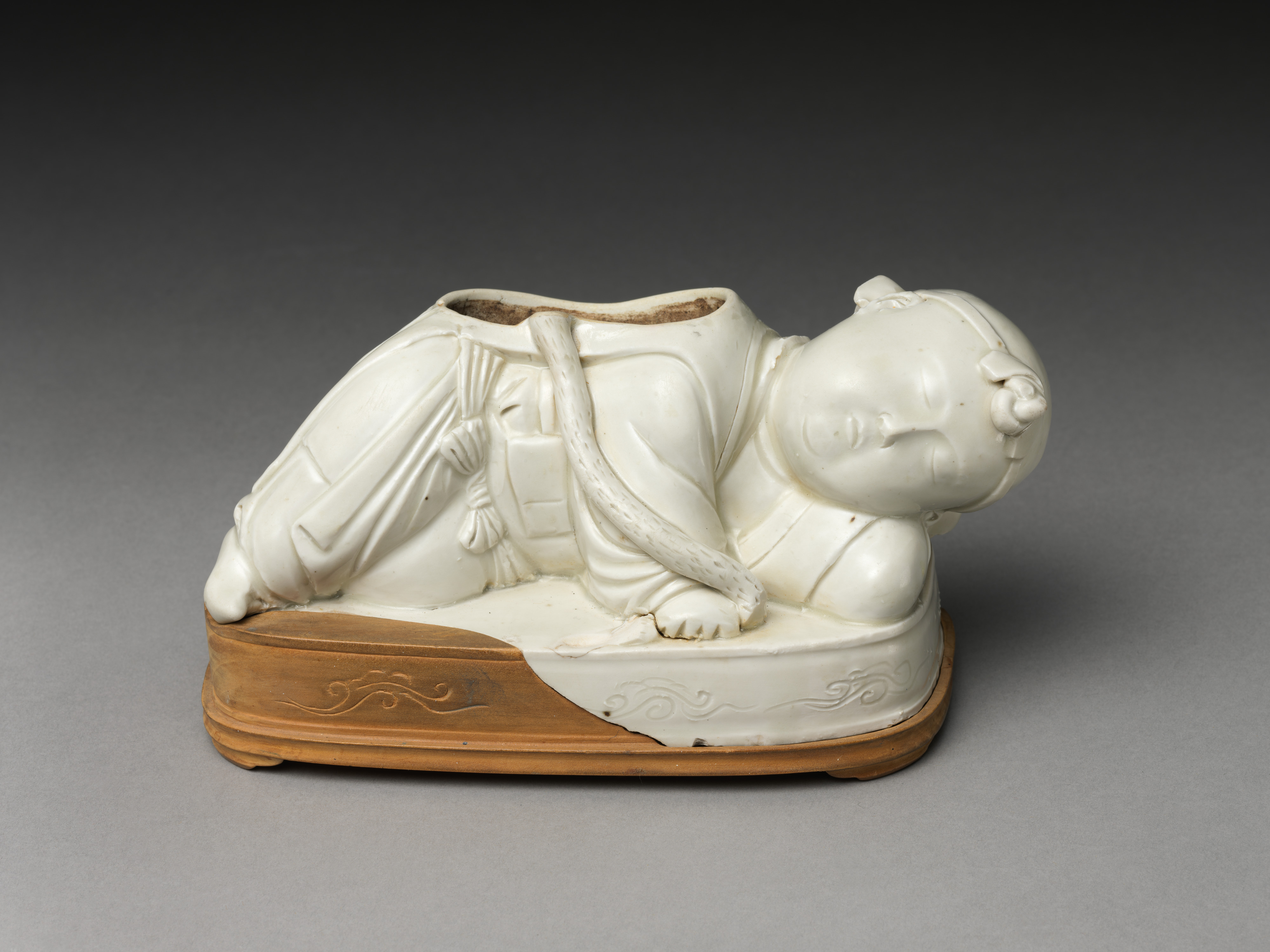
The 瓷枕 cí zhěn — the porcelain pillow — is, under the Song, a hollow object roughly thirty centimetres long. The dominant format is a parallelepiped, but Wang Ye’s catalogue records more diverse forms than one might imagine: cylinders, lotus blossoms, ingots, small structures imitating a garden pavilion, but also reclining tigers and sleeping children. The surface is hard, glazed, sometimes painted with a brush, sometimes incised in relief under a transparent glaze.
At this point, the first useful question is not why hard pillows? — that returns to assuming softness as the norm and hardness as the deviation. But the soft pillow, whether the European feather cushion or the cotton cushion of the contemporary bedroom, is a regional preference, not a universal given. Chinese households, from the Tang to the Qing, accepted the hard pillow without difficulty. Porcelain is, in that landscape, only one member of an older and broader material family.
This family includes the wooden pillow — the most modest, the most widespread, carved from a block or hollowed out of a trunk, present in nearly every household. It includes the woven-bamboo pillow, cool and light, common in southern houses. It includes the lacquered pillow, whose refined examples circulate in inventories of state furniture. And it includes, at the other extreme, the jade pillow — 玉枕 yù zhěn — attested as early as the Han dynasty in aristocratic burials, and which continues, later, to adorn the most solemn chambers.
The hard pillow is, moreover, not exclusively Chinese. Heian Japan used wooden supports; Joseon Korea had ceramic pillows of its own tradition. The 瓷枕 is a distinct Chinese lineage, with its kiln and its iconographic repertoire; but the hard pillow, in East Asia, is a shared practice.
The useful question, from there, is reformulated. Within this family, what does porcelain bring of its own?
Heat and season
What porcelain brings that wood or lacquer does not: thermal dissipation. The high-fired paste, covered with a smooth glaze, conducts heat away from the skin more rapidly than the fibres of wood or the absorbent layers of lacquer. Under the nape and under the cheek, the surface remains noticeably cooler than the surrounding air. The sensation, when one looks for it, is immediate.
This material property is not a neutral fact. It anchors the porcelain pillow in a season. In the humid summers of the Hebei plain and the south of the Yangtze, where the night does not discharge the day’s heat, the coolness of porcelain matters. The 瓷枕 is, in all likelihood, principally a summer object — equipment among other summer equipment: fan, bamboo mat, perforated screen. Wang Ye’s catalogue evokes this indirectly, without locking it into formula: the “practicality” he attributes to the porcelain pillow reads, in the material itself, as a response to the climate.
This material reading has its reverse. It invites another cliché — that of the “ancient wisdom that would have understood thermodynamics before us.” The reverse does not hold. No particular intelligence is at play: a people that lives in a humid climate and has access to mass ceramic know-how makes, almost mechanically, porcelain pillows. Dry climates do not. Periods without high-fired ceramics do not either. It is not the Song who deserve admiration; it is the material conditions that deserve to be read.
Porcelain is not about the dream. It is about heat.
The Song apex — Cizhou, the city, the popular image
Why Song-Liao-Jin
The porcelain pillow exists before the Song. According to Wang Ye’s catalogue, its earliest attestations go back to the middle and end of the Tang dynasty (7th–8th century), but in small format — about ten centimetres — and in limited quantity. It is under Song, Liao, and Jin (10th–13th century) that the format reaches its adult-use size, around thirty centimetres, and that production spreads into all spheres of the urban household. Tang pillows were minority objects; Song pillows are everyday domestic consumer goods.
The Liao and the Jin, conquest dynasties of the north, do not mark a rupture for this object. Cizhou, which passes from a Northern Song administration to a Jin administration without changing hands in practice, continues to produce comparable pillows in the same visual grammar. Material continuity, here, runs through political ruptures.
Under the Yuan (13th–14th century), the format continues to grow — up to about forty centimetres — but execution simplifies: less fine decorations, rougher glazes, less sorted pastes. Under the Ming and the Qing, the porcelain pillow fades from common domestic furniture. It survives in two specialized forms that the end of the fragment will evoke. The peak period spans three centuries, no more.
Cizhou, a popular kiln
The major production centre of Song pillows is, according to consensus historical reading, located in southern Hebei, at 磁州窑 Cí zhōu yáo — a system of rural kilns that mainly served not the court but the urban markets. The distinction is structural. The imperial kilns of Ru or Ding fired in small numbers, for palace inventories; Cizhou fired in series, at prices accessible to the households of the great northern cities — Bianjing, the capital, but also Zhending, Cizhou itself, and later several centres of the middle Yangtze. It is not a kiln of prestige; it is a kiln of mass.
The base clay at Cizhou is not the pure kaolin of the southern imperial kilns; it is a local stoneware, greyer, that a white slip covers before any drawing. It is this two-layer preparation — grey earth beneath, white surface above — that makes black brush-painting possible. The decoration is born, in the strict sense, from a material economy.
The signature technique carries a name: 白地黑花 bái dì hēi huā — white slip, black brush drawing, transparent glaze. The pictorial gesture is recognizable at first glance. On the white ground, the black brush leaves a simple trace, without hatching or gradation. The motif is set down in a single stroke, sometimes retouched, rarely corrected. The result is a graphic quality close to the print: efficient, legible from a distance, inexpensive to execute.
On the pillow surfaces, one finds the motifs that lived in the streets: 婴戏图 yīng xì tú — children at play — market scenes with itinerant peddlers, flowering branches, birds, calligraphic verses drawn from popular poetry. The Cizhou pillow is, in this respect, a chatty object.
A named piece
A representative example: a Cizhou pillow from the 12th–13th centuries, in 白地黑花, with a 婴戏图 motif on the upper face. Parallelepipedic form, surface painted with one or two children at play — one holding a peony, the other chasing a butterfly or a rooster — a floral frame, a recognizable brush signature. Common dimensions: around thirty centimetres long, twelve high, six or seven wide. The lateral sides, sometimes ornamented with geometric motifs, sometimes bare, frame the central scene that occupies the upper face. The reverse often carries, in two or three brush-drawn characters, the name of the workshop or the artisan’s mark.
The iconographic superposition is itself an argument. The sleeper rests her head on painted children. The object supports the everyday — sleep — and depicts the everyday — children at play, life passing outside. Image and use, on these pillows, hold within the same gesture.
The word stays, the object migrates
No lesson of wisdom to receive. No “object of dream.” A precise material object, produced in a precise kiln, at a precise moment, for a precise urban demand. When that demand fades — the Yuan weaken the northern cities, the Ming reorient the ceramic centre toward Jingdezhen and the court, the Qing inscribe sleep in softer materials — the porcelain pillow does not disappear right away. It slides toward other functions.
It becomes 明器 míng qì, a funerary object that accompanies the deceased into the tomb. And it becomes 脉枕 mài zhěn, a pillow placed under the patient’s wrist for the physician’s pulse-taking. Traditional Chinese medicine still uses, in some of its contemporary practices, a small cushion descended from this same function; the use of the mài zhěn, unlike that of the domestic pillow, has never ceased. The word zhěn remains. The material content migrates.
To read an object is also to watch it migrate. And it is to resist the idea that an “exotic” object is an object outside time. The porcelain pillow has a precise social, economic, and climatic history. Like every object.
Sources
Textual sources
No primary Song text has been identified in the NotebookLM source consulted for this fragment; a gap to be filled by secondary research in Song material history.
Studies
- 望野 (Wàng Yě) (ed.), 《千年梦华——中国古代陶瓷枕》 (Qiānnián mèng huá: Zhōngguó gǔdài táocí zhěn) — “A thousand years of flowering dreams: ceramic pillows of ancient China,” 文物出版社, 2008. Bilingual catalogue of more than forty Tang–Jin pieces with detailed entries; periodization, morphology, enumeration of decorative techniques. Principal NotebookLM source for the fragment.
- 冯先铭 (Féng Xiānmíng) (ed.), 《中国古陶瓷图典》 (Zhōngguó gǔ táocí túdiǎn) — “Illustrated dictionary of ancient Chinese ceramics.” General reference (consistency with #1 meiping and #2 mangkou).
Featured object
- The Metropolitan Museum of Art, Pillow with boy on hobbyhorse, no. 60.73.2. Zhang workshop (張家造), Cizhou kiln, Jin dynasty (12th–13th century). CC0 — Public Domain (The Met Open Access).
- The Metropolitan Museum of Art, Base of a pillow in the form of a boy, no. 1991.253.15. Ding kiln (定窑), Northern Song dynasty (960–1127). CC0 — Public Domain (The Met Open Access).
Porcelain is not about the dream. It is about heat.
MOSAÏNK · April 29, 2026