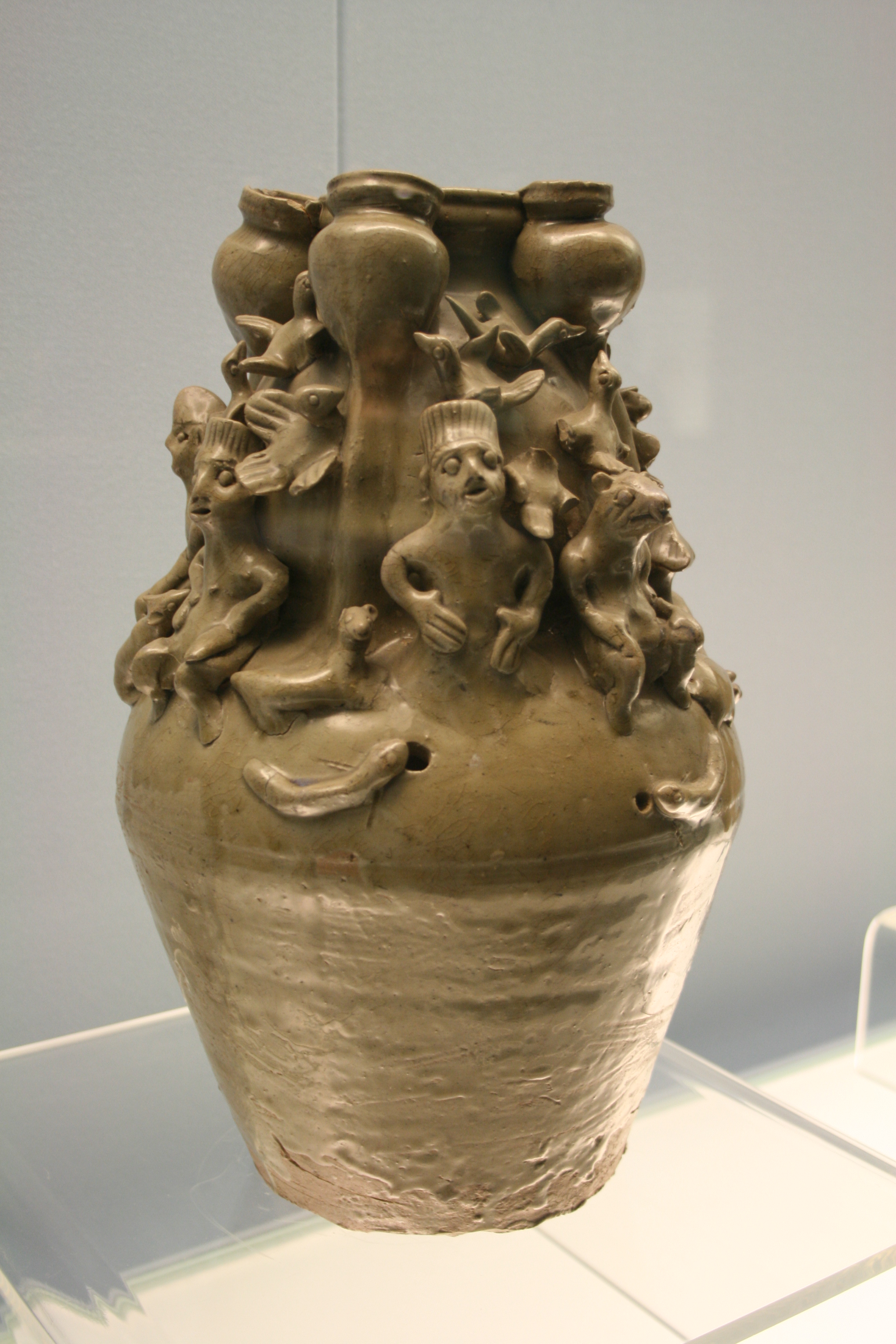
“张氏五娘五谷仓柜,上应天宫,下应地中,荫子益孙,长命富贵” — painted in black ink on the belly of an unearthed jar, the inscription gives the piece its own name: Mme Zhang’s five-grain granary, granted above to the celestial palace, below to the earth beneath; may it protect children and grandchildren, may it grant them long life and wealth. A utilitarian name, an accounting one. No salutation to abstract spirits, no mystical invocation: an inscription that itemizes.
The Chinese funerary jar cannot be read at face value. Beneath the devotional layer the eye expects — the jar that “appeases souls” — there is another, material, prior, more precise: the jar is a granary, and the granary is part of an inventory. Let us follow this inventory between the Han and the Song.
A domain, in miniature, on a lid
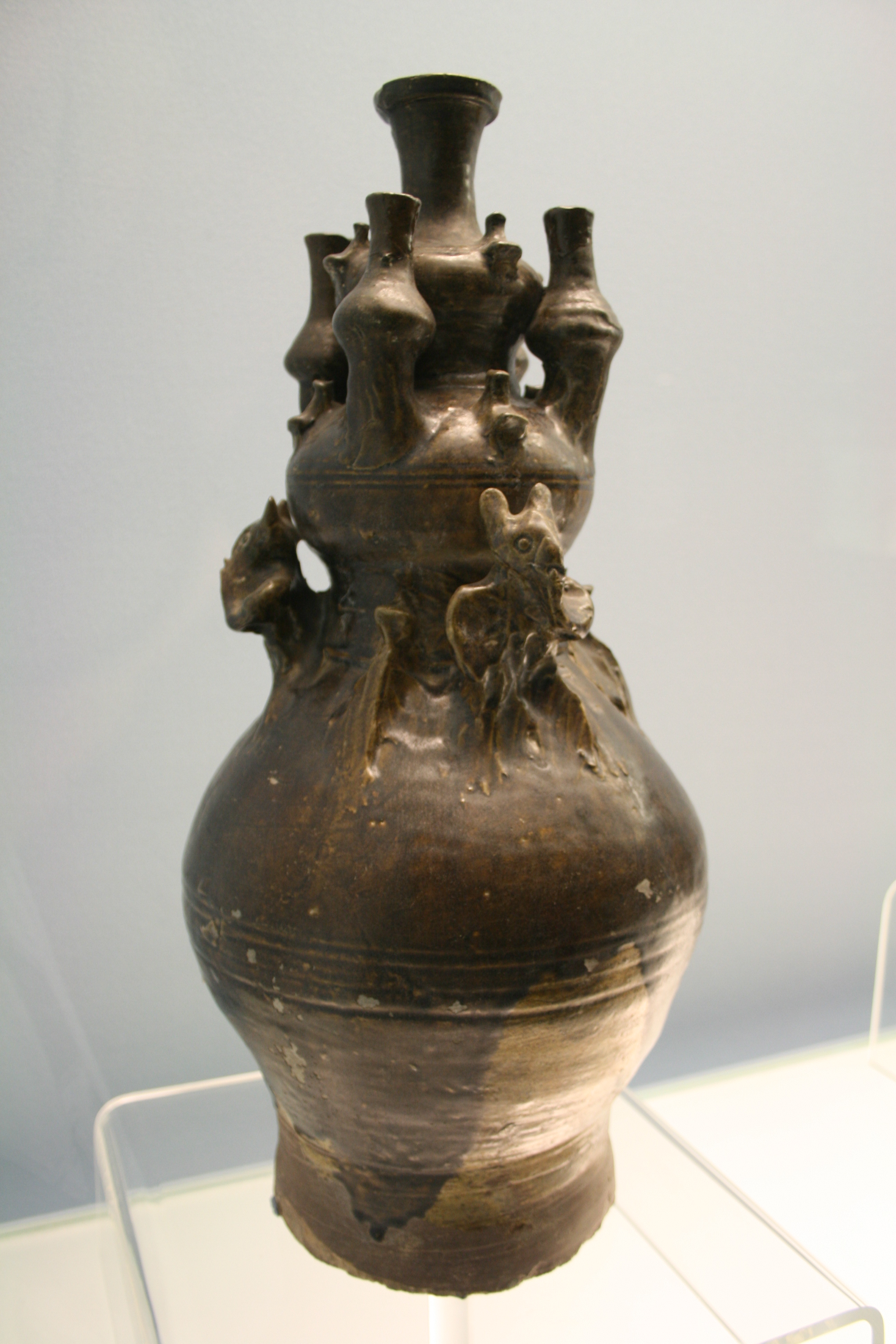
Under the Eastern Han, in the tombs of Jiangnan and Lingnan, a composite jar appears — a large central vase, encircled at the shoulder by four small satellite jars, non-communicating, under a brown-iron or, later, green glaze. This is the 五联罐 wǔ lián guàn — the “five-compartment jar.” The modern term 魂瓶 hún píng — “soul jar” — is not yet there. But the function is already fixed: to hold the grain of the deceased. The form is utilitarian before it is emblematic.
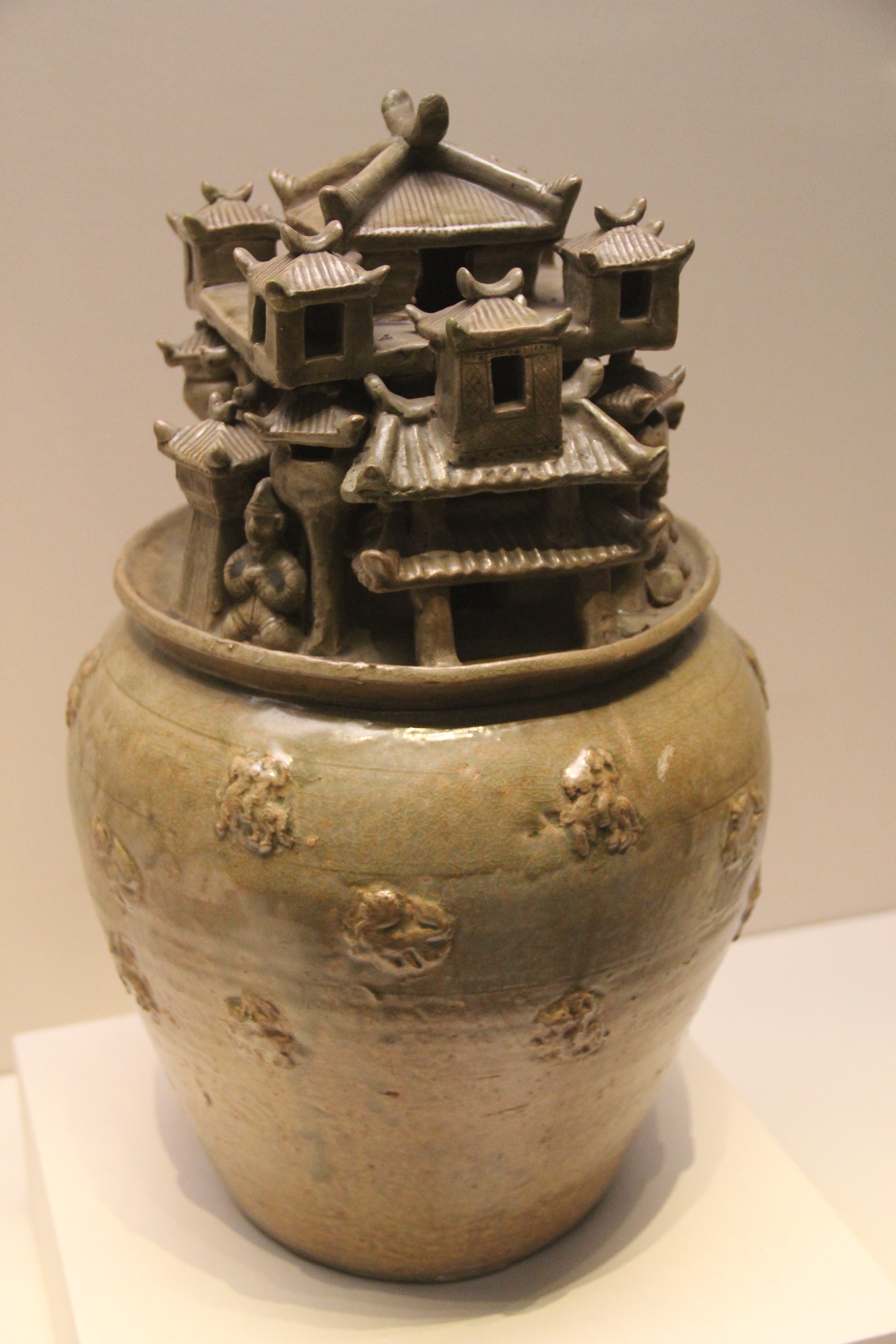
In the 3rd–4th centuries, on the 越窑 yuè yáo kilns of eastern Zhejiang, and then on the 婺州窑 wù zhōu yáo, the top of the jar takes on weight. The four satellites disappear; the cap is built up in tiered pavilions, in watchtowers, in entry porches; at their foot, musical figurines, birds, dogs, pigs, sometimes a complete funeral cortège. The paradigmatic piece of the Kingdom of Wu reproduced at the head of the fragment sums up the gesture: an entire estate — buildings, animals, servants — fixed in ceramic and set upon the lid.
This mechanism is read by 叶喆民 Yè Zhémín, in his 中国陶瓷史 Zhōngguó táocí shǐ — the History of Chinese ceramics, Sanlian, 2011 — against the Lǐjì and the Zuǒ zhuàn.
The 明器 míng qì — “objects for the spirits,” sometimes written 冥器, “objects of the dark” — do not form a subcategory of mystical offering. The Lǐjì codifies them as funerary equipment; the Zuǒ zhuàn adds that the lords receive their míng qì from the royal court, like a cadastre of the reign.
The stacked jar does the same at the scale of the household: it transposes to the sepulchre the material property of an estate — its 庄园经济 zhuāng yuán jīng jì, its estate economy.
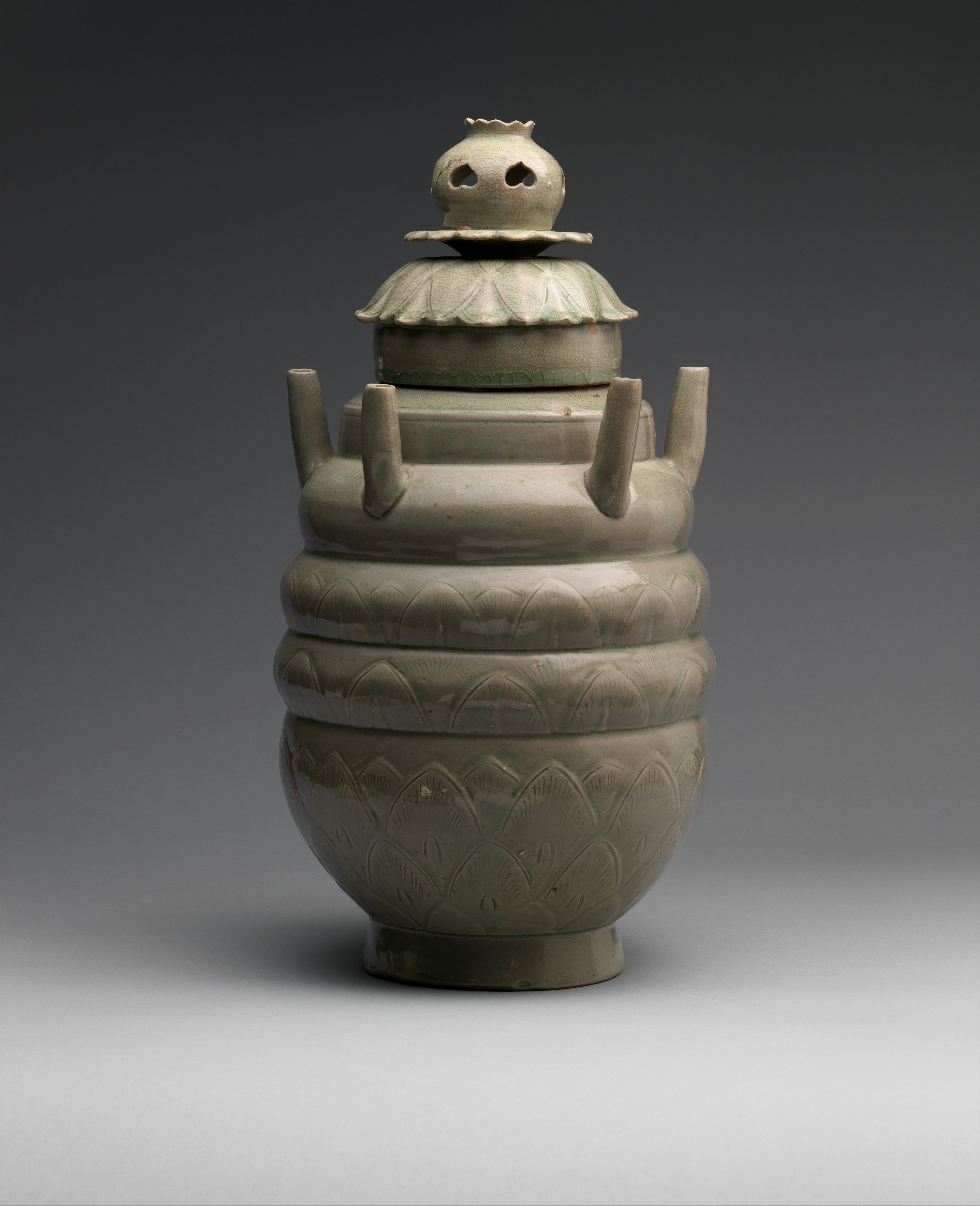
Under the Song, on the 龙泉窑 lóng quán yáo kilns, the complex cap simplifies. The form tightens, becomes tall and slender, almost a tower. Two documented variants appear: the 多管瓶 duō guǎn píng — “vase with multiple tubes,” a tapered body topped by five, six, sometimes seven vertical tubes counting the grains — and the 皈依瓶 guī yī píng, “vase of return,” a late Buddhist inflection. The Met holds a canonical example of the first, dated Northern Song, 38.7 cm high.
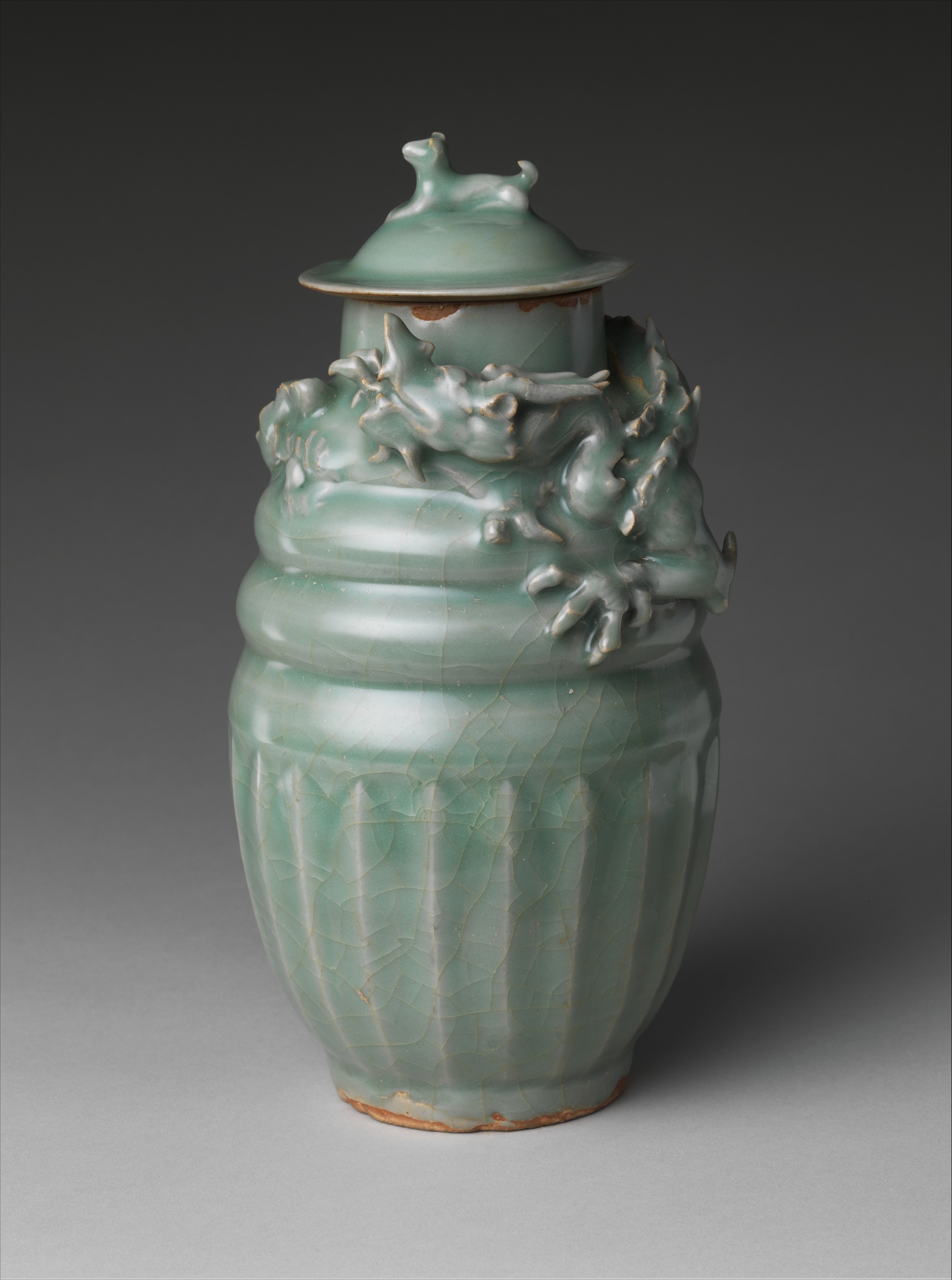
At the end of the Southern Song, the tubes metamorphose into effigies: a coiled dragon on one side, a clinging tiger on the other. This is the 龙虎瓶 lóng hǔ píng, attested for example on Met 18.139.1a, b (Southern Song, Longquan, H. 25.4 cm).
It is also here that certain pieces bear the 墨书 mò shū, the black-ink inscription cited in the opening: “five-grain granary,” “celestial palace,” “earth beneath.”
The nomenclature confirms the function. Tube = silo; the silo repeated makes the 五谷仓柜 wǔ gǔ cāng guì, the “five-grain granary.” And the 黄泉 huáng quán, the “yellow springs,” receive the deceased with their provisions counted.
Counting the furniture of the dead
The label often proposes “mystical rite of the beyond”; the object, for its part, says something else. The Chinese literati themselves, from the Ming on, refuse the mystical reading. 文震亨 Wén Zhènhēng, in the 长物志 Zhǎng wù zhì (ca. 1620), ranks the ancient unearthed ceramics — including the 尸枕 shī zhěn, the “corpse pillows” — among the pieces a connoisseur should not use. Not from fear of the beyond: from category hygiene. What belongs to the tomb does not migrate to the table of the living.
许之衡 Xǔ Zhīhéng, late Qing, in his 饮流斋说瓷 Yǐn liú zhāi shuō cí — notes on porcelain, early twentieth century — observes the same drift in turn: vases “of the Han-Wei type” are, in his time, no more than models to imitate, forms emptied, functions forgotten. The requalification is already with them. The funerary jar is a domestic object of a different kind, not a fragment of Orientalism.
The jar remains a granary — that of an estate the dead one carries.
Sources
Textual sources
- 《礼记》 Lǐjì (Memoirs on rites, ancient Han compilation, ~1st century BCE), section on the 明器 míng qì; transmitted via 叶喆民 (Yè Zhémín), Zhōngguó táocí shǐ, 2011.
- 《长物志》 Zhǎng wù zhì, 文震亨 (Wén Zhènhēng), ca. 1620, juan 7 “Utensils.” Passage on the shī zhěn, the Ming connoisseur’s exclusion of unearthed ceramics from the table of the living.
- 《饮流斋说瓷》 Yǐn liú zhāi shuō cí, 许之衡 (Xǔ Zhīhéng), late Qing — early Republic. Passage on “Han-Wei type” vases as model-objects for imitation, forms emptied of their funerary function.
Studies
- 《中国陶瓷史 — 增订版》 Zhōngguó táocí shǐ — zēng dìng bǎn (“History of Chinese ceramics — augmented edition”), 叶喆民 (Yè Zhémín), Beijing, Sanlian, 2011. Reading of the míng qì as the material infrastructure of the beyond, transposing to the tomb an estate economy.
- 《中国古陶瓷图典》 Zhōngguó gǔ táocí túdiǎn (“Illustrated dictionary of ancient Chinese ceramics”), 冯先铭 (Féng Xiānmíng) (ed.), Beijing, Wenwu chubanshe, 1998. Typological entry on the granary-jars and the tiered-pavilion jars of the Jiangnan; provenance of the mò shū inscription cited in the opening.
- 《古瓷鉴要》 Gǔ cí jiàn yào (“Reference points for the appraisal of ancient ceramics”), 张东 (Zhāng Dōng), Hangzhou, Zhejiang Sheying chubanshe, 2007. Framework for the Han — Three Kingdoms — Six Dynasties evolution, from the wǔ lián guàn to the stacked pavilions.
Featured object
- Shanghai Museum. Celadon funerary jar, Kingdom of Wu, 3rd century. Photograph: Gary Lee Todd, public-domain dedication (CC0). Wikimedia Commons. URL: https://commons.wikimedia.org/wiki/File:Three_Kingdoms_Celadon_Hunping_(%22Soul_Jar%22),_Wu_State.jpg
- Shanghai Museum. Brown-glazed funerary jar, Eastern Han dynasty, 2nd century. Photograph: Gary Lee Todd, public-domain dedication (CC0). Wikimedia Commons. URL: https://commons.wikimedia.org/wiki/File:Eastern_Han_Brown-glazed_Hunping_(%22Soul_Jar%22).jpg
- National Museum of China, Beijing. Celadon funerary jar, Western Jin dynasty, 265–316. Photograph: Gary Todd, public-domain dedication (CC0). Wikimedia Commons. URL: https://commons.wikimedia.org/wiki/File:Western_Jin_Celadon_Hunping_(Soul_Jar).jpg
- The Metropolitan Museum of Art, New York. Funerary jar, Longquan stoneware under celadon glaze, Northern Song dynasty, 10th–11th century. Accession 37.124a, b, Rogers Fund, 1937. Open Access (CC0). URL: https://www.metmuseum.org/art/collection/search/42438
- The Metropolitan Museum of Art, New York. Funerary jar with dragon, Longquan porcelain under celadon glaze, Southern Song dynasty, 12th–13th century. Accession 18.139.1a, b, Rogers Fund, 1918. Open Access (CC0). URL: https://www.metmuseum.org/art/collection/search/42476
The Chinese dead, like the living, carry their estate with them — a granary in miniature, a material cadastre.
MOSAÏNK · May 9, 2026
,_Wu_State.jpg)
.jpg)
.jpg)