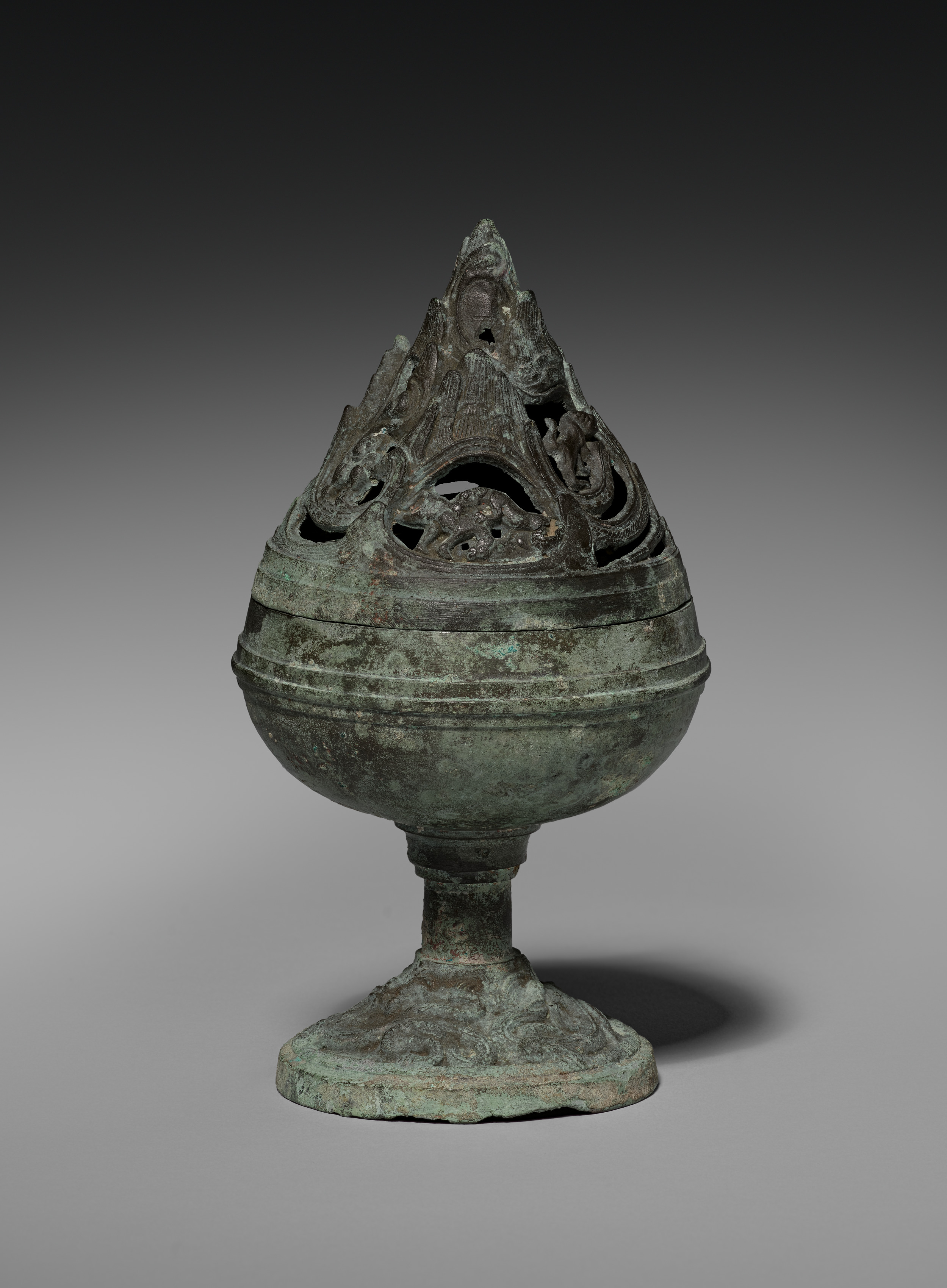
Take in your hand a bronze object barely taller than a teacup. Its lid rises into a small mountain: rocky peaks, pierced with narrow openings, among which hide animals, trees, sometimes a human figure. Light the incense in the hollow body, and the mountain begins to smoke; the smoke escapes through the ridges and coils around the summits like a sheet of cloud.
This object bears a name: 博山炉 bó shān lú — the “incense burner of Mount Bo.” It is found in the tombs of Han China (206 BCE – 220 CE), a piece of display as much as an object of ritual. Beneath its air of a desk accessory it hides a map: the mountain on the lid has a precise address in Chinese mythical geography. The real question it raises is not “what is a censer for?” but: how does one fit a landscape of immortality into an object set down on a table?
The island-mountain and its sea
What address? Scholars read this mountain as the dwelling of the immortals, and first of all as 蓬莱 Pénglái — the fabled island that tradition places off the eastern coast, risen from the waves of the Eastern Sea. It never comes alone: with 方丈 Fāngzhàng and 瀛洲 Yíngzhōu, it forms the trio of numinous mounts — the dwelling of beings who have conquered death, the soil of the plants that hold it off. The lid reduces this vast imaginary of immortality to the size of a hand.
Some pieces figure the sea itself. A tray rings the foot and gathers the water — 承盘 chéng pán — so that the island-mountain seems to emerge from the waves. Not all of them have one; but where it exists, the tray closes the scene: beneath the peak, the sea it rises from.
Then the smoke. The dominant scholarly reading sees in it the mist and clouds that wrap a summit — the lit incense makes the landscape breathe. Scholars keep their caution, for the exact symbolic reach partly escapes us, but agreement holds on the essential: form and function meet in a single image, that of a mountain that smokes.
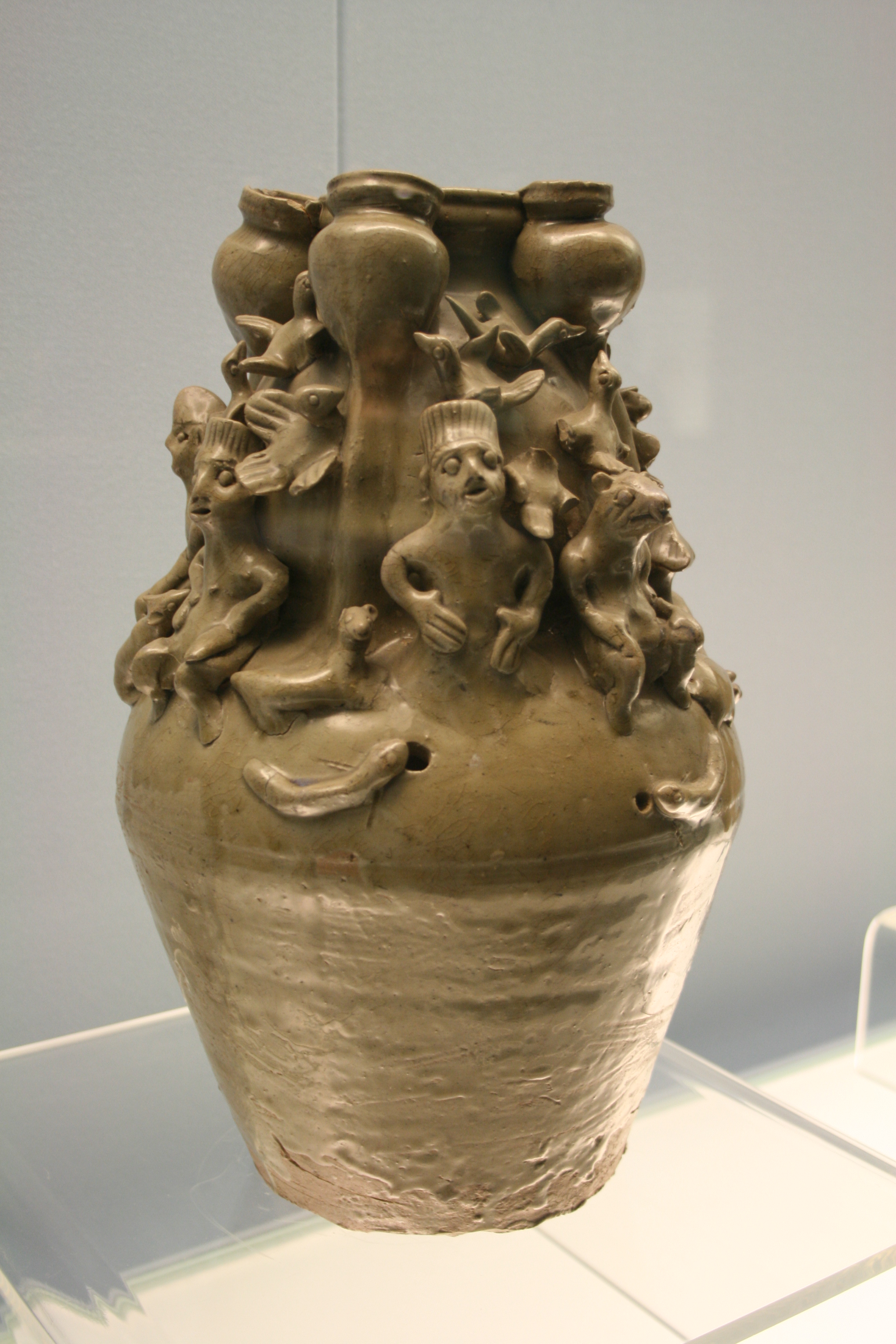
This mountain of immortals is not the only world the Han made small. The 魂瓶 hún píng — the “soul jar” — raises granaries and pavilions atop a funerary vase: a dwelling for the soul of the dead, an estate whose stores are counted. Both are found in tombs, but they do not encode the same world: the censer, a mountain of immortals brought to life by the smoke; the jar, an earthly domain to inhabit. Two geographies, two functions of object.
From bronze to green glaze
At the start, Mount Bo is a bronze object. At the height of the Western Han, the founders cast it, gild it, inlay it with gold and silver; the most famous were drawn from the princely tombs of 满城 Mǎnchéng, in Hebei, and rank among the finest bronzes of their time. The landscape is chased peak by peak, with its hunters and its wild beasts flung between the ridges.
One example held at Cleveland, which the museum itself names “Boshan Lu,” shows the form at its most legible: the low bowl, the lid drawn tight into peaks, the openings left between the ridges for the smoke to slip through.
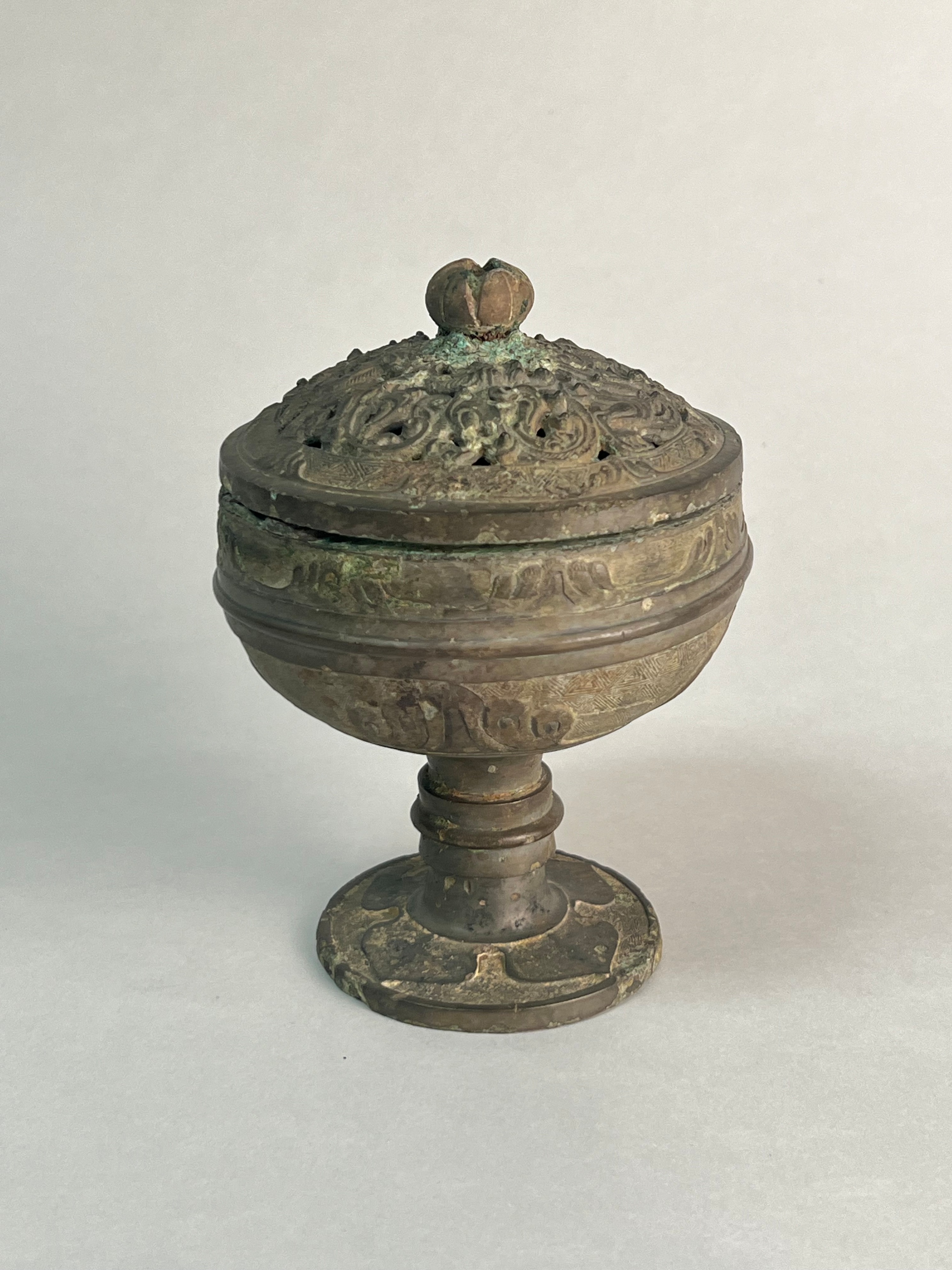
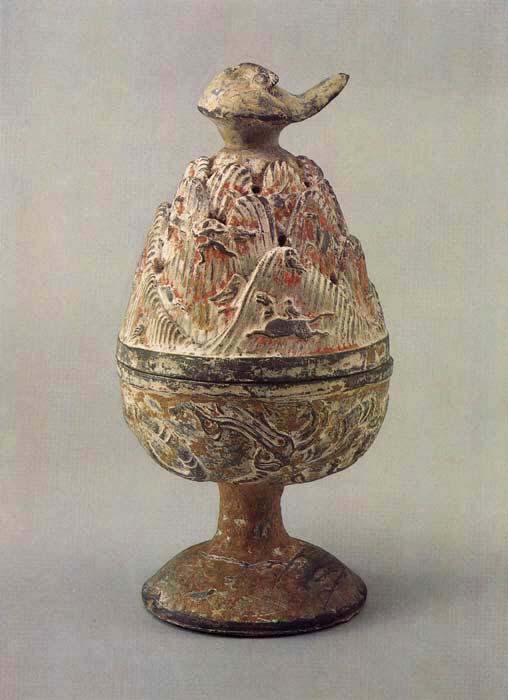
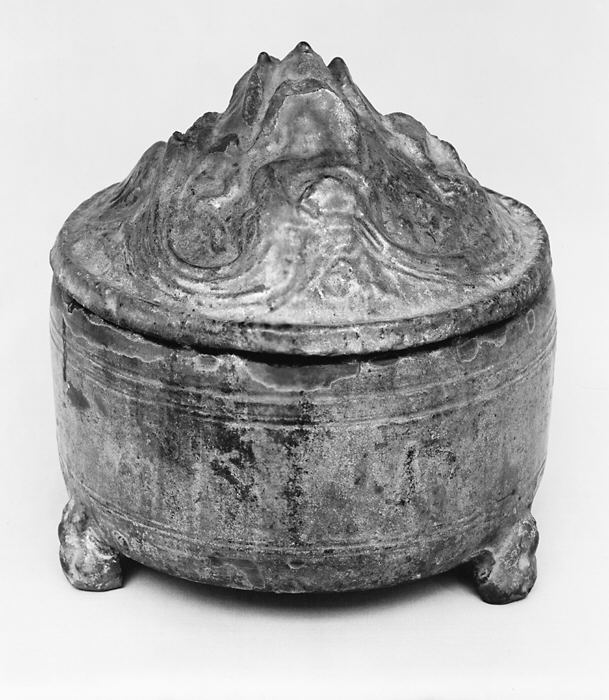
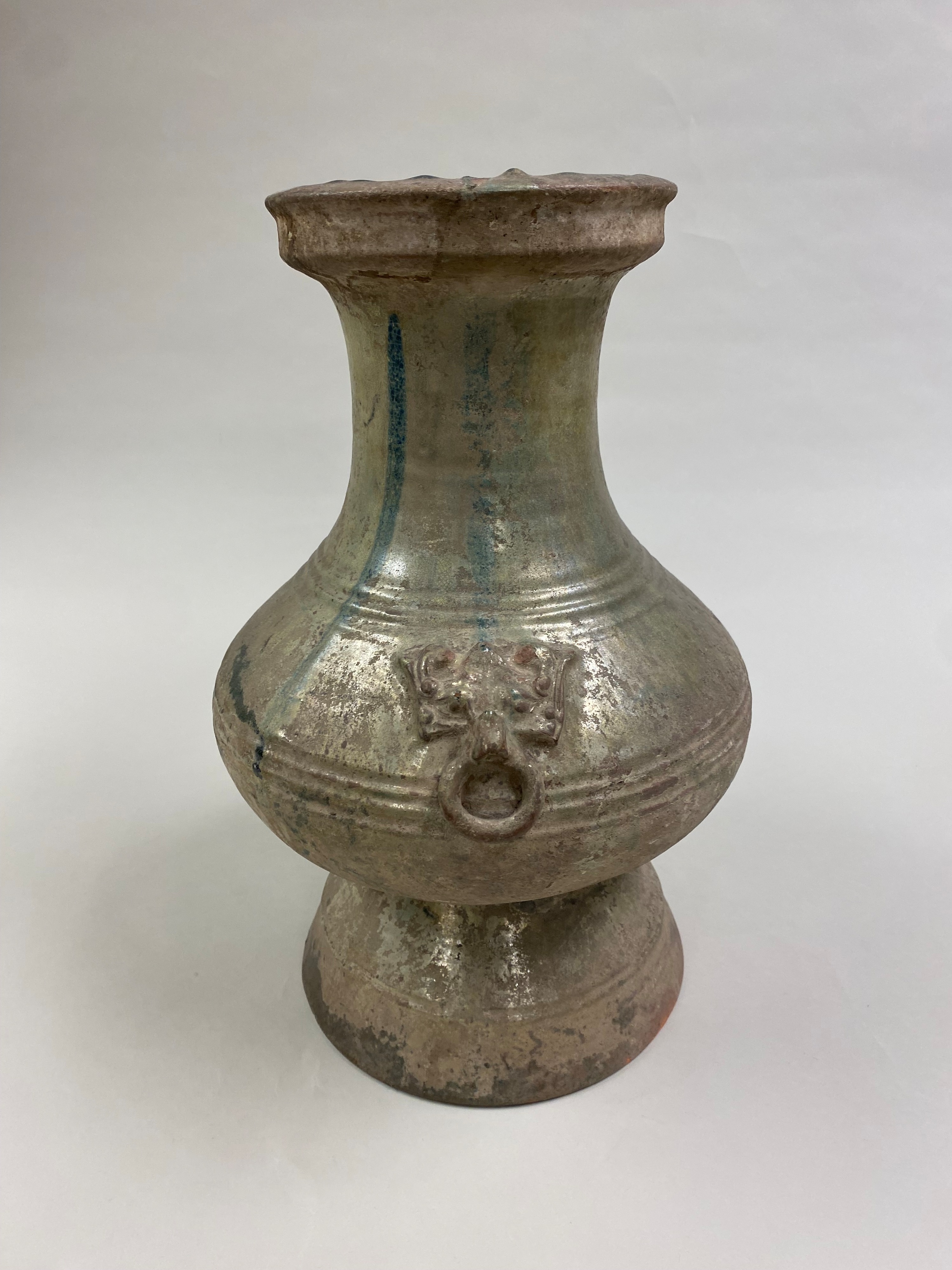
Then the material changes. From the Eastern Han (25–220) on, the same form is made more and more often in ceramic: in earthenware with a green lead glaze, 绿釉陶 lǜ yòu táo. The mountain-censer leaves the bronze-caster’s workshop for the potter’s. The shift is anything but incidental: it brings the cosmography of Mount Bo into the repertoire of ceramics, where the form will carry on well beyond the Han, from kiln to kiln, down to the Song. It is through clay, more than through bronze, that Mount Bo will have endured.
A geography one lights
Mount Bo is a geography one activates. Cold, it is only a small sculpture; but with the incense set in its body, it becomes what it figures — a mountain of immortals that smokes, a landscape one lights with the tip of a flame. If it fits on the corner of a table, it is because someone judged that a land of immortality could have a lid, a chamber and a foot. The idea reads first in the chased bronze of the Western Han; it is taken up, a century later, in the green glaze of the potters — and it is this second life, the life of clay, that brings it close to us.
Sources
Textual sources
- 司马迁 (Sīmǎ Qiān), 《史记·封禅书》 (Shǐjì — Fēngshàn shū), 卷二十八 — Han (~1st century BCE). The classic locus of the tradition of the three numinous mounts 蓬莱 / 方丈 / 瀛洲, set in the Eastern Sea; the cosmological referent of the mountain-lid. The body draws on the modern scholarly reading, without quoting the text.
Studies
- Susan N. Erickson, “Boshanlu — Mountain Censers of the Western Han Period: A Typological and Iconological Analysis,” Archives of Asian Art, vol. 45 (1992), pp. 6–28. The reference typological and iconological study of the mountain censers of the Western Han.
- Peter Romaskiewicz, A Visual Primer for Chinese Mountain Censers. An iconographic reading of the lid’s mountain as the island of Penglai risen from the sea; the shift from bronze to ceramic under the Eastern Han.
Featured object
- The Cleveland Museum of Art. Incense Burner (Boshan Lu) (博山爐), bronze, Western Han dynasty. Accession 1986.46 (composite piece, with mountain-lid). Open Access (CC0).
- The Metropolitan Museum of Art, New York. Vase with a mountain-lid, earthenware with a green lead glaze, Han dynasty (1st–2nd century). Accession 13.100.13a,b. Open Access (CC0).
- The Metropolitan Museum of Art, New York. Earthenware censer, Eastern Han dynasty (25–220). Accession 65.74.2a,b. Open Access (CC0).
- The Metropolitan Museum of Art, New York. Bronze censer, Eastern Zhou to Han dynasty (770 BCE – 220 CE). Accession 1989.363.218a,b. Open Access (CC0).
- The Metropolitan Museum of Art, New York. Earthenware jar with a green lead glaze, Han dynasty. Accession 29.100.160. Open Access (CC0).
This lid is a map: the mountain of the immortals, brought down to table height.
MOSAÏNK · July 10, 2026