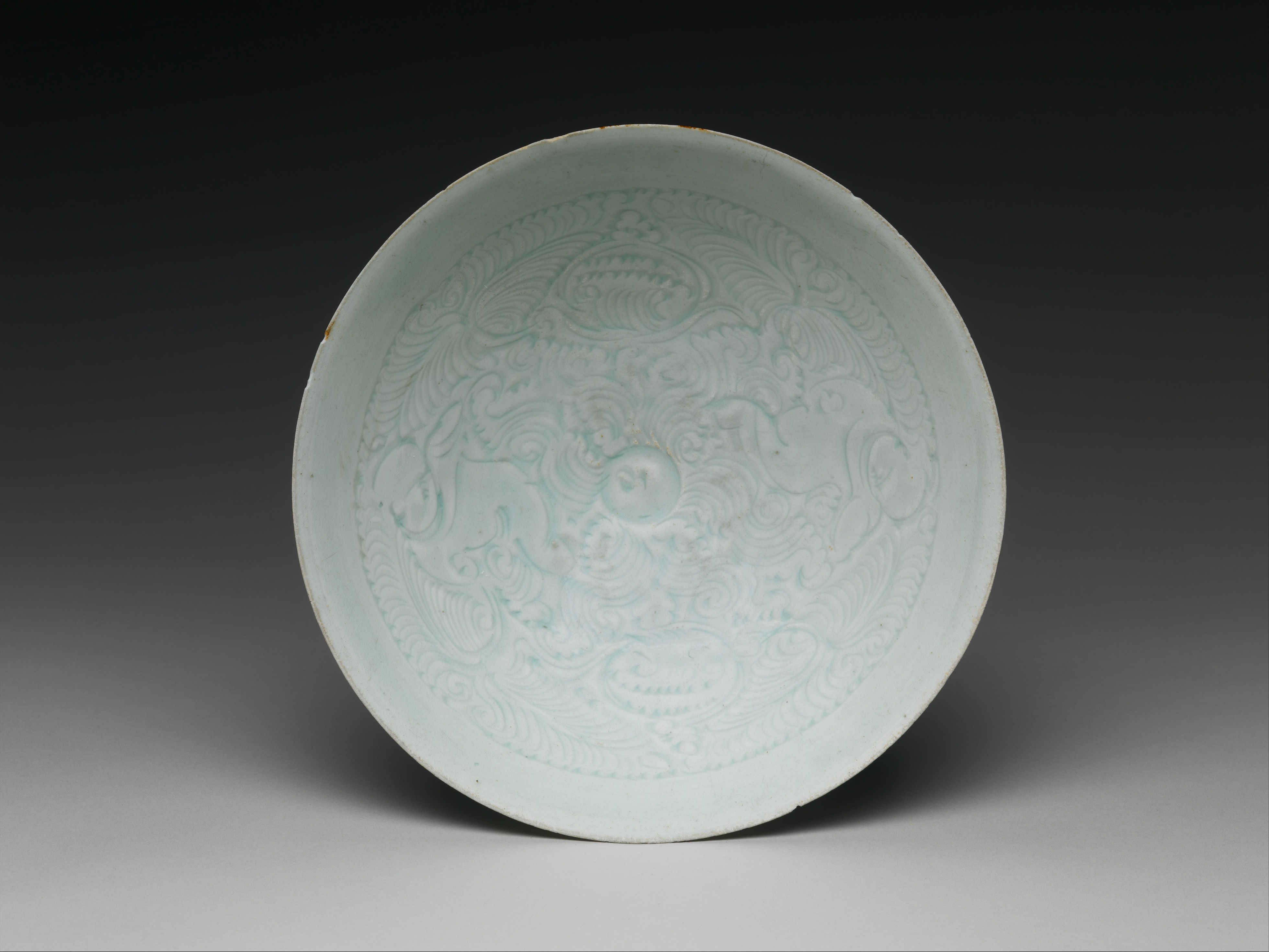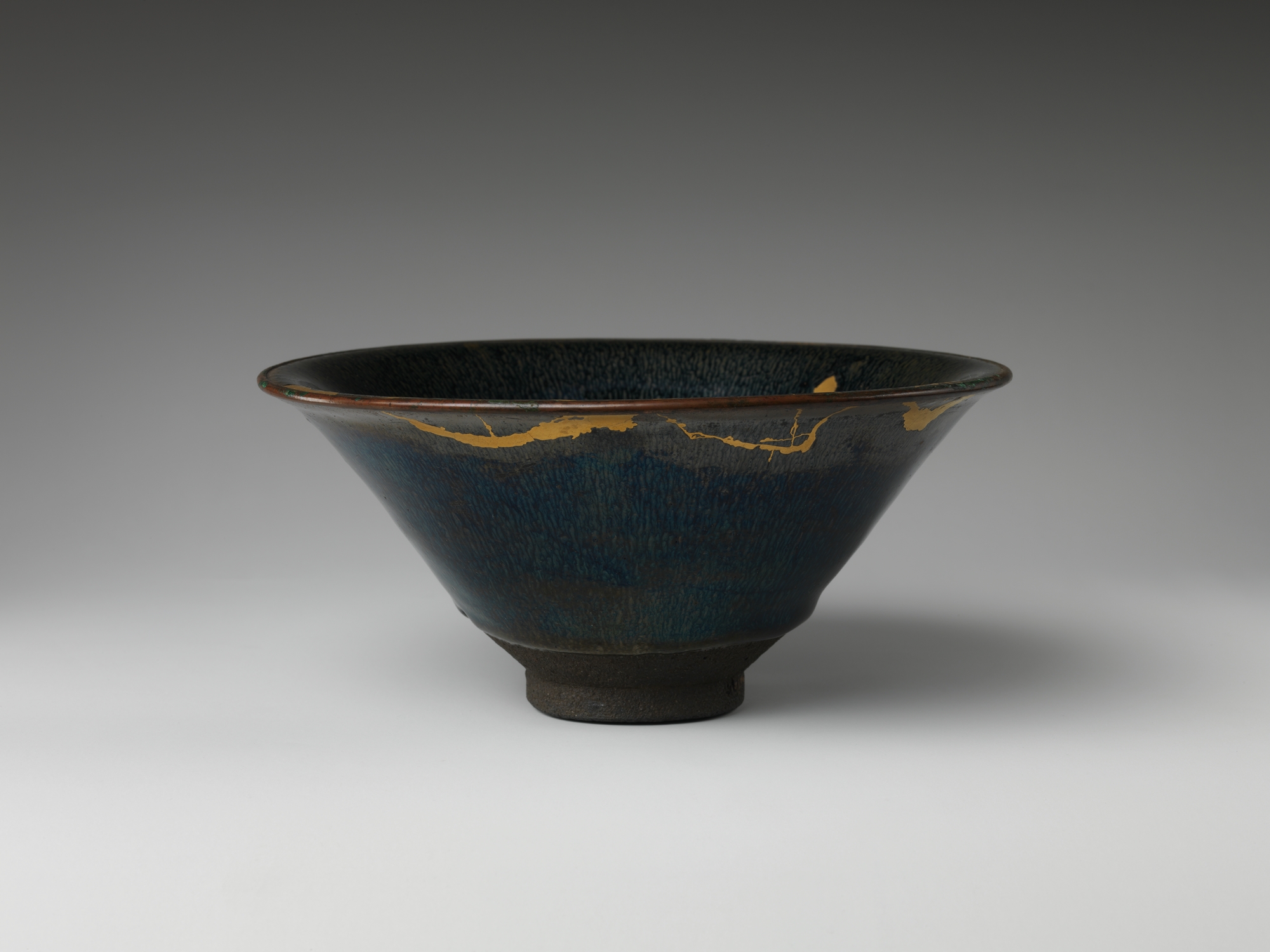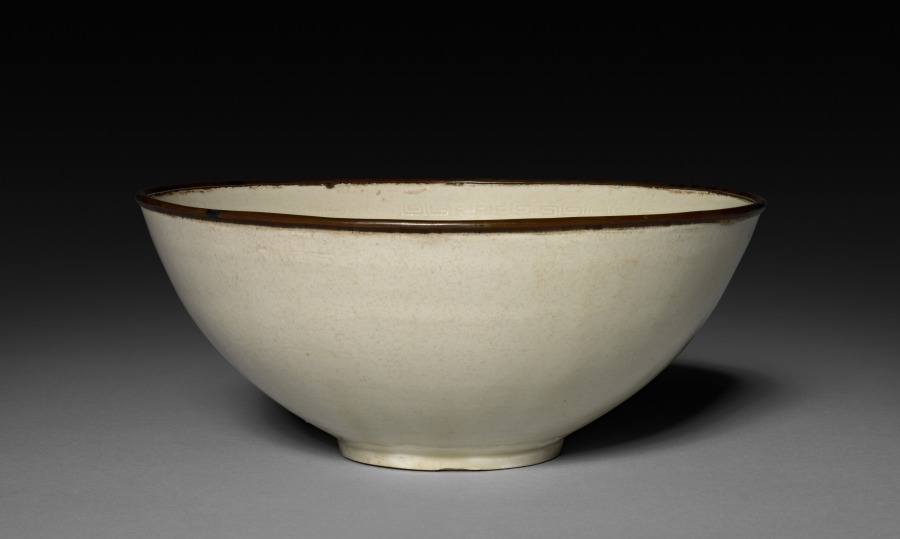
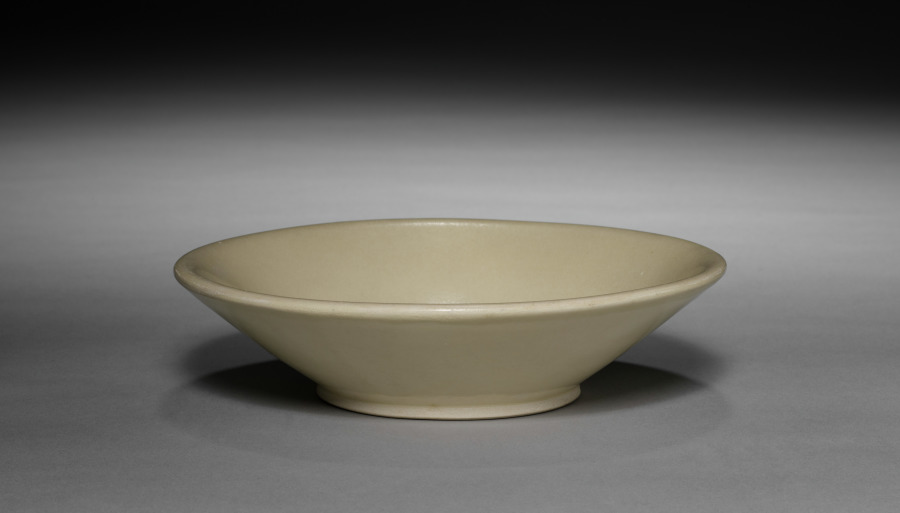
One holds a Ding bowl in the hand. Fine porcelain, ivory glaze, the colour of a candle held against the light, an incised pattern almost effaced under the material. The piece is nearly a thousand years old, and its surface holds without roughness. But the lip — the edge where the mouth would come to rest — is rough, raw, without glaze. A metal ring wraps it, most often in copper, sometimes in silver. To a quick reading, the gesture is legible: someone, at some moment in the object’s life, has covered a flaw.
This reading calls for a detour. It is not wrong — the bare lip is an inconvenience. But it inverts, on closer inspection, the order of time.
The economics of the kiln — why the lip stays bare
The economic decision
The kiln of 定窑 Dìng yáo, under the Northern Song (960–1127), is one of the most prestigious in the empire. Set in Hebei, a few days’ journey from the capital Kaifeng, it produces in mass a fine ivory porcelain with a transparent glaze, for the tables of well-off families and for the court. Its competitors — Ru, Jun, Yaozhou — count; but Ding produces more, and more regularly.
In the middle and end of this period, its firings adopt a new method: 覆烧叠置法 fù shāo dié zhì fǎ, inverted firing by stacking. Instead of placing each bowl on its base, the potter inverts it and sets it, lip down, on an L-shaped ceramic support — a 支圈 zhī quān. Several bowls, several supports, stacked together in the kiln: the firing, which previously held perhaps fifteen or twenty pieces, now holds twice that, sometimes more. Yield doubles, costs fall. The method does not stay local for long. Within a few decades, it spreads to all the major production centres.
The chemical constraint
But this firing is not just a management decision; it is a decision constrained by the material. The fine glazes of Ding bowls contain a significant proportion of aluminium oxide — Al₂O₃ — which gives them rare refractivity and hardness when fired. At the temperature where Ding fires its pieces, the glaze softens, becomes sticky. If the lip of the bowl is glazed and rests on a support, piece and support stick to each other during firing; the piece comes out broken, or unusable.
To resist the hardness of the paste, the support rings themselves must be made of a highly refractory clay. And to prevent the piece from sticking to its support, the glaze must be removed from the lip. The 芒口 máng kǒu — the bare lip — is therefore neither a potter’s distraction nor an aesthetic choice: it is a direct physical effect of the device. The Ding innovation lies precisely in the fact that supports and pieces, despite their different compositions, shrink at the same rate during cooling, without deforming the piece.
The diffusion — Jingdezhen
The method does not stay at Ding. At the end of the Northern Song, the kiln of 湖田窑 Hútiányáo, at Jingdezhen, adopts it in an intermediate form — an inverted firing by stamp-cup — that allows about ten pieces to be fired in a single container. In the middle and end of the Southern Song, under the double pressure of the local exhaustion of porcelain stone and a heavier fiscal burden, Hutian moves to the integral version of the device and multiplies by more than four the vertical loading density in the kiln. This is not an aesthetic refinement — it is a response to a supply crisis. Inverted firing, at that moment, saved the industry.
The metal ring
On Ding bowls intended for well-off families, the bare lip is encircled with metal — 金银扣 jīn yín kòu, the “gold-and-silver clasp.” The hierarchy of materials, as read from inventories and excavations, is counter-intuitive: copper is by far the most common, silver less so, gold rare. The most precious pieces are not, mechanically, those that carry the most prestigious of the three mounts.
The metal has, on these bowls, two intertwined functions. It covers the rough paste and gives the lip a smooth finish, a mouth fit for use: the bare lip, unprotected, catches at the slightest friction, pinches the lips, scratches neighbouring porcelain when pieces are stacked. And it signals, by its very nature, the rank of the owner — the metal is read at the same moment it is touched. To a Song reading, these two functions cannot be ranked. They arrive together. The bowl is at once repaired and labelled; the metal is worth as much for the comfort it ensures as for the rank it proclaims.
On these bowls, what modernity files under “decoration” and what it files under “function” arrive together — and hold together.
The objection — the Shuiqiu tomb
The imperial evidence
Before complicating the reading, we must consolidate it. The narrative “flaw → corrective metal” finds a contemporary support, and an imposing one: the writer 陆游 Lù Yóu (1125–1210), in his 老学庵笔记 Lǎo xué ān bǐ jì, reports a court detail that sums up the issue.
「故都时定器不入禁中,惟用汝器,以定器有芒也」
“In the time of the old capital, Ding pieces did not enter the imperial enclosure; only those of Ru were used, because Ding pieces had bare lips.”
Under the Northern Song, at Kaifeng, the court therefore rejected Ding pieces for their bare lips, and substituted Ru pieces with complete glazing. The inconvenience is real. It carries a documented symbolic cost in the highest usage. The narrative “bare lip = flaw to correct” holds.
The temporal inversion
And then comes a discovery that inverts the order of time. At 临安 Línán, in Zhejiang, the tomb of Lady 水邱氏 Shuǐqiū shì — dated to the end of the Tang dynasty, around the ninth century — yields, among its grave goods, Ding bowls ringed with metal. With glazed lips. No bare lip on these pieces. The glaze descends to the edge, smooth and complete, and yet the metal is there, set on the lip as on the Song examples.
The dating is decisive. Inverted firing — that which creates the bare lip — is invented at Ding only in the middle and end of the Northern Song, around the eleventh and twelfth centuries. The Shuiqiu tomb precedes this innovation by two centuries. The Hebei workshops were certainly already producing white ceramics in the second half of the ninth century — Ding was emerging then, in forms closer to the neighbouring Xing kiln — but none of these workshops had yet adopted the inverted firing that would, two centuries later, create the bare-lip problem.
If glazed Ding bowls are already ringed there, it is because the practice of the metal ring was not born to cover the bare lip: it existed before the bare lip existed.
The linear reading — “inverted firing creates the flaw, the metal covers it, later the metal becomes prestige” — does not just invert two functions. It inverts two centuries. The metal ring was first — or in any case, also — signal, status, aesthetics. Inverted firing and the bare lip it created would have joined, later, a mounting practice that had been awaiting them for some time.
Chinese scholarly literature keeps a prudence on this point. 《古瓷鉴要》 Gǔ cí jiàn yào mentions the find without closing the case; the question of the origin of the metal ring remains open. It is this opening that deserves to be held. Drawing too firm a conclusion — “the metal was always ornament, never repair” — would be making the inverse error, and closing a file the excavations have not yet settled.
Metal was not waiting for the bare lip
The narrative “the flaw becomes luxury” is too clean. It flatters our desire for a history of the object in which chance redeems itself in elegance, in which the faulty material finds its redeemer. But the evidence, taken seriously, complicates: the metal ring may not have begun as repair. It was perhaps already — in part — status, already ornament, and inverted firing may have only joined, two centuries later, a practice that was awaiting it.
Reading an object well means resisting the cleanest story when the evidence says otherwise. No Eastern mystique to invoke. A kiln economy, a glaze chemistry, and a metal ring that already made sense before either of them.
Sources
Textual sources
- 陆游 (Lù Yóu), 《老学庵笔记》 (Lǎo xué ān bǐ jì), Southern Song (late twelfth century).
- 张东 (Zhāng Dōng), 《古瓷鉴要》 (Gǔ cí jiàn yào), 浙江摄影出版社, year not specified. Chapter “定窑瓷器”.
Studies
- 李家治 (Lǐ Jiāzhì), 《中国科学技术史·陶瓷卷》 (Zhōngguó kēxué jìshù shǐ: táocí juàn) — “History of science and technology in China, ceramics volume,” 科学出版社, 1998. For the chemistry of Ding glazes and the mechanics of 覆烧 fù shāo.
- 冯先铭 (Féng Xiānmíng) (ed.), 《中国古陶瓷图典》 (Zhōngguó gǔ táocí túdiǎn) — “Illustrated dictionary of ancient Chinese ceramics.” General reference (consistency with #1 meiping).
Featured object
- The Cleveland Museum of Art, Bowl, Ding ware, no. 1917.383. Northern Song dynasty (960–1127). CC0 — Public Domain (Cleveland Open Access).
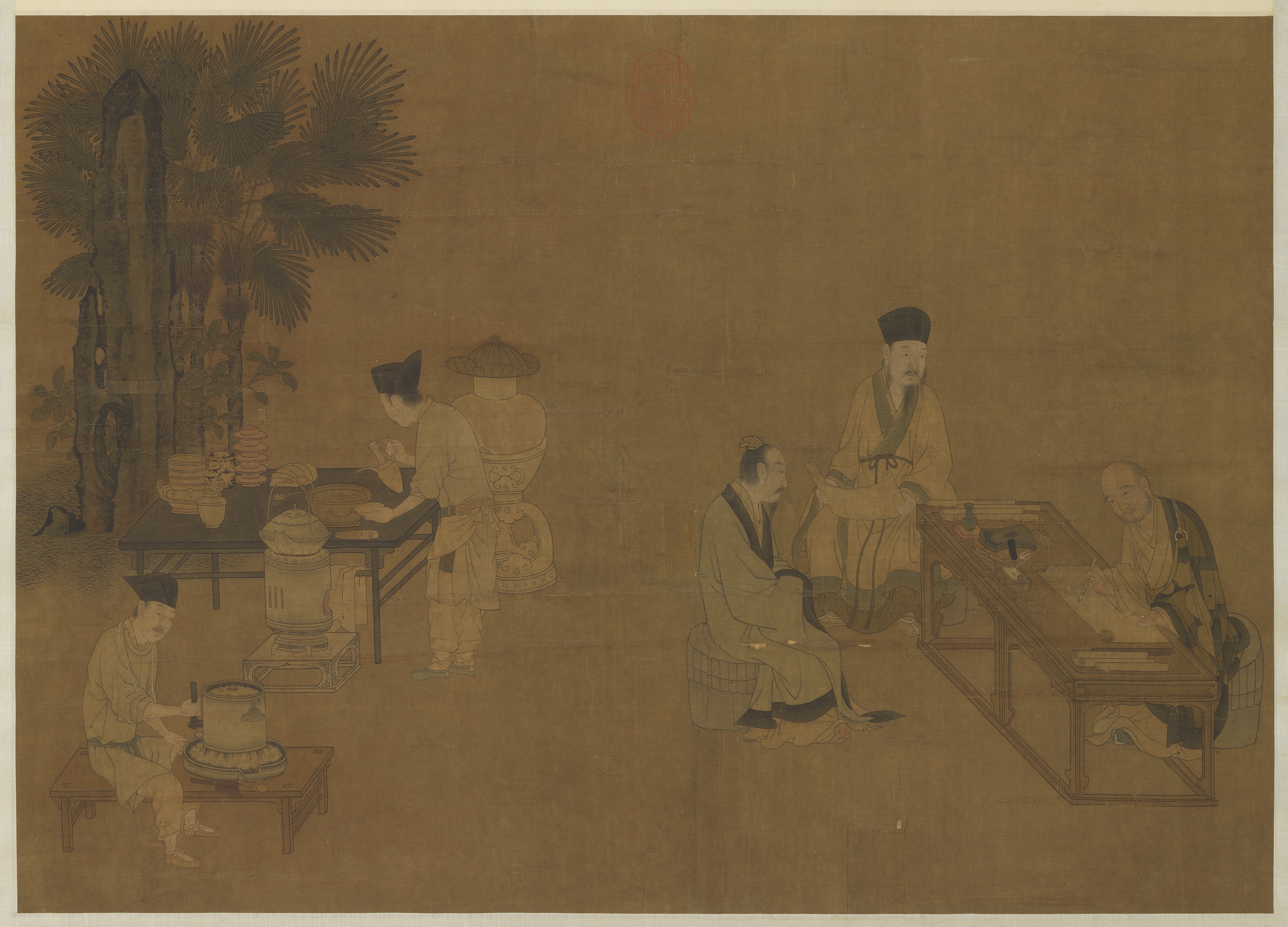
- National Palace Museum, Taipei. Niǎn chá tú (Tea service), attributed to Liu Songnian, Southern Song, 12th–13th c. NPM Open Data (CC-BY 4.0).
- The Cleveland Museum of Art, Bowl, Xing-type Ding ware, no. 2020.186. Late Tang / Five Dynasties (9th–10th c.). CC0 — Public Domain (Cleveland Open Access).
The metal ring precedes by two centuries the flaw it is meant to repair.
MOSAÏNK · April 28, 2026