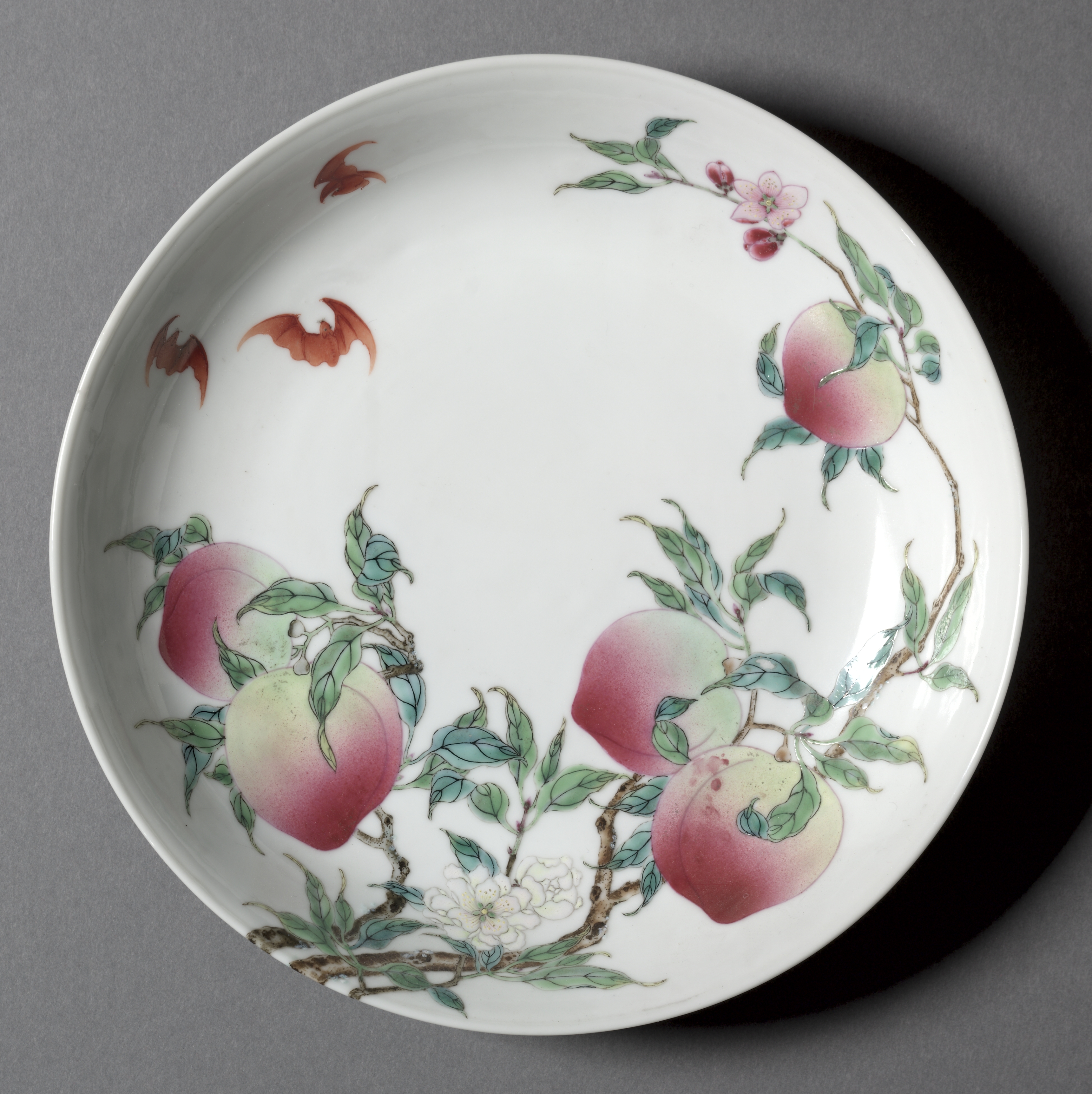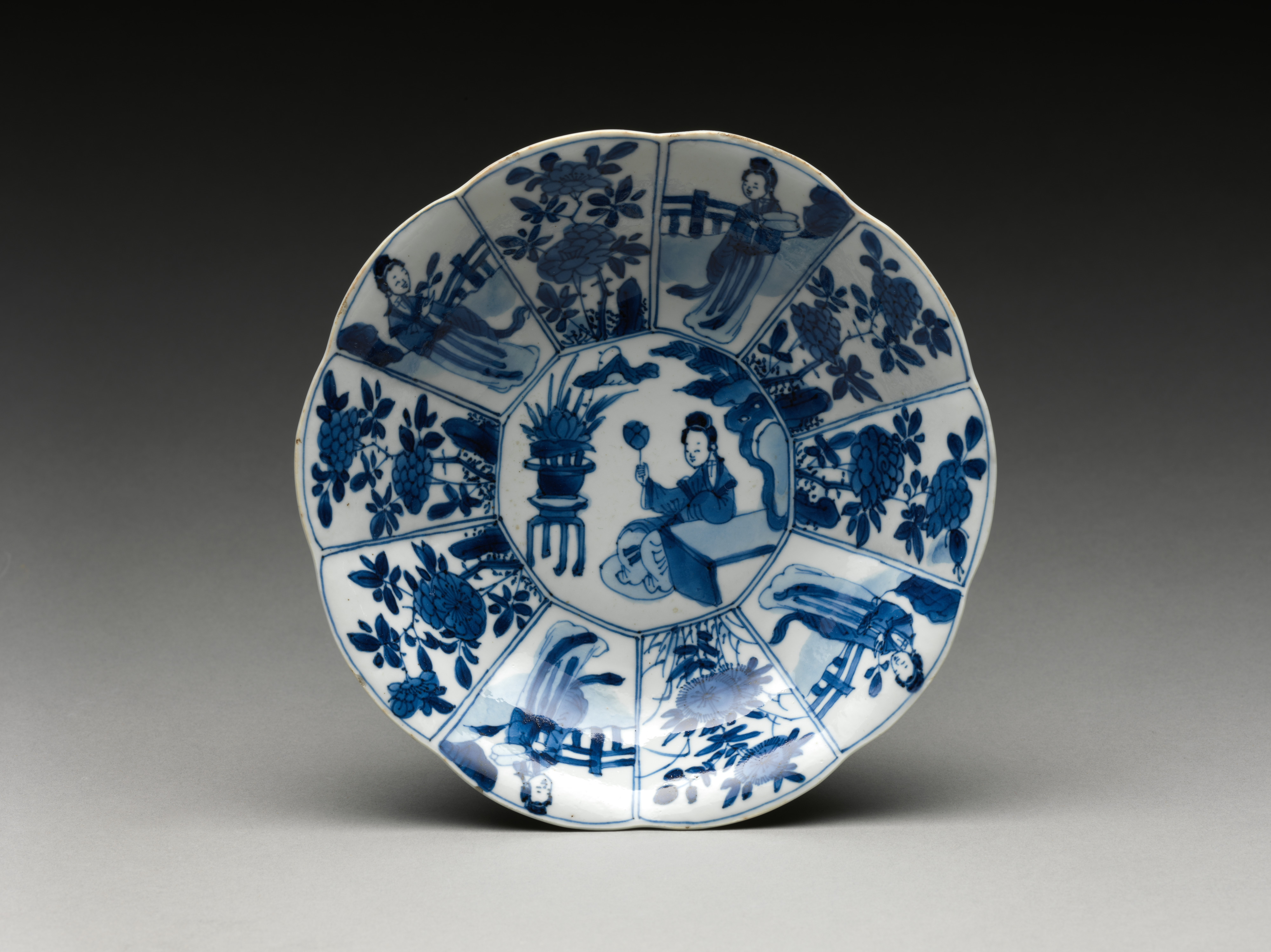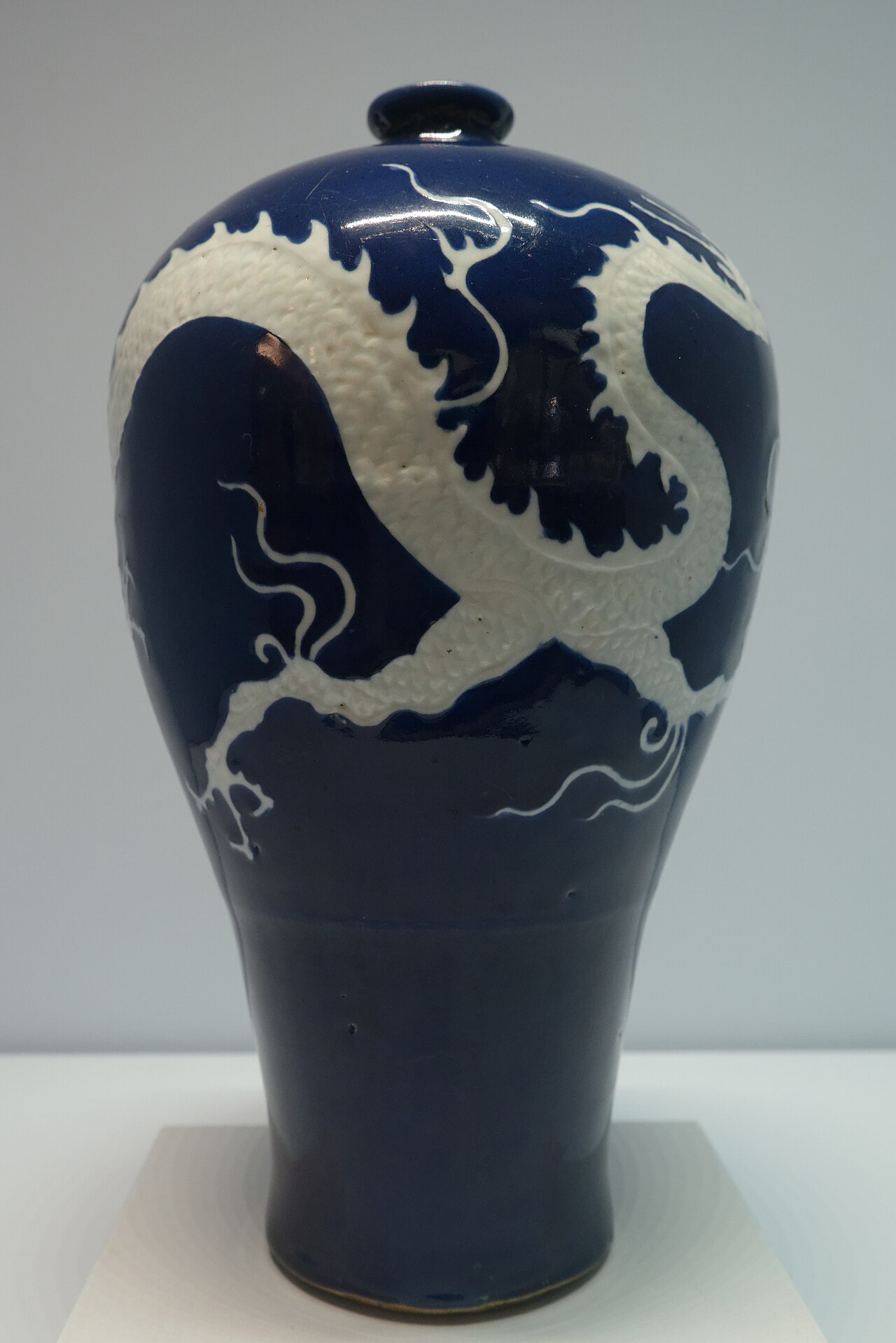
Three porcelain dishes lined up behind the glass, each carrying a dragon — so the label announces. To the untrained eye, they appear to belong to the same Chinese repertoire. To the trained eye, they do not resemble each other. The first: a sinuous, almost serpentine animal, with a fine head and a slender body. The second: a massive dragon, with a domed jaw, as if turned upward. The third: an elongated dragon, with an almost calligraphic silhouette, claws stretched without relief. The visitor expects an explanation — three schools, three workshops, three geographies? The answer is simpler. Three centuries. The dragon is not the same because it has never been the same.
The motif is not a fixed image
The Chinese term for what the European eye calls “the Chinese dragon” is 龙纹 lóng wén — literally, “the dragon motif.” The language is precise: it does not designate a fixed image transmitted by tradition, but a convention that reproduces itself from workshop to workshop, from reign to reign, and that deforms with each reproduction.
This nuance is not anecdotal. It governs the way one must read the decoration of a Chinese porcelain. The motif is not an immobile emblem that workshops would have repeated identically for a thousand years. It is a grammar whose syntax each era adjusts — silhouette, head, jaw, claws, general bearing. Five major inflections distinguish themselves on the sequence of Chinese ceramic kilns, from the Six Dynasties (3rd–6th century) to the end of the Qing (1912). They are not random: each has a precise morphological logic, and each corresponds to a determined state of the system that commands production — workshop, court, economy, market.
What follows isolates the five successive portraits and gives, for each, the distinctive morphological trait. A final section proposes a bounded interpretive reading of the whole: the form of the dragon, over the long run, functions as a dated seismograph of the power that commands it.
Five successive faces
1. The dragon-beast — Six Dynasties and Tang (3rd–9th century)
In the early stages of pre-imperial ceramics, the dragon resembles less an emblem than a beast. Under the 六朝 Liù Cháo (the Six Dynasties, 220–589), it is massive, almost crocodilian — open mouth, short snout, threatening bearing. Under the 唐 Táng (618–907), the convention lightens: the animal becomes vital, almost joyful, with the muscles of a healthy beast. The distinctive morphological trait of the Tang period is the claw — abandonment of the bestial paw in favour of a bird-like claw, triangular, slightly curved, sharp. The dragon is not yet a political emblem; it is still a powerful animal that the imagination lends to a mythical repertoire. No official sacrality yet encloses it.
2. The imperial seal — Song (960–1279)
A first turn begins under the 宋 Sòng. The figure of the 真龙天子 zhēn lóng tiān zǐ — “the true dragon, son of heaven” — gradually attaches to imperial authority in the court repertoire, and morphology follows: the dragon becomes heavy, massive, with an open jaw, with prominent claws. It is conceived to intimidate — to speak of sovereignty, not to decorate. The silhouette is compact, the body thick, the bearing frontal; the dragon-beast of the Tang, vital and free animal, recedes in the court ceramic register. The constitution of a strict iconographic monopoly of the imperial dragon on official pieces — which the curator 柯玫瑰 Kē Méiguī (Rose Kerr) places in the middle of the fourteenth century, beginning of the Ming — is yet to come. But it is here, under the Song, that the morphological trajectory begins to take on the heaviness that subsequent dynasties amplify or modulate.
3. The warrior serpent — Yuan (1279–1368)
Under the Mongol dynasty of the 元 Yuán, the dragon radically changes its bearing. It becomes sinuous, slender as a serpent, with a reduced head and an elongated body. The muscles are drawn in relief, but distributed on an elegant rather than massive silhouette. This inflection bears an identifiable trace of the system that commands production: the Mongol court, heir to a nomadic culture and a martial iconography, imposes on the dragon a register of agile vigour rather than intimidating mass. The most codified detail of the period deserves mention: on pieces destined for the domestic trade or for non-imperial kilns, the dragon bears three or four claws; the five-clawed dragon is strictly reserved for court use. The five-claw rule will survive the Yuan, but it is here that it formalizes itself as an observable material distinction. The piece reproduced as the hero — a meiping from the Musée Guimet — shows exactly this silhouette: sinuous body, reduced head, musculature in relief, painting in cobalt blue under glaze from the Jingdezhen kilns.
4. The pig-snouted dragon — Ming (1368–1644)
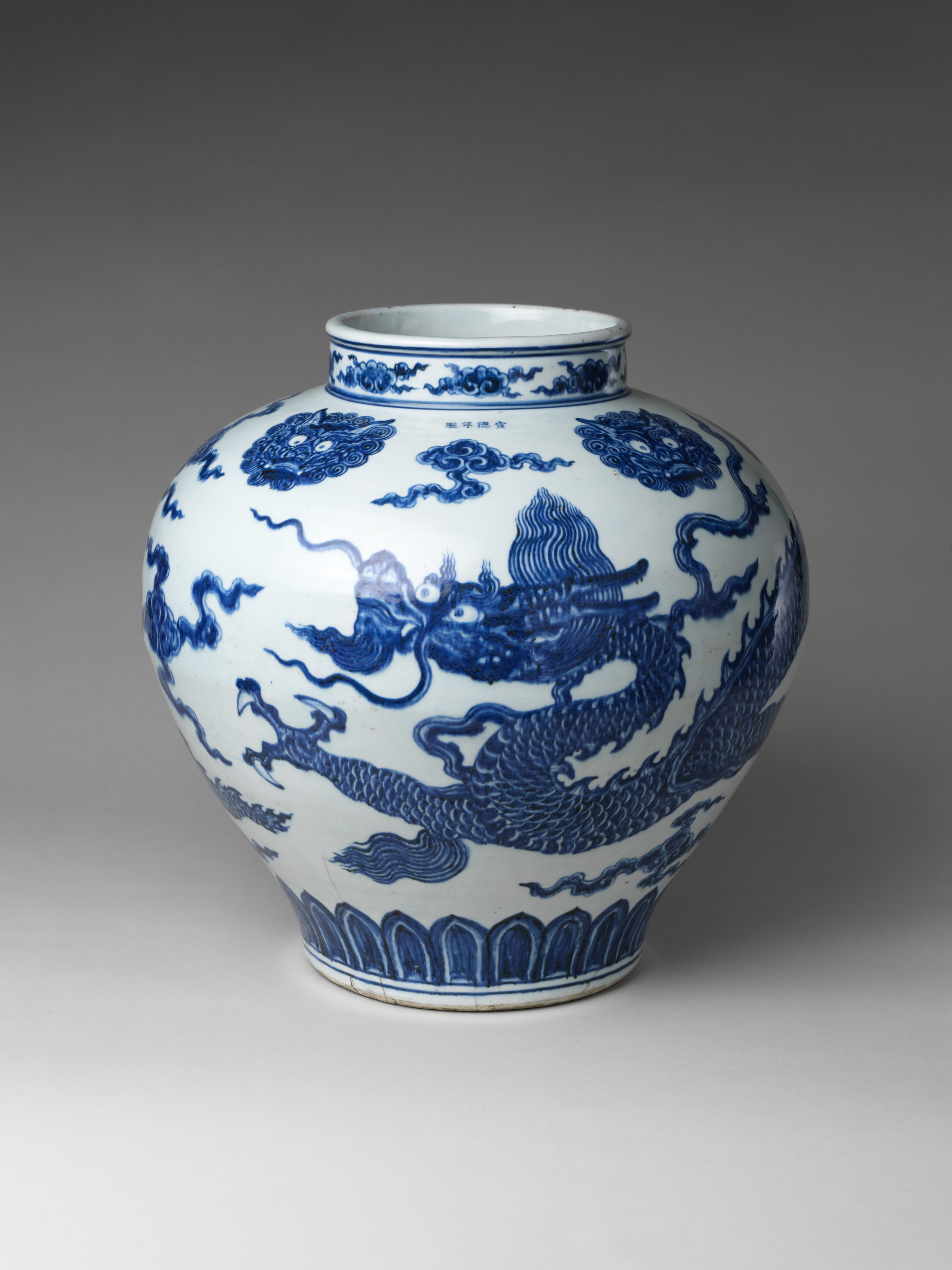
Under the 明 Míng, the convention densifies once more. The dragon becomes massive again, but with a facial trait that will be its signature: the domed jaw, the snout almost turned up, the upper maxillary bone protruding and longer than the lower. The workshops have a familiar name for this morphology: 猪嘴龙 zhū zuǐ lóng, literally “pig-snouted dragon” — the formulation is descriptive of workshop usage, not pejorative.
This domed face stabilizes over two full centuries of court production. Its internal variation, however, deserves attention. Under the early reigns — 永乐 Yǒng Lè (1402–1424), 宣德 Xuān Dé (1426–1435) — the convention emerges in a martial pose, the muscles taut, the bearing threatening; under the terminal reigns (崇祯 Chóng Zhēn, 1627–1644), the same morphological convention thins, hollows, the dragon appears exhausted on its paws. The form remains recognizable; the commission, however, has changed.
5. The desacralized dragon — Qing (1644–1912)
Under the 清 Qīng, the imperial dragon undergoes a final mutation. From the start of the dynasty up to the reign of 乾隆 Qián Lóng (1735–1795), the court dragon retains its function as seal, but its morphology tends toward a more calligraphic than martial silhouette. Its claw — this is the workshop detail that expertises cite most willingly — loses its muscular volume to become stretched, almost schematic: the late workshops name it 鸡爪 jī zhǎo, literally “chicken claw.”
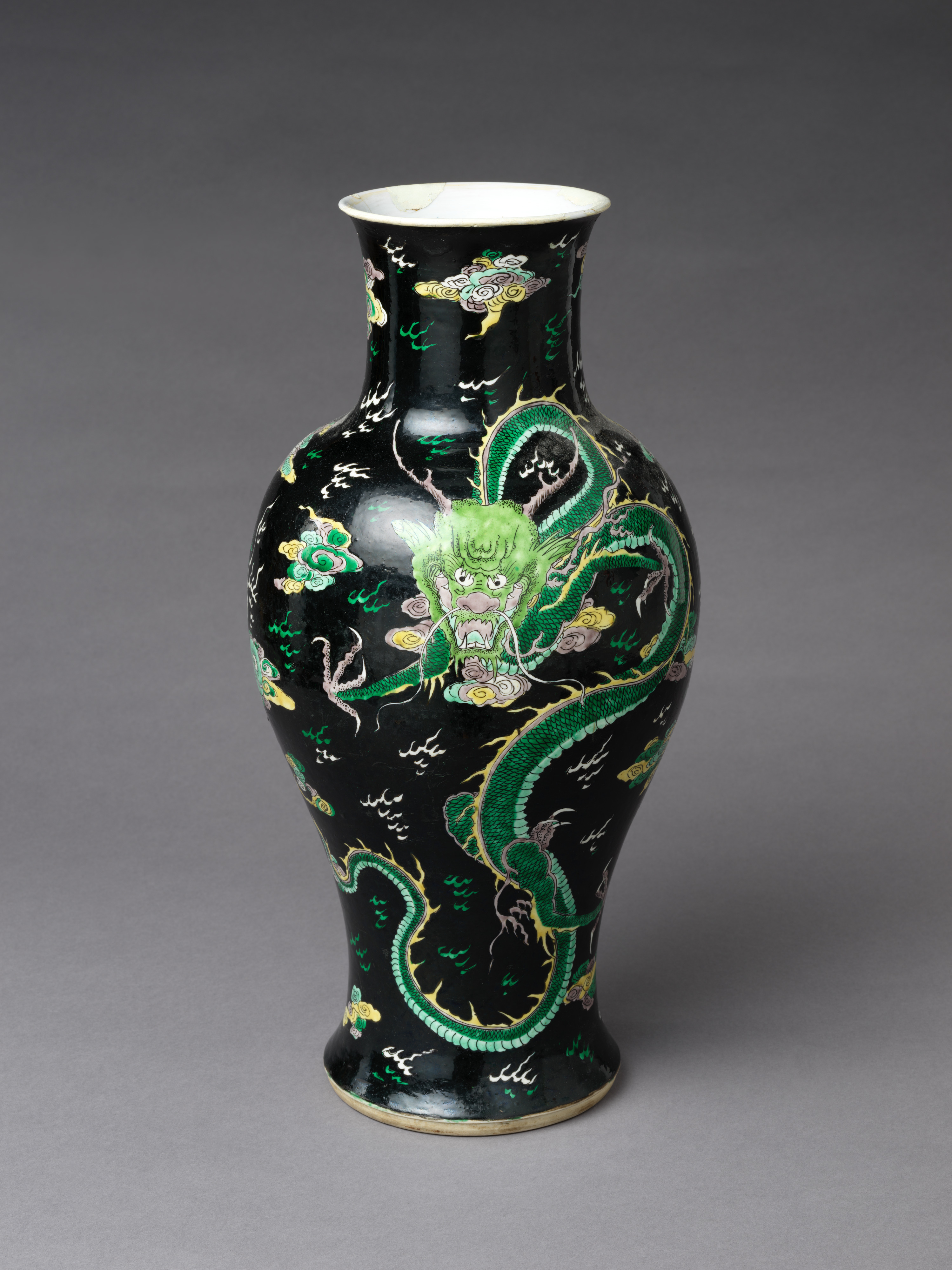
Under the terminal reigns — from 嘉庆 Jiā Qìng onward, after 1796 — the very convention shifts. The Jingdezhen kilns, whose court production declines with the imperial commission, reorient a growing share of their capacity toward the market: export pieces, common-grade domestic objects, polychrome enamel services destined for commercial circulation. The dragon then leaves the strictly imperial register to enter this broader circulation; it adorns families of objects — famille rose, famille noire — produced for Chinese domestic use or for international trade, in decorative registers where the function of sovereign emblem dissolves into commercial ornament. This migration is not merely aesthetic: it follows the economic logic of a system in which the institution that codified the motif effaces itself, and in which the market takes over. This desacralization is itself a trace: the star of the imperial system fades, the dragon goes out with it.
The motif as seismograph
The sequence of the five portraits authorizes a bounded interpretive reading. Over the long run, the dragon motif registers the inflections of the political and economic commission that produces it — what one may call, with the usual caveats, its seismograph function.
The observable mechanism is simple: the ceramic workshops are organs of the state or of the economy that pays them. When the court commission demands a sovereign emblem, the motif compacts — Song, early Ming. When the iconography of a conquering power displaces the convention, it stretches — Yuan. When the court commission thins or withdraws, the motif exhausts itself or descends toward the market — late Ming, late Qing.
This reading is documented at two levels. From the side of court regulations, the 大明会典 Dà Míng huì diǎn — the Ming administrative code, 萬曆 Wàn Lì edition of 1587 — records, for the eighth year of the Jiajing reign (1529), an imperial-workshop arrangement that conjoins a codified motif repertoire (画样 huà yàng) and salaried remuneration (募工给直 mù gōng jǐ zhí, “engage the artisans, give them salary”). The dragon figures there under several named subtypes — 赶珠龙 gǎn zhū lóng (“dragon chasing the pearl”), 升降戏龙 shēng jiàng xì lóng (“ascending and descending dragon at play”) — direct evidence that the imperial commission codified iconography at the very level of the nomenclature. From the side of second-order analysis, the same Rose Kerr, long in charge of the East Asian ceramics collections at the Victoria & Albert Museum, has observed the inverse movement at the end of the sequence: as court power shrinks in the nineteenth and twentieth centuries, the dragon motif descends toward export pieces and common-grade domestic objects. Desacralization then reads as the direct consequence of the withdrawal of the institution that codified the motif.
The limits of this reading must be named. It is not predictive — the dragon does not say the future of a dynasty, it carries partial traces of it. The morphology / power correlation is not biunivocal: other factors (firing techniques, workshop fashion, dominant palette) interfere permanently. And this reading privileges court or semi-official production, where political commission leaves the clearest traces; it verifies less well on purely commercial production, which follows its own logics.
The proposition is therefore not that the dragon predicts political history. It is that it carries datable traces of it, observable to the naked eye on the ceramic material, and that these traces form, over seven centuries, a coherent sequence.
Seven centuries in a single motif
Learning to read the dragon as a dated motif — and not as a transhistorical emblem — changes the way a museum display case is looked at. Where the visitor identified “the Chinese dragon,” they learn to see a Yuan dragon, a Ming dragon, a late-Qing dragon, and to read in their differences the inflections of the system that produced them.
The lesson is not specific to the dragon. Many ornamental motifs undergo diachronic variation — the European crown, for instance, has its own morphological chronology. What is specific to the Chinese dragon is the precision with which its inflections are datable: seven centuries of court ceramics, named reigns, an observable institutional commission. The motif is not a mystery. It is a chronology.
Sources
Textual sources
- 《大明会典》 (Dà Míng huì diǎn) — “Compendium of regulations of the Ming dynasty,” 萬曆 Wàn Lì edition (1587, definitive version). Ming administrative code, preserving the imperial regulations of the 工部 gōng bù (Bureau of Works) on the court kilns and workshops. The notations on the eighth year of the Jiajing reign (1529) — 画样 huà yàng (codified motif repertoire) and 募工给直 mù gōng jǐ zhí (salary arrangement) — document the institutionalization of iconographic commission under the Ming.
Studies
- 柯玫瑰 (Kē Méiguī, Rose Kerr), Chinese Ceramics: Porcelain of the Qing Dynasty 1644–1911, Victoria & Albert Museum Far Eastern Series, V&A Publications, 1986 (Chinese edition under the title 《英国维多利亚和阿尔伯特国立博物院藏 中国清代瓷器》, 广西美术出版社, 1995). Canonical reference in the history of the decorative arts on Qing production, and notably on the migration of the dragon motif outside of court commission in the nineteenth and twentieth centuries.
- 赵自强 (Zhào Zìqiáng), 《古陶瓷鉴定》 (Gǔ táocí jiàndìng) — “Expertise of ancient ceramics,” whose appendix V «历代龙纹的演变» (lì dài lóng wén de yǎn biàn), “The evolution of the dragon motif across the dynasties.” Source of the detailed morphological observations (Tang bird-claw, Ming domed jaw, Qing stretched claw).
- 陈德富 (Chén Défù), 《中国古陶瓷鉴定基础》 (Zhōngguó gǔ táocí jiàndìng jī chǔ) — “Foundations for the expertise of ancient Chinese ceramics,” 四川大学出版社. University manual that gathers the Zhao Ziqiang appendix and confirms the systematization of the five morphological inflections.
Featured object
- Musée national des arts asiatiques – Guimet, Paris. Meiping vase with dragon decoration, Yuan dynasty (14th century), no. G1211. Jingdezhen porcelain, painting in cobalt blue under glaze (青花). Photo via Wikimedia Commons (CC BY 4.0).
- The Metropolitan Museum of Art, New York. Jar with dragon decoration, Ming dynasty, mark and period of Xuande (1426–1435), no. 37.191.1. Jingdezhen porcelain, 青花. CC0 — Open Access.
- The Metropolitan Museum of Art, New York. Vase with dragon decoration, Qing dynasty, 18th–19th century, no. 14.40.180. Jingdezhen porcelain with polychrome enamels on a black ground (黑地粉彩, “famille noire”). CC0 — Open Access.
The dragon is not a fixed iconography — it is a dated seismograph.
MOSAÏNK · May 1, 2026