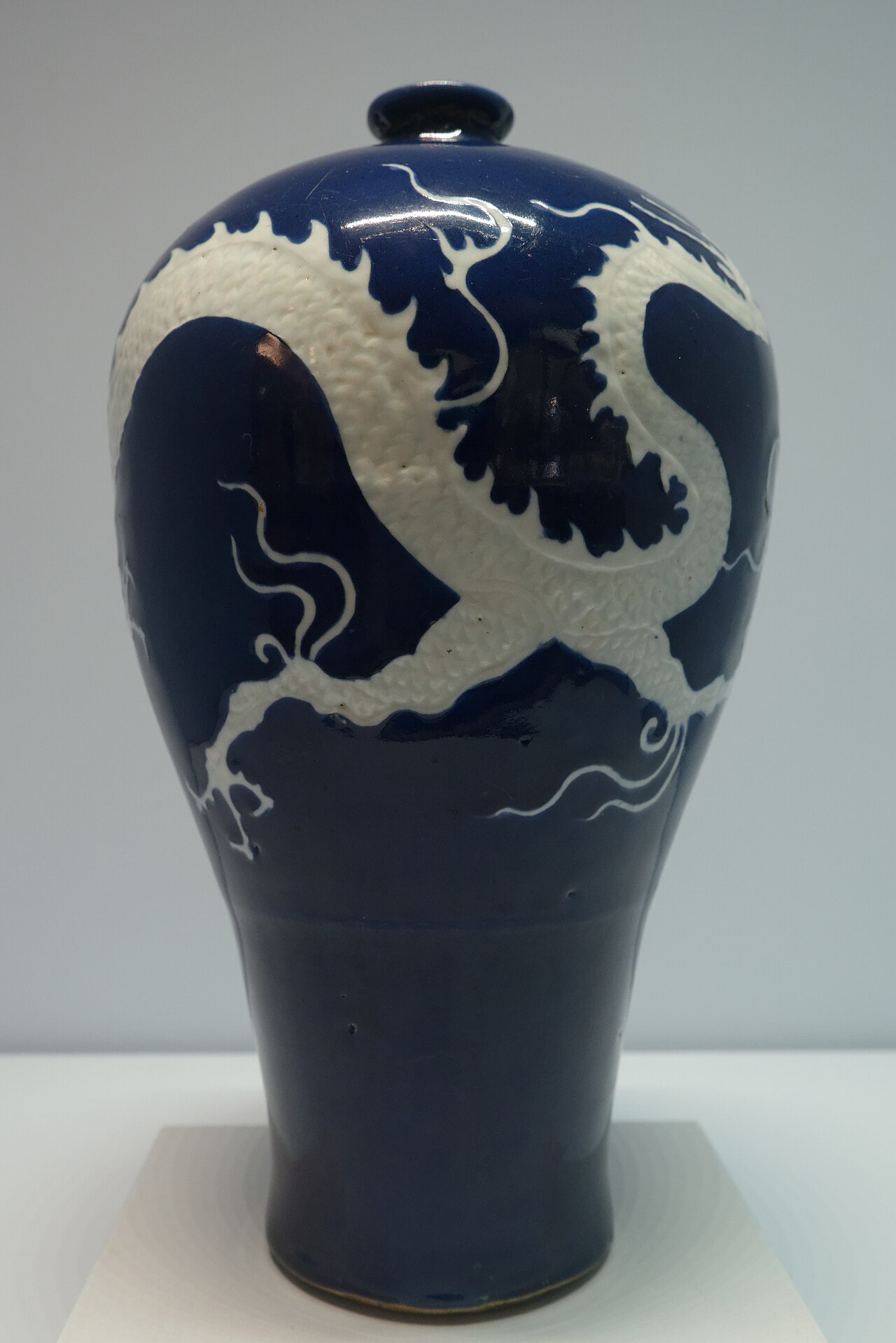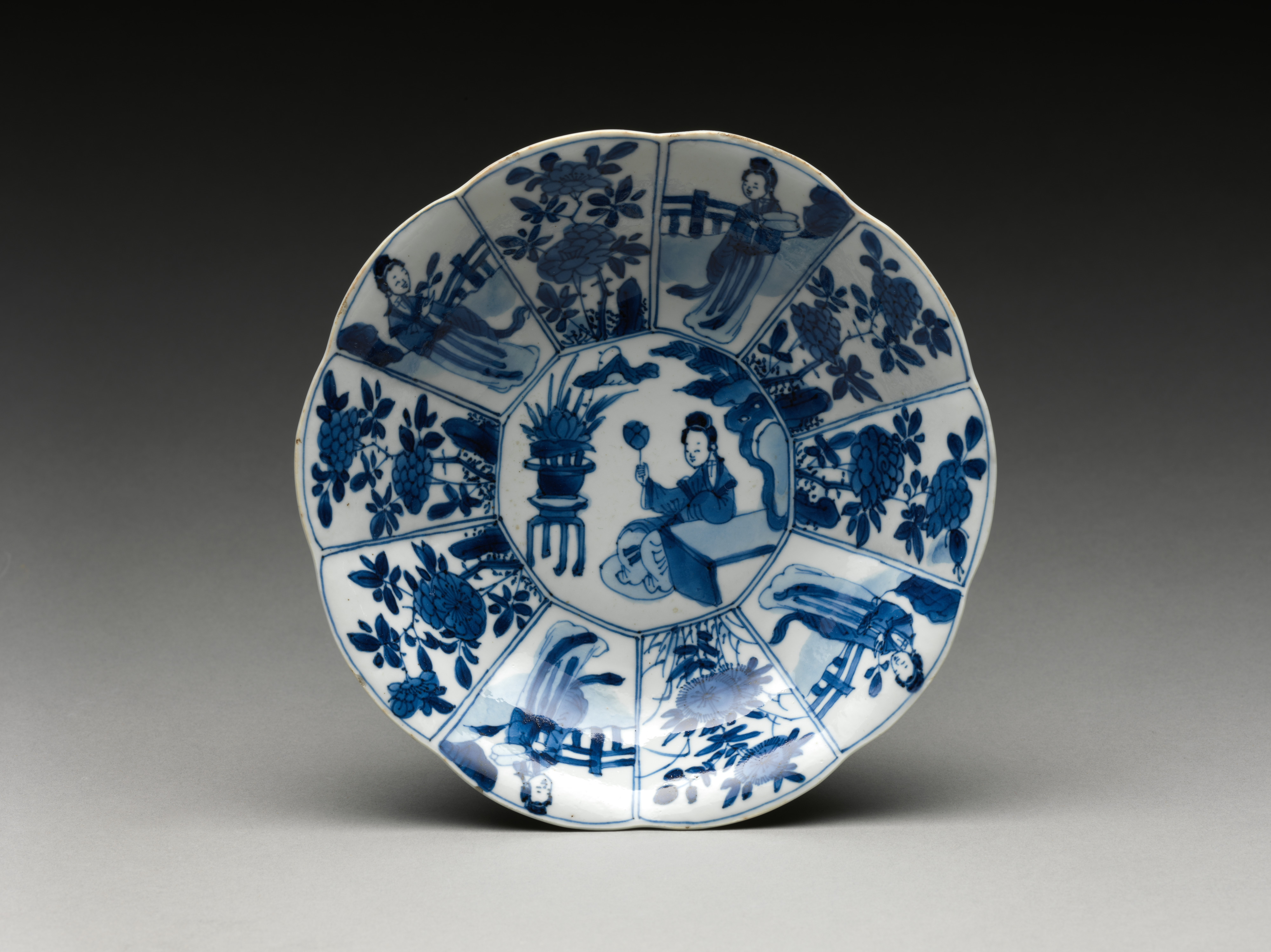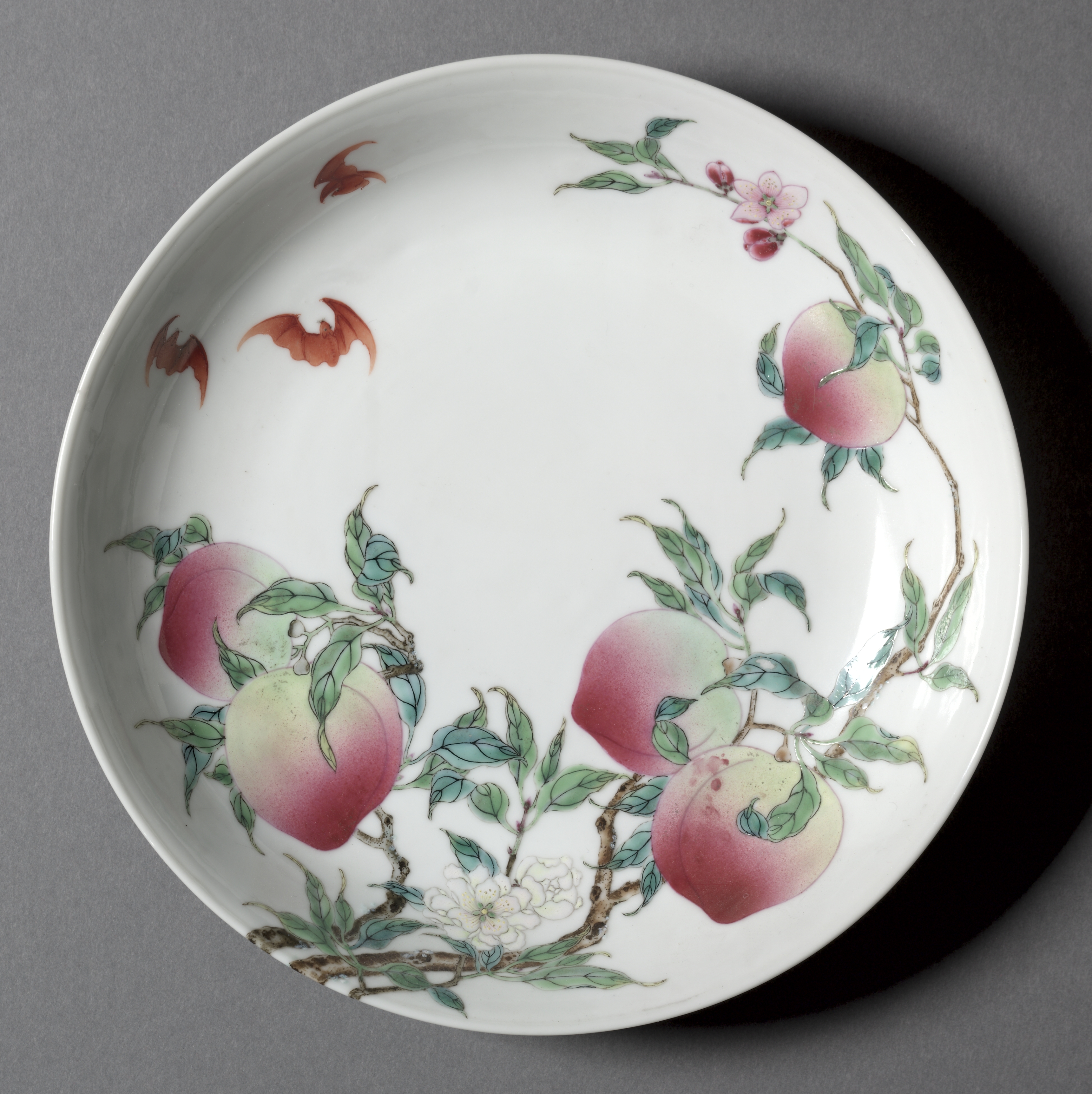
A dish of court porcelain: ripe peaches, green and brown foliage, small red creatures floating above the branches. The piece is recent on the scale of Chinese ceramics — eighteenth century — but its palette is the culmination of a long refinement. The European eye identifies: peaches, foliage, bats. The European eye goes no further.
Yet there is, on this dish, a complete sentence. It says: “long life, happiness.” It is written with a fruit and a mammal, and read by any literate eighteenth-century owner the way one deciphers a familiar word. No mystery for those who know the grammar — only precision. This fragment would like to restore that grammar.
The workshop rule
Every Chinese porcelain produced from the Ming onward carries motifs. Many carry several. And in the great majority of cases, these motifs are not placed there to look pretty — they bear a precise intention. The language of the workshops has a word for this intention: 寓意 yù yì, the meaning inscribed in the motif.
The compilation by the ceramic historian 许之衡 Xǔ Zhīhéng (1877–1935), published under the Republic in his 《饮流斋说瓷》 Yǐn liú zhāi shuō cí (1924–1925), retains a workshop formula transmitted orally from generation to generation:
「图必有意,意必吉祥」 tú bì yǒu yì, yì bì jí xiáng
“Every image carries a meaning; every meaning is auspicious.”
This is not a poetic proverb. It is a production rule. On court porcelains as on pieces destined for the domestic trade, the decoration is never purely ornamental: it carries a wish addressed to the owner — long life, descendants, success in the examinations, household peace. Three distinct grammars allow a motif to bear this charge. They are not ranked among themselves, and they often coexist on the same piece. What follows isolates each and gives an example.
Mechanism 1 — Homophony
A word can be written with an image
Chinese is a language with a very high density of homophones — words pronounced the same way but written with distinct characters. On a porcelain, the painter exploits this density: he paints the animal or plant whose name is pronounced like the wish he wishes to formulate. The motif then becomes a visual pun, legible to any owner whose ear catches the sonic coincidence. Three examples set up the mechanism.
Three puns
蝠 fú (bat) → 福 fú (happiness). The mammal is, to the European eye, a nocturnal animal, ambiguous, sometimes troubling — it does not have the positive aura of a butterfly or a robin. To the Chinese ear, its name coincides phonetically with that of happiness. This single coincidence is enough: the bat becomes the most frequent good-luck motif of the register. Most often it is paired with the 桃 táo (peach), the fruit that Chinese mythology associates with the Queen Mother of the West and her gardens of immortality. The bat-peach pair then signifies fú shòu, “happiness and long life.” The dish described in the opening is exactly this.
鹿 lù (deer) → 禄 lù (official salary, prosperity). The deer is the animal of the official — its name coincides with that of the mandarin emoluments the state pays to the literati who pass the examinations. A porcelain covered with deer in a forest wishes its owner career advancement. The motif is particularly common on pieces destined as a promotion gift or for the cabinet of a high-ranking official.
鹭 lù (egret) + 莲 lián (lotus) → 一路连科 yī lù lián kē (“pass every examination in one stroke”). This is the double pun — the most virtuosic of the register. The visual formula “an egret crossing a lotus pond” reads phonetically as “ascending all the imperial examinations one after the other.” To grasp the wish’s reach, one must recall that the imperial examinations kējǔ were, for thirteen centuries (605, under the Sui, to 1905, under the Qing), the principal channel of social mobility in China. A porcelain offered to a son in study said, literally, what parents today would say to a candidate for the elite schools.
A canonical family
The bat-peach pair is, from the reign of Yongzheng (1722–1735) onward, carried by a family of pieces in which the 粉彩 fěn cǎi palette — “powdered colours,” a palette of opaque enamels stabilized under Yongzheng after a late introduction under Kangxi — gives the peaches their matte volume and the bats their characteristic coral red. The typology is broad: dishes, vases, bowls, cups. The Cleveland dish reproduced as the hero belongs to this family. The decoration is not signed; it does not need to be. It is read.
Mechanism 2 — The symbol
The thing is worth what it evokes
Not every motif is a pun. Some function by reference — either by observable material property (the pomegranate contains many seeds, so it speaks of fertility; the vine climbs in continuous clusters, so it speaks of lineage), or by mythological reference (the peach, the fruit that legend associates with the Queen Mother of the West and the gardens of immortality, speaks of longevity). The meaning is not verbal — it is transposed, from a property or a story, toward a wish.
The triplet of the three abundances
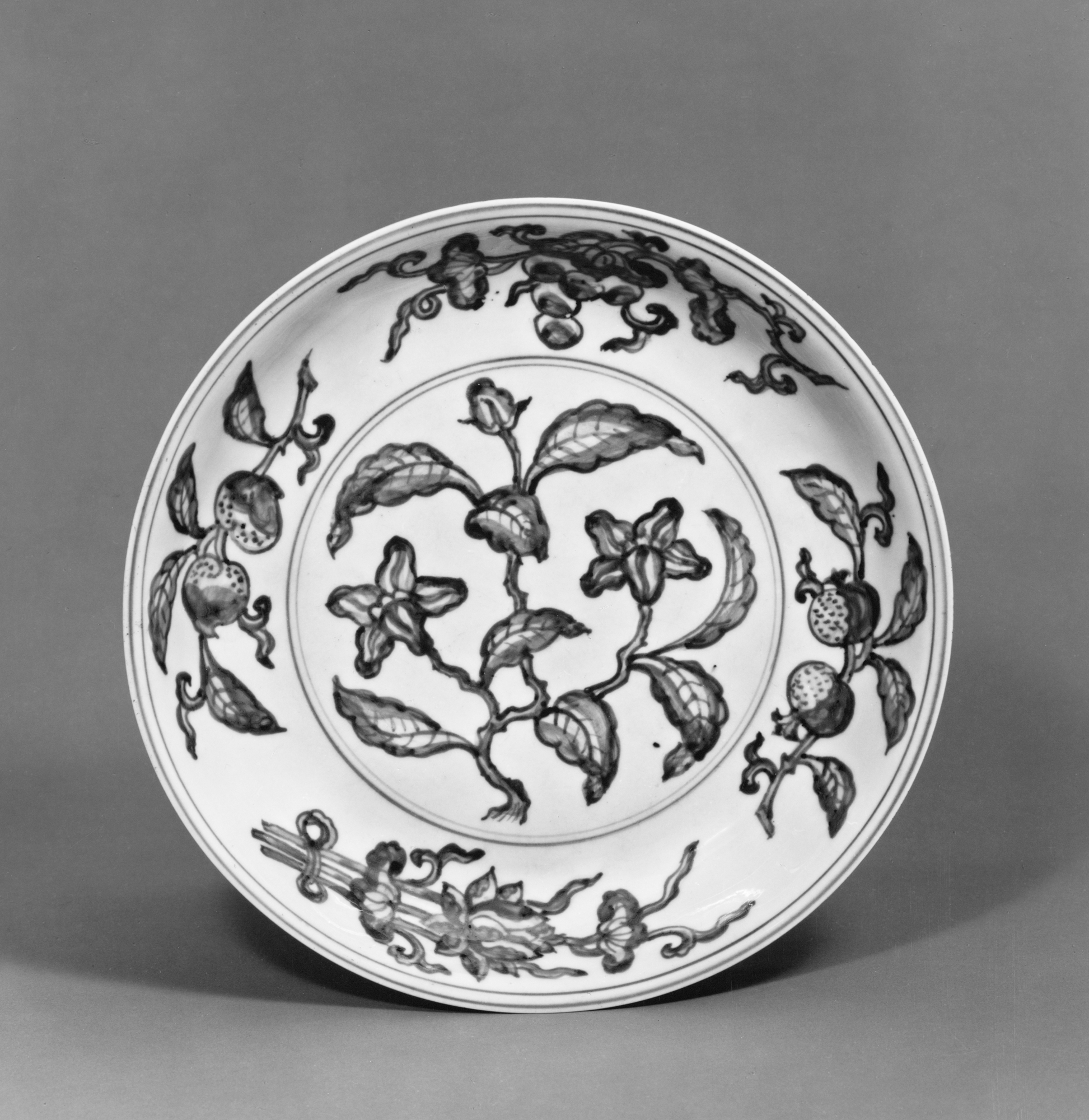
The canonical formula of this family is the triplet 三多 sān duō, “the three abundances”: peach, pomegranate, grape gathered on the same piece.
- 桃 táo (peach) — duō shòu, abundant longevity, by reference to the mythology of the peach of immortality.
- 石榴 shí liu (pomegranate) — duō zǐ, abundant descendants, by visual reference to the fruit’s wealth of seeds.
- 葡萄 pú tao (grape) — duō zǐ sūn, descendants who continue, by reference to the cluster and the climbing vine.
Gathered, the three fruits address to the owner the complete dynastic triad of wishes: to live long, to have sons, to see the lineage continue. Such a piece finds its place on a wedding table, or in the cabinet of a high official who projects his own family across several generations to come.
A Zhengde dish
The dish with a yellow ground and motifs in underglaze blue, produced under the reign of Zhengde (1506–1521), in the middle Ming period, arranges the three fruits in a centred composition. The motif is sober: the three fruit branches occupy the centre of the dish, one per fruit, without overload. It is an image of domestic ritual use, conceived to be read at a glance by a literatus who recognizes the grammar.
Mechanism 3 — The moral emblem
Nature as moral mirror
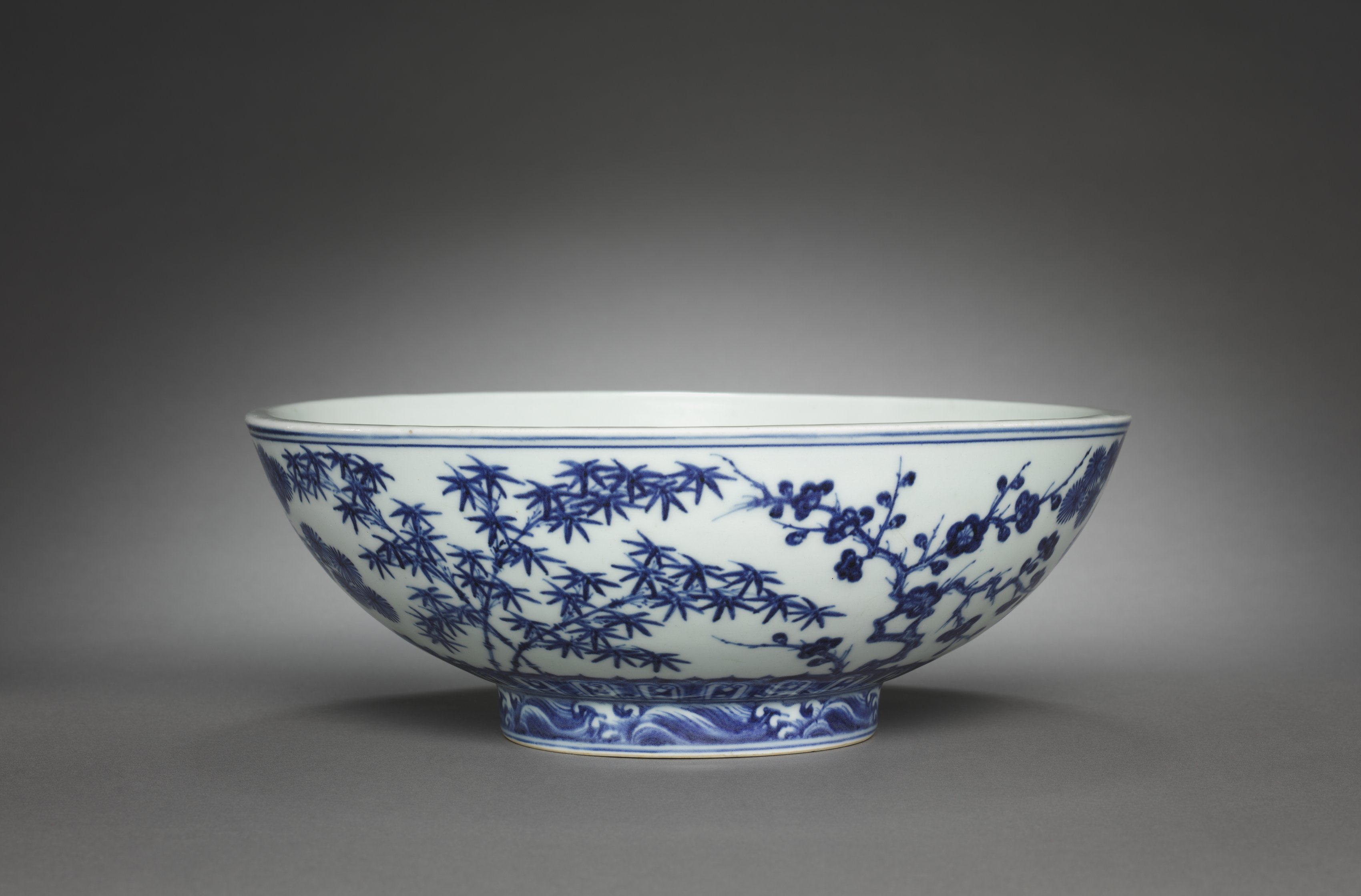
A last class of motifs does not say a wish for the owner — it says what the owner is, or wishes to be. The plant does not encode an external happiness; it serves as emblem to a moral quality. This is the grammar whose use is most stably fixed: taken up by Southern Song literati — 赵孟坚 Zhào Mèngjiān (1199–c. 1267) is the emblematic reference — then repeated almost without variation through the Ming and the Qing. The stability rests on a usage: these three plants have served, since the Southern Song, as moral self-portrait for the literati, which explains the persistence of the triplet on domestic objects.
The three friends of winter
The canonical triplet 松竹梅 sōng zhú méi — pine, bamboo, plum — is called 岁寒三友 suì hán sān yǒu, “the three friends of winter.” Each plant carries a quality that Song poetry stabilized:
- 松 sōng (pine) — persistence: it keeps its colour through full winter.
- 竹 zhú (bamboo) — supple integrity: it bends without breaking.
- 梅 méi (plum) — discreet courage: it flowers in the snow, before any other flower.
An object decorated with the three friends does not say “I wish you courage” — it says “such is the conduct to which this owner aspires.” It is an emblem of self.
A piece — the blue-and-white
The blue-and-white porcelains 青花 qīng huā take up this triplet from the reign of Xuande (1426–1435) — where it becomes an established register among the dominant motifs (dragons, lotuses, floral friezes) — and deploy it widely under the reign of Kangxi (1662–1722). The graphism is tight, almost calligraphic: the painting operates more as writing than as decoration.
A porcelain that wishes
Chinese porcelain is not a repertoire of pretty images. It is a text. Three rules allow it to be read: a word can be written with an image (homophony), a thing can refer to a wish through its nature or a story (symbol), a plant can serve as emblem to a virtue (moral emblem). Learning these rules changes the way a museum display case is looked at. The decoration ceases to be decoration — it becomes a sentence addressed to someone.
The lesson is not specific to China. Many cultures have encoded wishes in domestic objects. What is specific to China is the stability of this grammar — it has held for several centuries, almost without variation, and inscribed itself in court production as in commercial-kiln production. This stability is no accident. As 孔六庆 Kǒng Liùqìng observes in his 《中国陶瓷绘画艺术史》 Zhōngguó táocí huìhuà yìshù shǐ, ceramic painting could follow neither the strict realism of court painting nor the individuality of literati painting — auspicious thought is here a community language, not an authorial one. It is no secret. It is a rule.
Sources
Textual sources
- 许之衡 (Xǔ Zhīhéng, 1877–1935), 《饮流斋说瓷》 (Yǐn liú zhāi shuō cí) — “Remarks on porcelain from the Yinliuzhai studio,” compilation published under the Republic (民国十三年 / 1924; “1925” frequently cited in secondary literature). Catalogue of Ming-Qing workshop usages; the formula “图必有意,意必吉祥” is attributed there.
Studies
- 史树青 (Shǐ Shùqīng, ed.), 《中国艺术品收藏鉴赏百科·陶瓷》 (Zhōngguó yìshùpǐn shōucáng jiànshǎng bǎikē, juǎn 1: táocí) — “Encyclopedia of the connoisseurship and collecting of Chinese art objects, ceramics volume,” 大象出版社. Catalogue of Ming-Qing auspicious imagery.
- 孔六庆 (Kǒng Liùqìng), 《中国陶瓷绘画艺术史》 (Zhōngguó táocí huìhuà yìshù shǐ) — “History of the art of Chinese ceramic painting.” For the confirmation of the Song literati stabilization of the 松竹梅 triplet and the analysis of ceramic painting as a community language.
- 何炳棣 (Hé Bǐngdì / Ho Ping-ti), The Ladder of Success in Imperial China: Aspects of Social Mobility, 1368–1911, Columbia University Press, 1962. Classic study of social mobility through the imperial 科举 examinations under the Ming and the Qing — anchor for the “thirteen centuries” mention.
Featured object
- The Cleveland Museum of Art, Dish with peaches and bats, no. 1930.639. Qing dynasty, Yongzheng reign (1722–1735). Reign mark 大清雍正年製. 粉彩 overglaze enamels. CC0 — Public Domain (Cleveland Open Access).
- The Metropolitan Museum of Art, dish with the 三多 motif, no. 19.28.9. Ming dynasty, Zhengde reign (1506–1521).
- The Cleveland Museum of Art, bowl with the 松竹梅 motif, no. 1953.631. Ming dynasty, Xuande reign (1426–1435), reign mark 大明宣德年製. CC0 — Public Domain (Cleveland Open Access).
The motif is not an ornament: it is the sentence of a wish, written in the language of images.
MOSAÏNK · April 30, 2026