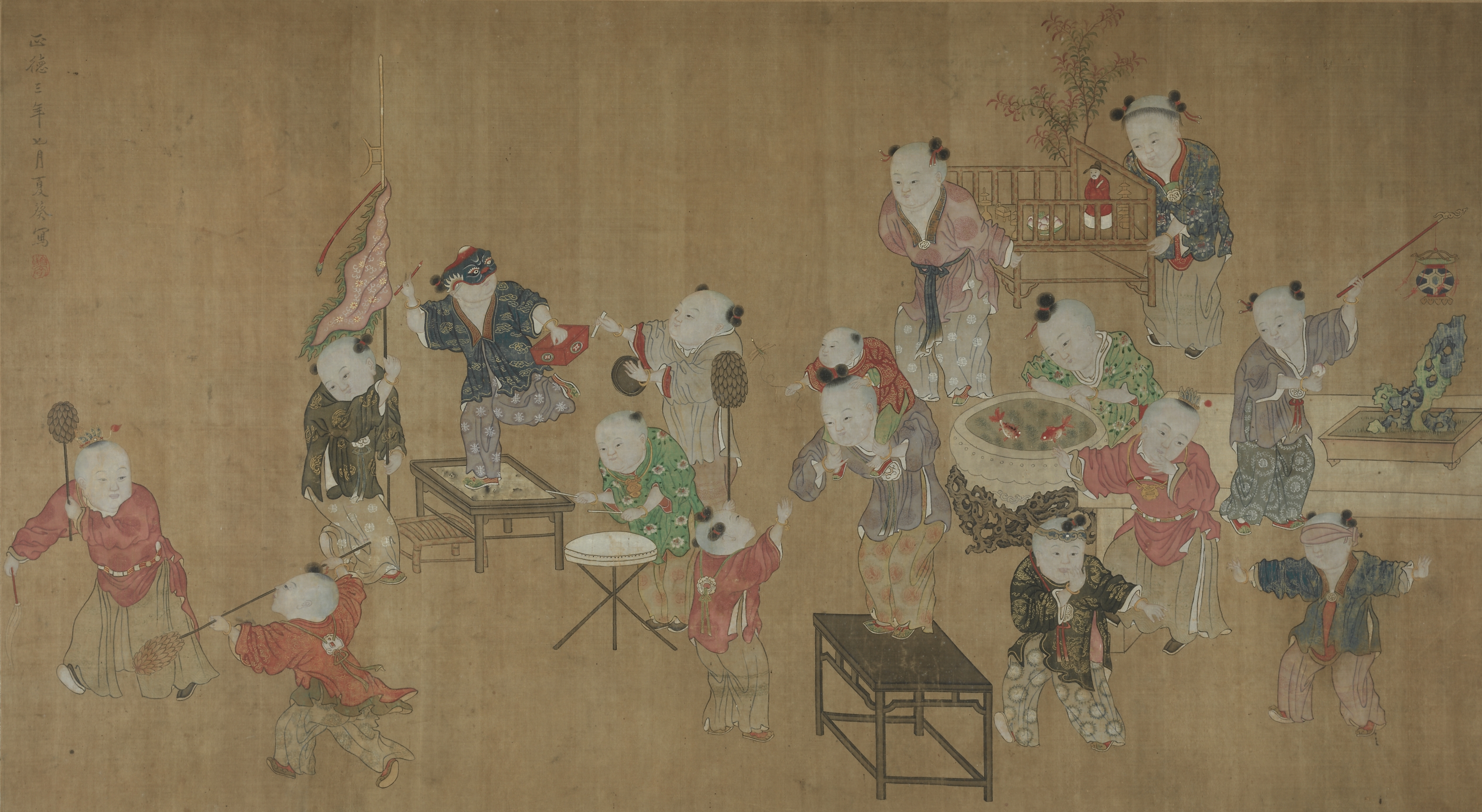
At the center of a large Ming hanging scroll kept at Cleveland, a garden swarms with children — sixteen in all, thrown into footraces, mock combats, improvised concerts. One alone holds the eye. He wears a mask on his face, holds a brush in one hand, a rice measure in the other, and stands, balanced, on a low table. He is not playing like his neighbors: he is miming. The museum’s caption says it quietly — he imitates 魁星 kuí xīng, the god of the imperial examinations. Once named, the gesture changes the whole composition. The painting does not describe childhood; it deposits, in the costume of a child, a wish for official success. And this wish is not isolated. Each of the other children carries another, painted onto his very attribute.
The rule, and its proofs
This painting never shows girls. The motif has a name — 婴戏图 yīng xì tú, “children at play” — and a twin name, more arithmetical, 百子图 bǎi zǐ tú, “a hundred children.” The admission is lexical: the target count is masculine. The bilingual gloss opens the door. The painting counts, and it counts sons. The club is closed, and closed in advance: Chinese painting can also, alongside, show girls, but as another genre, far rarer, and one that does not receive the same kind of attention. It is that other category, studied apart, which confirms the rule here by contrast.
At Cleveland, the caption itself takes the composition apart: the sixteen children there carry out “scholarly, religious, and military activities” — the three paths by which, under the Ming, one entered the imperial civil service. Two of the eldest wear a small crown with red pompoms: that is 加冠 jiā guān, the official headdress received on taking office. The brush and rice measure the masked child holds say another wish, that of a place in the examination. No gesture is left to chance. Each accessory — crown, brush, measure, kite, double coin — codes a pronounceable formula, like the entries of a visual dictionary.
From observation to model
The motif was not born as a model. In the 12th century, 苏汉臣 Sū Hànchén, painter in residence at the courts of the emperors Huizong and then Gaozong, established it within Song court painting. He cast on it an observer’s eye: the fall of a sleeve, the posture of an ankle, a toy held between two fingers, the furniture around — work on two or three figures at a time, in the 格物 gé wù tradition — “the attentive examination of things” — which the Song literati then claimed as method. At its beginnings, the motif was the work of an individual eye.
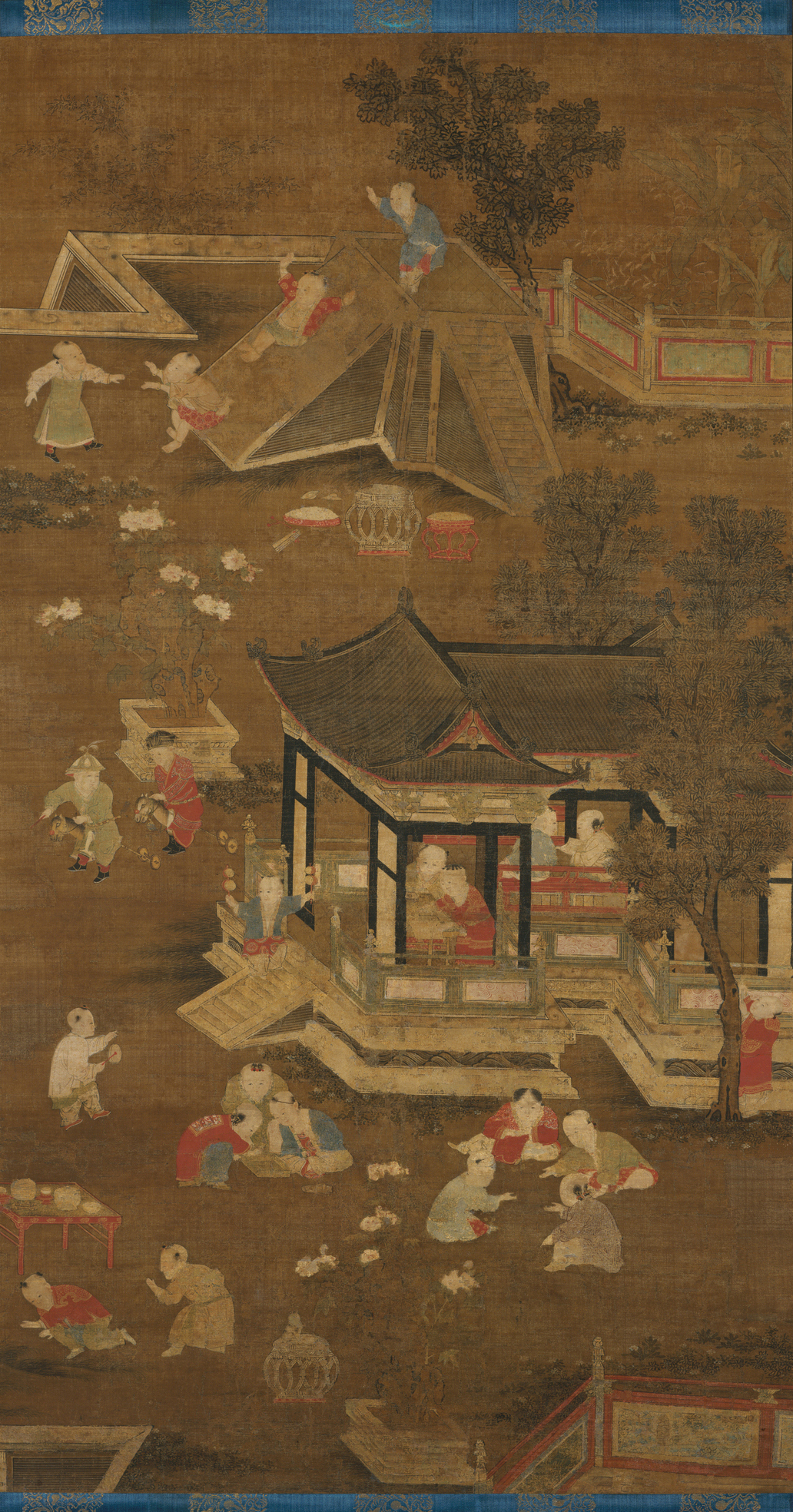
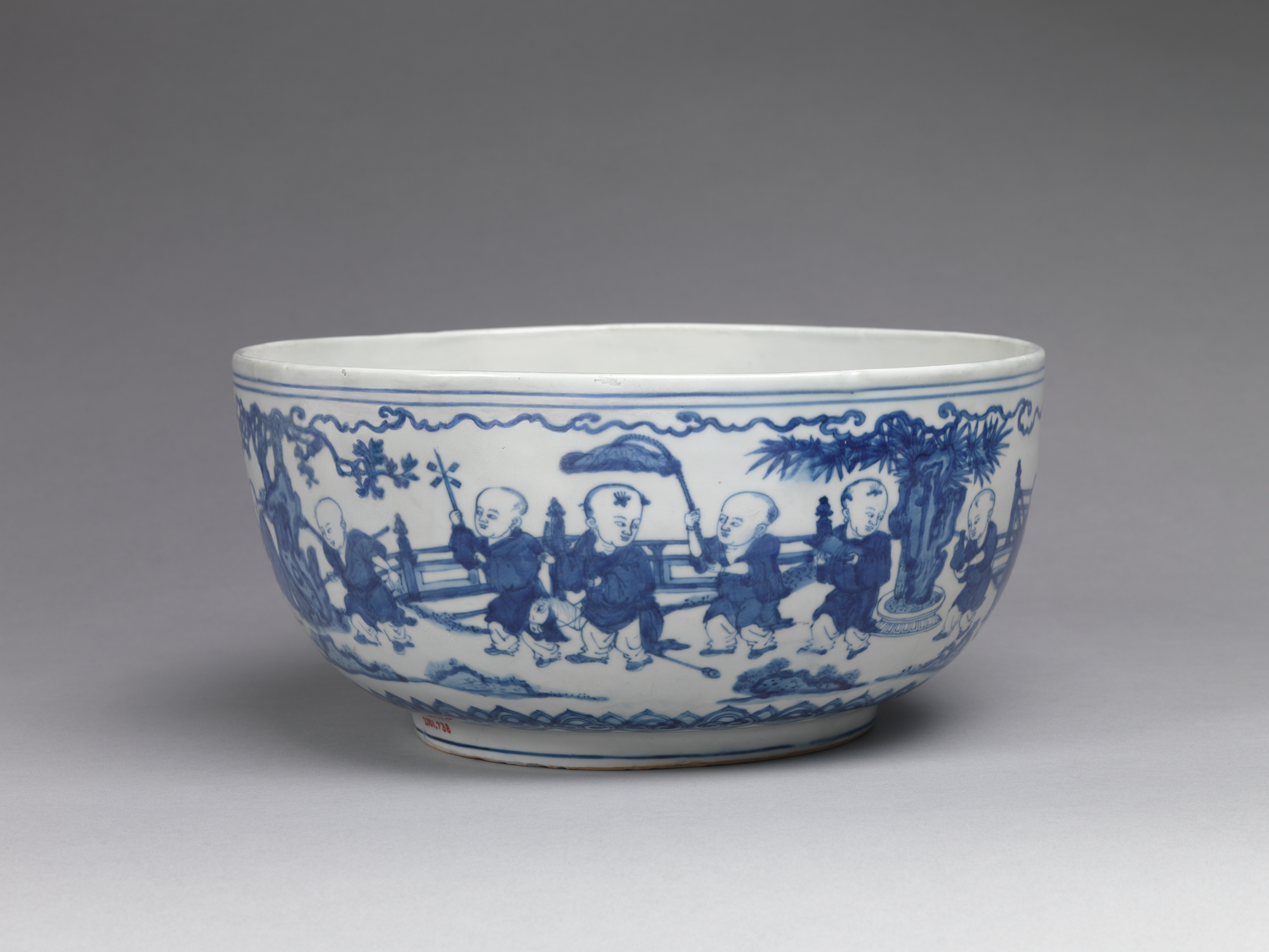
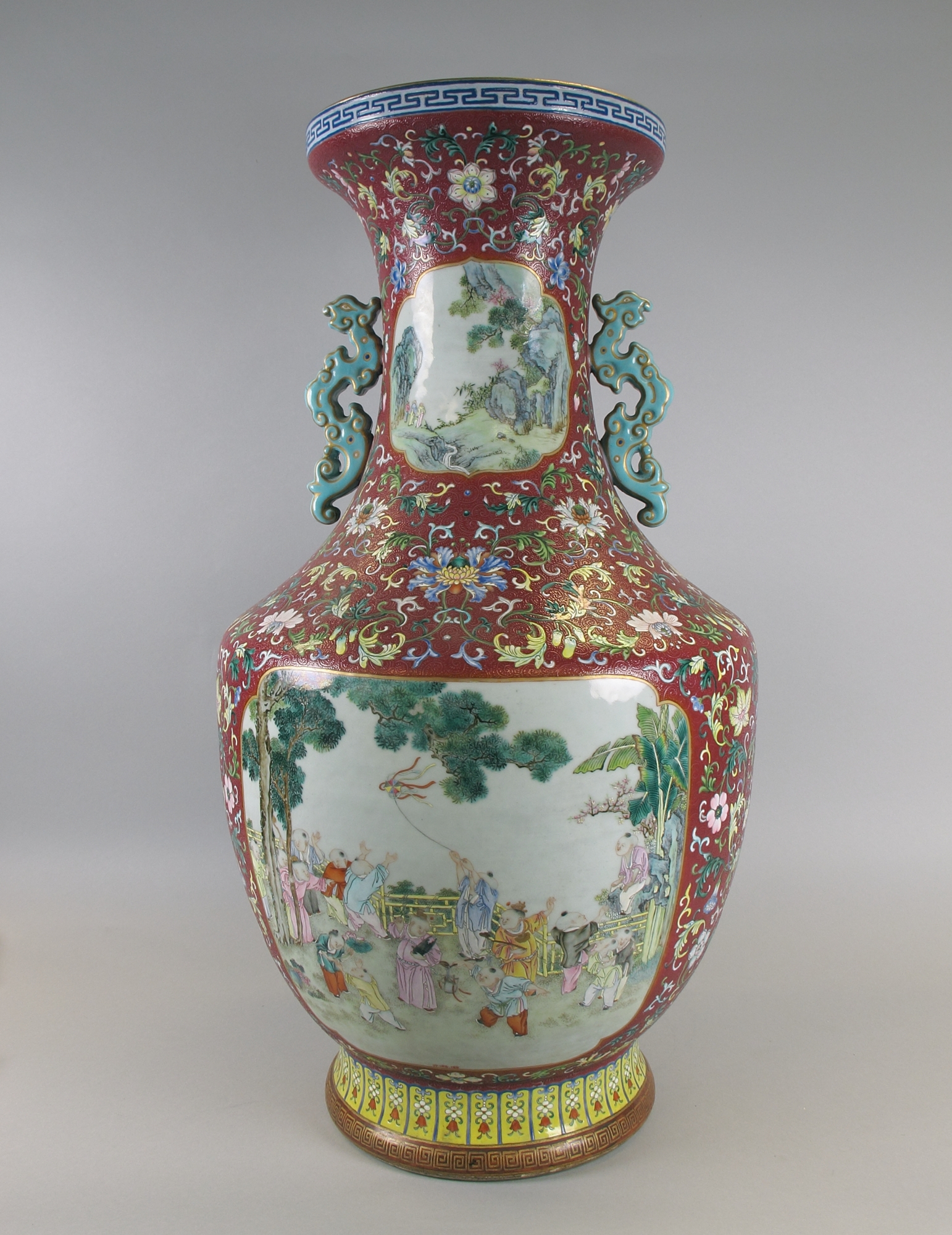
A century later, the motif changes hands. A painting at the Metropolitan, from the early Ming, gathers twenty-two children playing at hobbyhorses, hurtling down a great stone slide, thrown into a turning round; the painter’s name, this time, no longer holds. The curatorial caption writes it plainly: the Ming court workshop took up the styles and the subjects of the Song academy. Observation has become citation. From the reign of 嘉靖 Jiājìng (1522-1566), the kilns at 景德镇 Jǐngdézhèn turned out in series bowls, dishes, and jars decorated with the same composition. Under Qianlong a century later, the 锦地开光 jǐn dì kāi guāng — the “reserve on a brocade ground” — confined the children within a fixed cartouche cut into the belly of a vase, like a prefabricated module set, on the same piece, alongside scenes of literati in gathering. The motif had detached itself from the brush that had thought it.
The wish hung on the wall
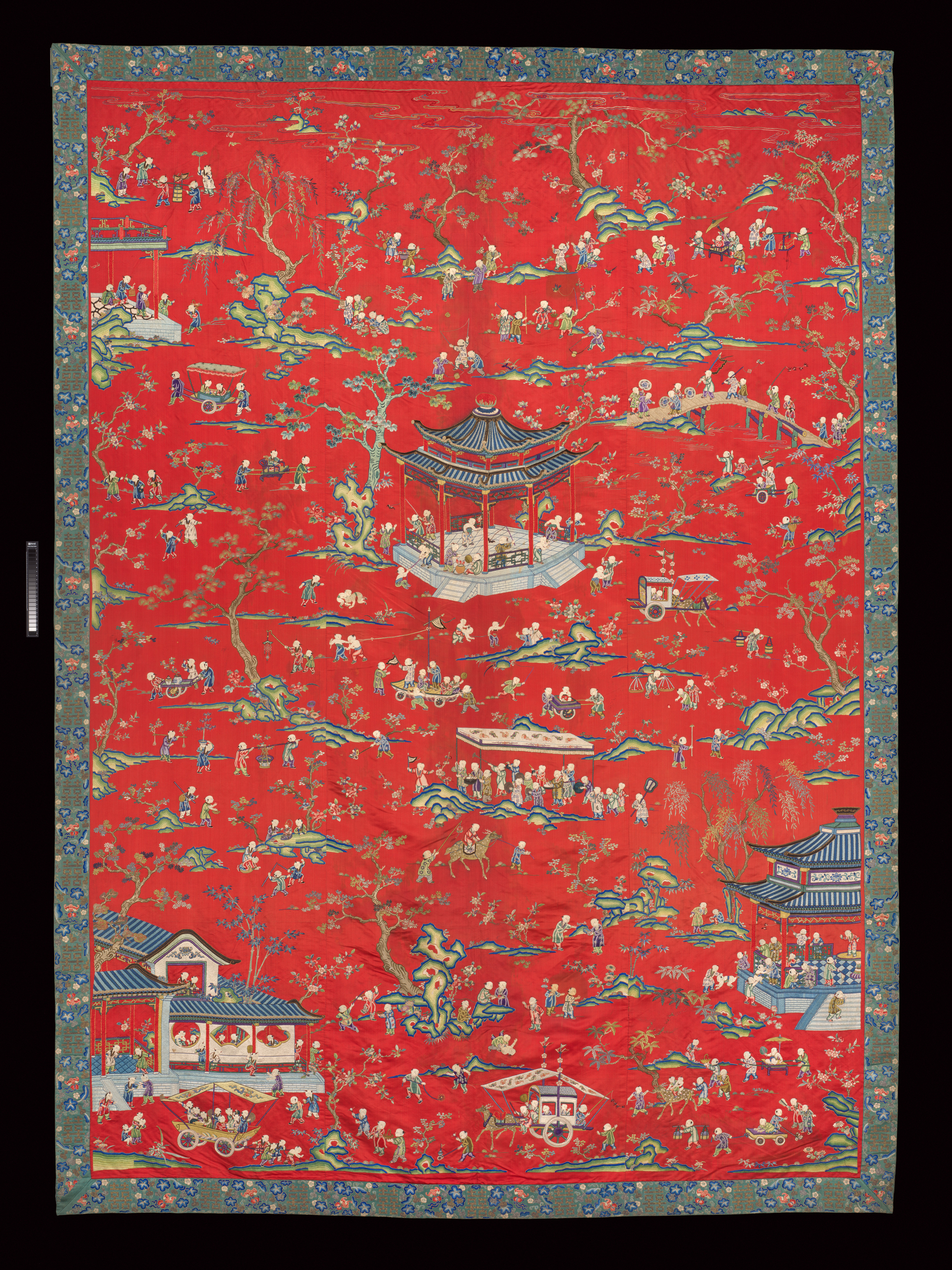
The migration ends on an embroidery. In the 19th century, a polychrome silk hanging kept at the Metropolitan deploys two hundred and fifty children — wrestling matches, hide-and-seek, butterfly hunts, ball games — and the museum caption specifies its function: this kind of piece, hung on the wall, decorated nuptial chambers. The wish of descendance has left the court scroll, crossed the jar and the dish, to end stretched above the bed. There remains no trace, here, of the Song painter’s individual eye; only a list remains, embroidered thread by thread. The painting of children had never been a painting of children.
Sources
Textual sources
- Curatorial notice, The Cleveland Museum of Art — Children at Play (1915.110, attributed to Xia Kui 夏葵, dated 1508). Unpacking of the three categories of activity (“scholarly, religious, and military”); identification of the masked child imitating Kuixing; small crowns with red pompoms read as 加冠. Primary attribution status.
- Curatorial notices, The Metropolitan Museum of Art — Children playing in the palace garden (1987.150, early Ming); Vase with children at play and scholars in gathering (17.120.189, Qianlong); Hanging with children at play (30.75.33, 19th century). Identification of the academic return at the early Ming, of the 锦地开光 device under Qianlong, and of the nuptial function of the embroidered hanging.
Studies
- Ann Barrott Wicks (ed.), Children in Chinese Art, University of Hawai’i Press, 2002. A reference collective study on the iconography of childhood in Chinese painting; the “motif without girls” rule is documented there.
- Picturing Parental Love for Girls in Song China, Journal of Chinese History (Cambridge), 2023. The rare and marginal type of paintings of girls under the Song; the inverse argument that confirms, by contrast, the rule of the yingxitu motif.
Featured object
- The Cleveland Museum of Art. Children at Play (嬰戲圖), attributed to Xia Kui 夏葵, dated 1508, Ming dynasty. Hanging scroll, ink and colors on silk. Accession 1915.110. Open Access (CC0).
- The Metropolitan Museum of Art, New York. Children playing in the palace garden (嬰戯圖), anonymous painter, early Ming (late 14th – 15th century). Hanging scroll, ink and colors on silk. Accession 1987.150. Open Access (CC0).
- The Metropolitan Museum of Art, New York. Large bowl with children at play in a garden, mark and era 嘉靖 (1522-1566), Ming. Jingdezhen porcelain, cobalt blue under glaze. Accession 2001.738. Open Access (CC0).
- The Metropolitan Museum of Art, New York. Vase with children at play and scholars in gathering, Qianlong era (1736-1795), Qing. Jingdezhen porcelain, polychrome enamels over glaze. Accession 17.120.189. Open Access (CC0).
- The Metropolitan Museum of Art, New York. Hanging with children at play (清 刺繡百子圖), Qing dynasty, 19th century. Silk and metallic-thread embroidery on satin. Accession 30.75.33. Open Access (CC0).
These are not children at play; it is a wish counting its sons.
MOSAÏNK · June 27, 2026