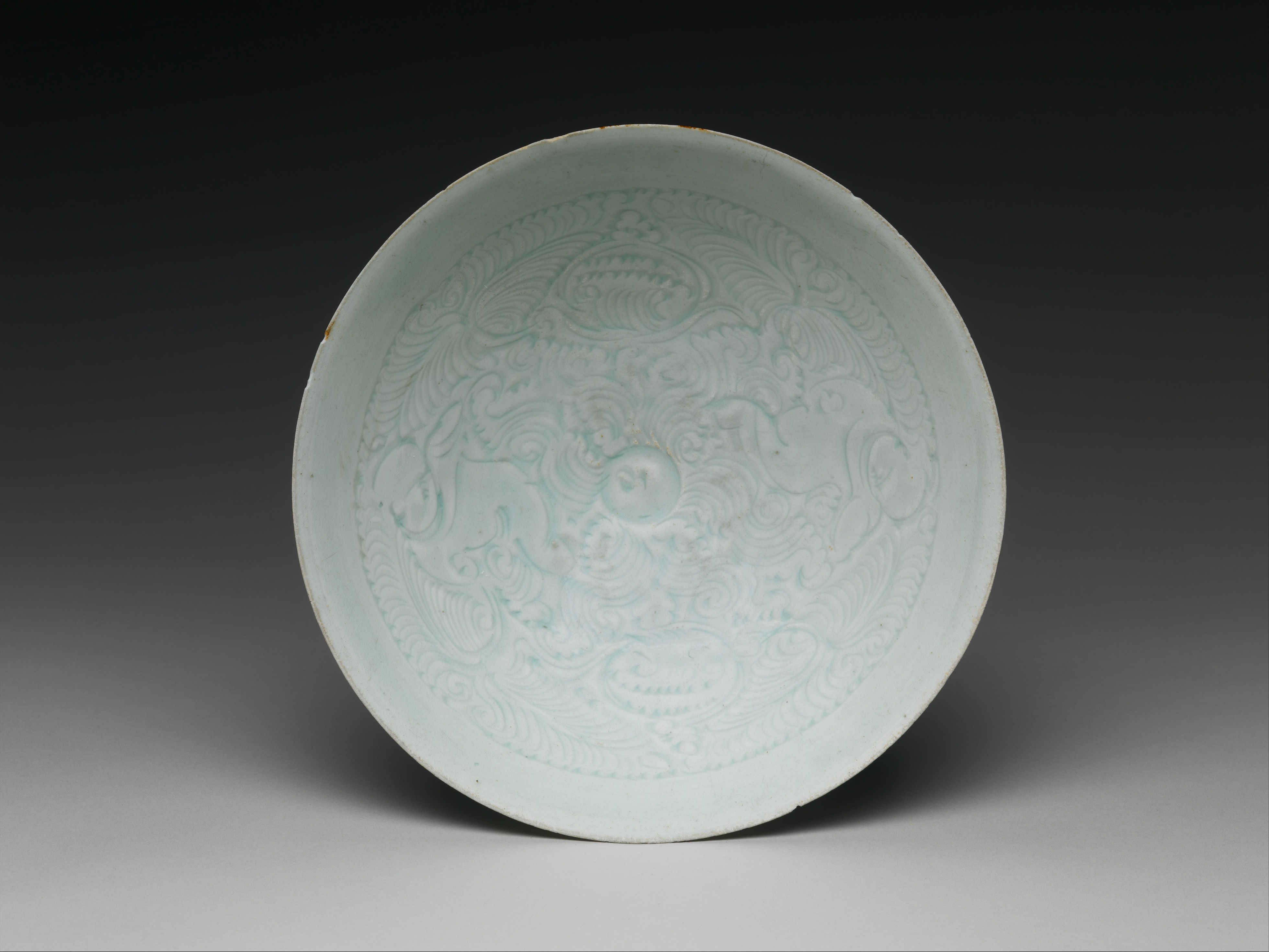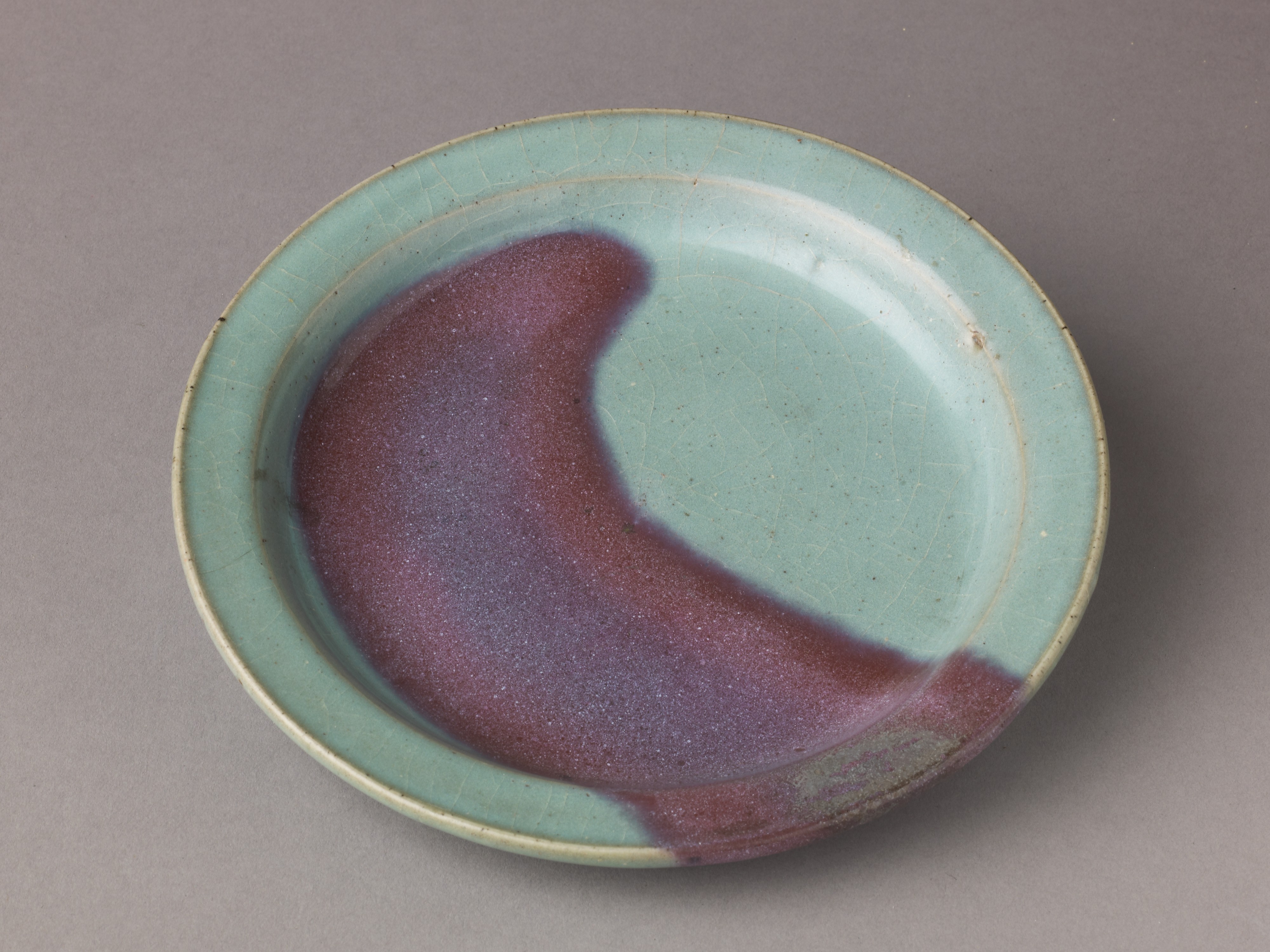
At the bottom of a Jun bowl, on a sky-blue glaze, runs an irregular furrow — a thicker stream, refrozen, winding without apparent plan. At first glance, the European eye reads it as a drip, a stroke of badly mastered flow, the residue of a glaze that should have spread more evenly. And it would be right, factually: that is exactly what it is, the trace of a fluid which, at very high temperature, settled in a cord rather than in a sheet.
But the furrow has a name. The Song connoisseurs called it 蚯蚓走泥纹 qiūyǐn zǒu ní wén — “earthworm tracks in the mud.” And that name, in classical Chinese prose, is not a humorous concession to the flaw. It is the criterion that certifies the authenticity of a Jun. A piece that does not bear this furrow is suspect.
The displacement is what interests us. Let us follow it, between Song and Ming, across an entire family of firing failures that Chinese literary prose, over several centuries, requalified as connoisseur categories.
Three mechanisms, a single name
The generic term, in Chinese, is 窑变 yáo biàn — the transformation of the kiln. Its logic is first chemical. In a wood-fired kiln, the temperature is not uniform; the atmosphere oscillates between oxidation and reduction with the draught; the metal oxides the glaze contains — iron, copper, titanium — react to these fluctuations without anyone being able to steer them to the degree. Three distinct physical mechanisms, in practice, produce the phenomena that Song-Ming prose grouped under a single aesthetic attention.
The first is the differential of expansion. When a body and its glaze do not have the same coefficient of contraction on cooling, the vitrified layer cracks — a phenomenon ceramists call 釉裂 yòu liè, or more commonly 开片 kāi piàn, “crackle.” On the bowls of 汝窑 rǔ yáo, the Song imperial kiln, the crackle is suffered: the pieces leave the kiln with a fine network that no one, at firing time, explicitly wanted. Later, on the kilns of 哥窑 gē yáo, the same phenomenon will be reproduced deliberately, hierarchized, and finally named.
The second is chromatic transformation in the strict sense. When the glaze contains copper — Jun is the paradigmatic case — and the kiln atmosphere passes through a reducing phase, metallic copper redeposits in microscopic droplets that diffract the light. The result is a purple flow, sometimes blood-red, sometimes mauve, spread over a sky-blue ground. The blue itself is not an added pigment: it comes from Rayleigh scattering on liquid phases suspended within the body of the glaze. The Jun piece reproduced at the head of the fragment shows the event: a wide purple flow crosses the inside of the plate, from the bottom up over the rim. It is this phenomenon — chromatic, random, spread — that the prose 陶说 Táo shuō names “the metamorphosis of fire, whose reason cannot be explained.”
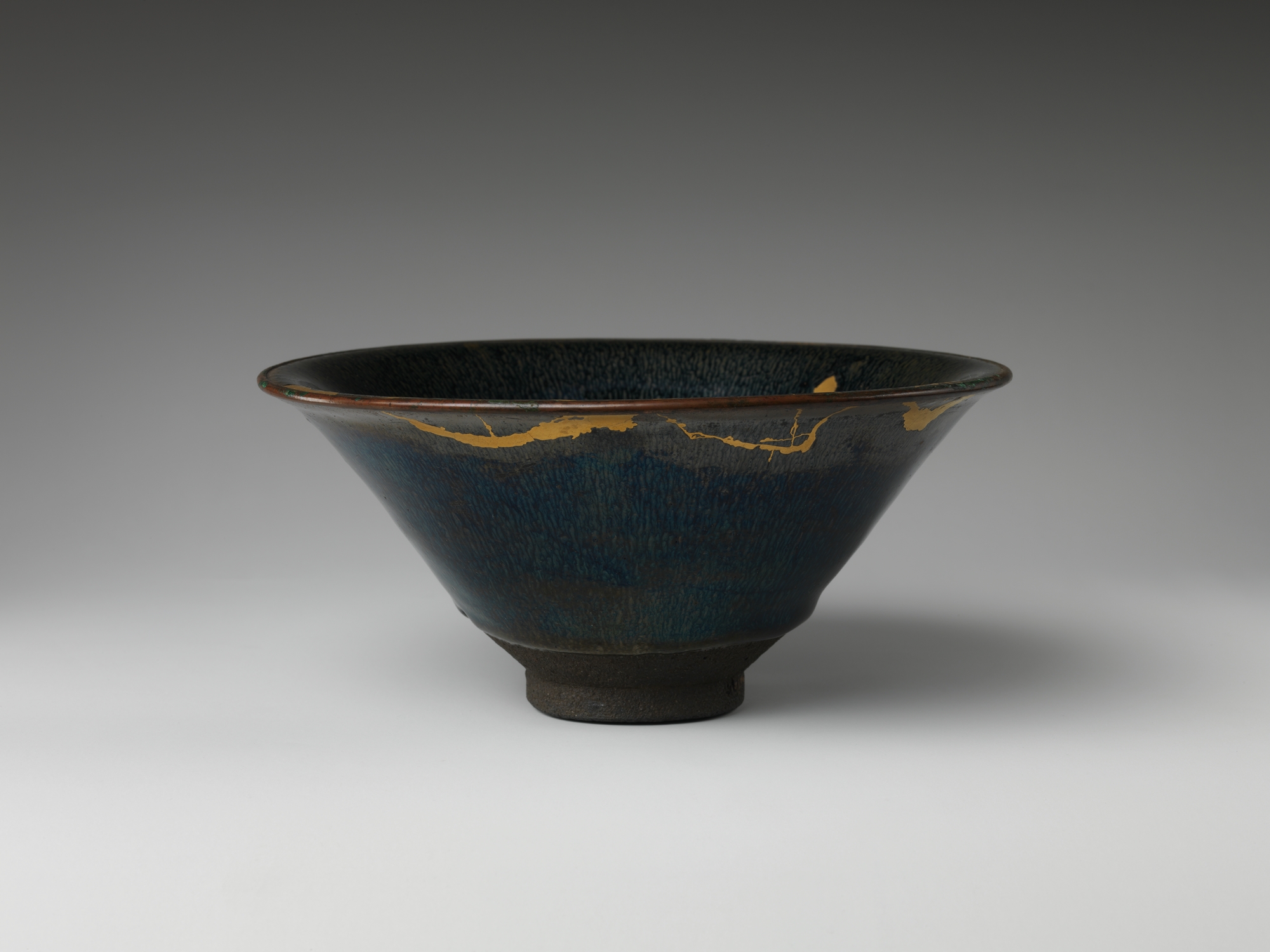
The third is crystalline precipitation. On the kilns of 建窑 jiàn yáo, in Fujian, the black glaze is saturated with iron oxide. On slow cooling, this iron crystallizes at the surface; the crystals, depending on their orientation and density, draw radial striations — 兔毫 tù háo, “hare’s fur” — or regular metallic spots — 油滴 yóu dī, “oil drops.” Very rarely, the crystallization produces iridescent disks of thin-film interference, shimmering blue, green, purple depending on the angle of view: the 曜变 yào biàn, “the changing brilliance.” Only four pieces have come down to us. They are in Japan, classified as national treasures. We will return to them.
All of this — crackles, copper flows, iron precipitates — is not steered at firing. It happens, and it is recognized at the kiln mouth. Classical Chinese prose, which named each of these accidents, is older by several centuries than the chemistry that explains them today.
Three moments of literary requalification
The gesture that interests us is not the accident itself. It is the prose that takes hold of it — that recognizes it, hierarchizes it, that ends up producing an entire canon of objects sought for their failures. And that gesture, in China, does not unfold in a single move. It breaks down into three distinct moments.
First moment: taxonomic recognition. Composed in the eighteenth century by 朱琰 Zhū Yǎn, the Táo shuō cites in this regard a passage from the 博物要览 Bówù yàolǎn, a late Ming treatise:
“The Guan and Ge kilns sometimes yield transformed pieces, in the forms of butterflies, birds, fish, qilins; beyond the expected glaze colour, the colour sometimes changes, turns yellow, red, purple — resembling forms, charming. The metamorphosis of fire, the reason cannot be explained. But the transformation does occur sometimes; it is not extraordinary.”
The tone is exact. No mysticism, no sentimental praise: a literate connoisseur taxonomizing a poorly understood chemical event by assigning it an iconographic repertoire. The flaw is described, as one would describe a species of flower or a calligraphic variation. The absence of causal explanation does not become, under this pen, a call to mystery: it is noted, and one moves on to the next piece.
Second moment: hierarchization. This is the decisive contribution of the 长物志 Zhǎng wù zhì, a connoisseur’s treatise composed by 文震亨 Wén Zhènhēng at the end of the Ming dynasty, around 1620. Wen Zhenheng ranks the Guan, Ge, Ru, and Jun by strict grids. For crackles:
“Ice crackle, eel-blood, and iron foot are at the top; plum blossom and ink veining come next; fine crackle is at the bottom.”
Four levels, ordered from rarest to most banal. The grid does not admit imperfection as an unformed category — it organizes it. A crackle that is too fine is at the bottom: it is the suffered crackle, that of the Ru. A crackle “in ice,” on the contrary, has been read, recut, and placed at the top. The flaw is graded, and the gradation presupposes an expert reading that knows how to recognize the mesh, the rhythm, the depth of the network.
Third moment: the crystallization of an autonomous Chinese critical vocabulary, which designates this grid as an aesthetic category in its own right. The gesture is modern: it belongs to contemporary criticism, and it fixes retrospectively what the Ming treatises practiced without theorizing. On the bowls of Ge, the double network of crackles — dark main lines and brown-gold secondary lines — bears a name: 金丝铁线 jīn sī tiě xiàn — “gold threads and iron lines.” 马未都 Mǎ Wèidū, in his Mǎ Wèidū shuō shōucáng, gives the formula that has become canonical:
“The jīn sī tiě xiàn is in reality a defective beauty of ceramic firing. The failure of the Ge kilns, the literati invested it with an aesthetic requirement of its own — the 缺陷美 quēxiàn měi, defective beauty. The highest level of Chinese sensibility is this beauty beyond the norm, pathological — the 病态美 bìngtài měi. It is this that was raised to the highest, and it is in this position that the Ge kiln was born.”
The decisive terms are not defective beauty. They are pathological beauty. Ma Weidu uses these two notions without softening them. He describes a cold canon, which values precisely what a reflexive Western reading — one that immediately brings together “praise of the flaw” and Japanese wabi-sabi — would want to read as meditative humility. Chinese prose has nothing of this. It is connoisseurship: lettered, hierarchical, distanced. It has grades, as one has them in calligraphy or painting. It is older, in its critical vocabulary, than the modern formulation of wabi-sabi; and it is, above all, different in register. The habitual conflation of the two traditions under the English word imperfection flattens both.
Three pieces, three mechanisms
Three pieces, from the Southern Song to the Yuan, illustrate each of the three mechanisms. All three are kept in open-access collections.
The Jun plate reproduced at the head of the fragment — jūn yáo, Jin/Yuan dynasty, kept at the Met — shows the second category. The purple flow, spread broadly over the sky-blue ground, is the copper event spoken of in the previous section; one sees the limit of the purple stretching from the bottom toward the rim, in a blurred but legible border. No brush placed it — nor any master glazer. It was recognized, at the kiln mouth, as the event that placed this piece in the high category. What the literary gesture names, here, is the unforeseen occurred.
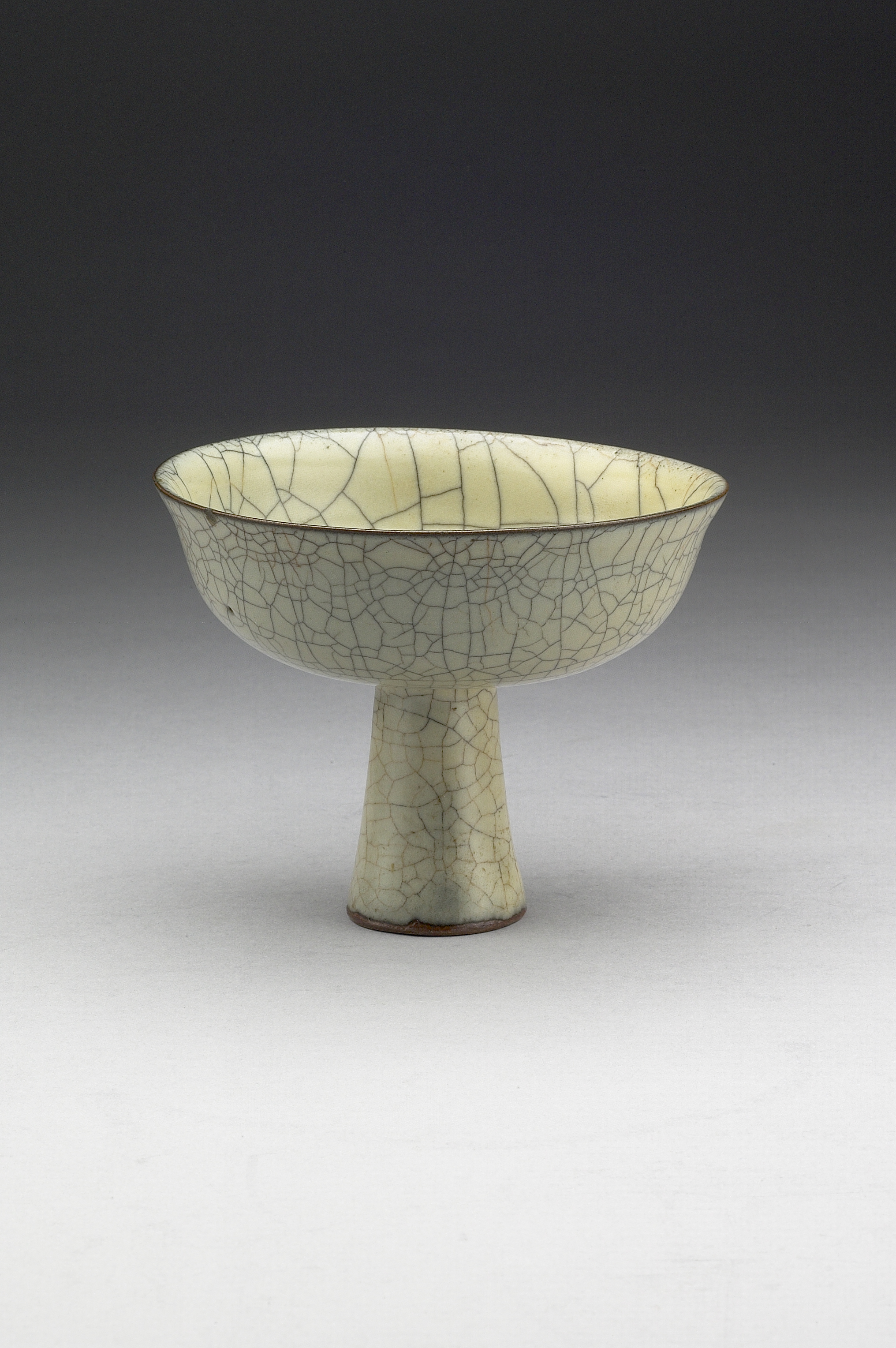
The Ge stem bowl illustrated above, kept at the National Palace Museum in Taipei, gives the first category. The double crackle weft is clear: a dark main network, a finer and lighter secondary network, brown-gold beneath the celadon glaze. The contrast between the two wefts is what jīn sī tiě xiàn names — one must see the two densities, otherwise the naming falls flat. Let us note it explicitly: the piece is dated Yuan, not Song. It is a point that must be acknowledged rather than masked. The Ge bowls transmitted to us are, for the most part, post-Song; the prose of the Zhǎng wù zhì, at the end of the Ming, fixes in critical terms a canon whose concrete exemplars were produced over the previous two or three centuries — Southern Song, Yuan, early Ming. The canon precedes its own theoretical fixation, and the theoretical fixation retrospectively stabilizes a repertoire of objects already transmitted.
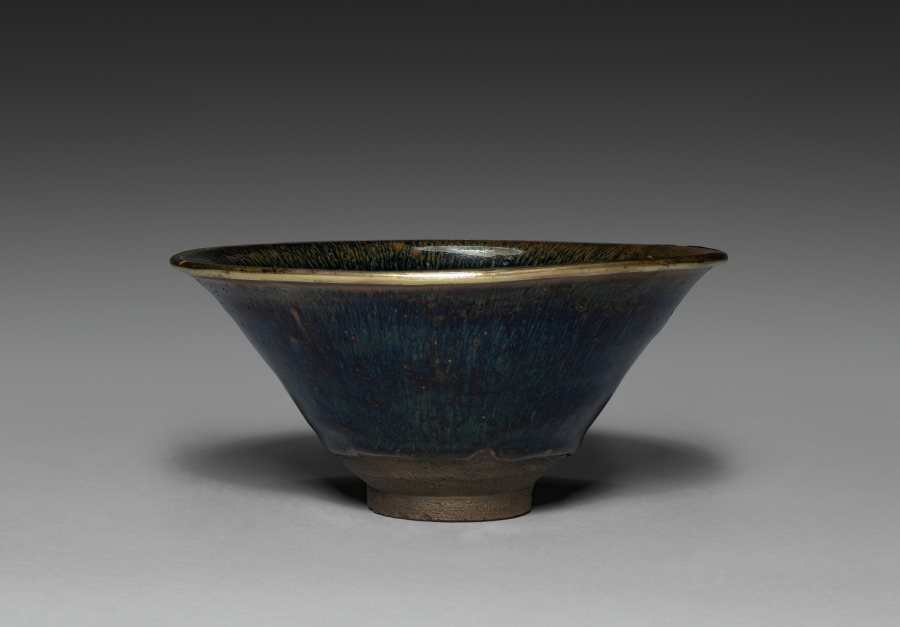
The Jian tea bowl kept at the Cleveland Museum of Art gives the third category. The black glaze is saturated with iron; on the slow cooling of the kiln, the iron precipitated in radial striations from the centre toward the rim, drawing the tù háo. The bowl, produced in Fujian during the Southern Song, belongs to the same family of kilns that, at the same period, yielded the rare yào biàn spoken of above. On these latter pieces, the crystallization yields not striations but iridescent disks. Only four have reached us, kept in Japan, all classified as national treasures. The detail merits a careful reading: these bowls were produced in China, imported into Japan as objects of the tea ceremony, classified as national treasures by modern Japanese institutions — but their making, their chemical logic, their first aesthetic qualification are Chinese and earlier. The requalification of the flaw was not imported from Japan. It was exported to it.
Asking for the grammar of the flaw
For an English-speaking reader trained to associate “the beauty of imperfection” with wabi-sabi alone, reading a Ge crackle, a Jun furrow, or the fur of a Jian presupposes a displacement. The same attention to the flaw exists elsewhere, earlier, under another regime — that of the literate connoisseur, not the monk. And this difference changes what the piece says. The Jun bowl is not a lesson in modesty. It is a trophy of discernment. To read the object is to enter a library, not a sermon. And the library, in this case, is Chinese, hierarchical, older — and still largely absent from the European labels that present these pieces.
Sources
Textual sources
- 朱琰 (Zhū Yǎn), 《陶说》 (Táo shuō), eighteenth century. Notice on the “metamorphosis of fire” and on the Guan / Ge transformations into animal forms, cited from the 博物要览 (Bówù yàolǎn).
- 文震亨 (Wén Zhènhēng), 《长物志》 (Zhǎng wù zhì), late Ming, c. 1620. Hierarchy of the crackles of Guan / Ge / Ru and gradation of the colours of Jun.
Studies
- 卢嘉锡 (Lú Jiāxī) (gen. ed.), 李家治 (Lǐ Jiāzhì) (vol. ed.), 《中国科学技术史·陶瓷卷》 (Zhōngguó kēxué jìshù shǐ: Táocí juàn) — “History of science and technology in China: ceramics volume,” Beijing, Kexue chubanshe, 1998. Chemical mechanism of the Jun (liquid-phase droplets + Rayleigh scattering on copper ions), of the Ge (body / glaze contraction differential), and thin-film optics of the Jian crystallizations.
- 马未都 (Mǎ Wèidū), 《马未都说收藏·陶瓷篇(上)》 (Mǎ Wèidū shuō shōucáng: Táocí piān) — “Ma Weidu on collecting: ceramics, volume 1,” Beijing, Zhonghua shuju, 2008. Modern formulation of quēxiàn měi / bìngtài měi as an autonomous Song-Ming canon, parallel to and not subordinate to wabi-sabi.
Featured object
- The Metropolitan Museum of Art, New York. Plate, Jun ware, Jin/Yuan dynasty, twelfth–thirteenth century. Accession 1975.1.1661, Robert Lehman Collection. Open Access (CC0).
- National Palace Museum, Taipei. Stem bowl with celadon glaze, Ge ware, Yuan dynasty, 1279–1368. Selection sNo 04001091. NPM Open Data (CC-BY 4.0).
- The Cleveland Museum of Art. Tea bowl with “hare’s fur” glaze, Jian ware, Southern Song dynasty, twelfth–thirteenth century. Accession 1948.206. Open Access (CC0).
The flaw is not the opposite of beauty — it is one of its categories.
MOSAÏNK · May 4, 2026