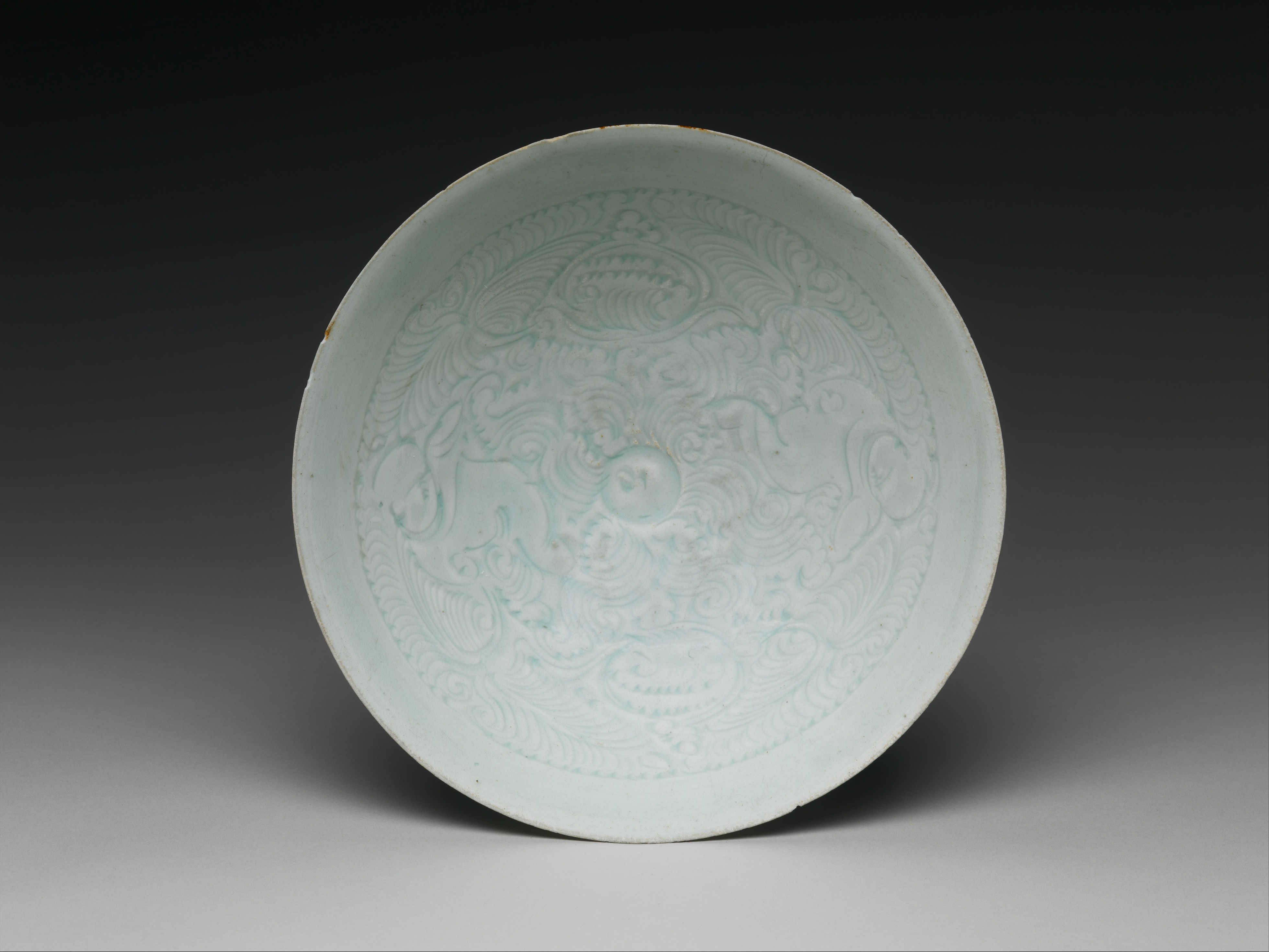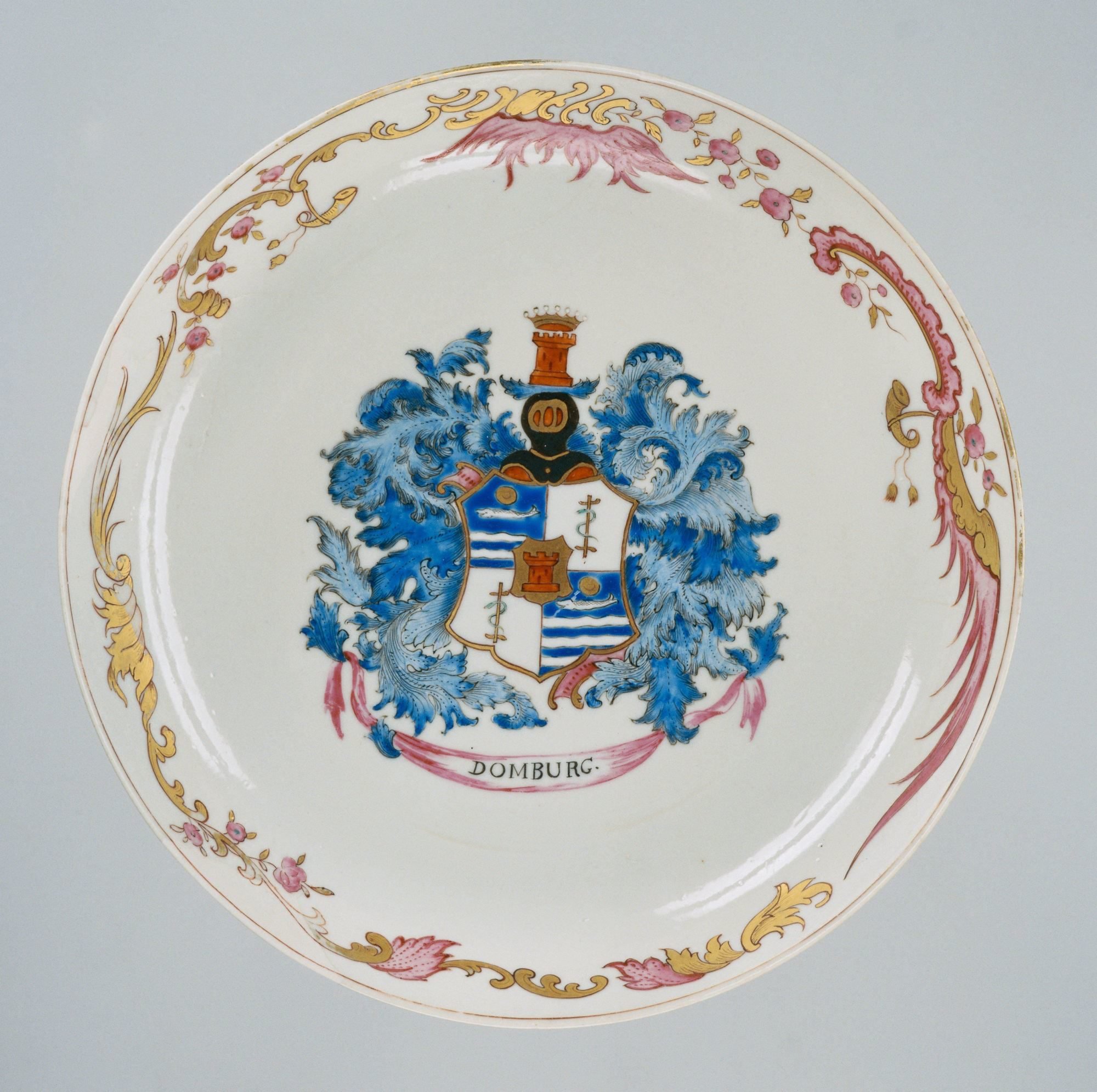
“Those who come solely for trade, their goods are taxed accordingly.” — 粤海关志 Yuè hǎi guān zhì, “Treatise of the Guangdong Maritime Customs Bureau,” preface (序), 1839. The voice is that of the Guangdong customs on the eve of the first Opium War: plain, dated, administrative. It records in its register the arrival and departure of every vessel coming in by the Pearl River. It is through this custom-house that, in the mid-eighteenth century, passes the biscuit of a plate now held at the Rijksmuseum: white, fired in the north, declared on entry, ready to receive the crest of Albertus Domburg, notary of the Dutch East India Company — the Vereenigde Oostindische Compagnie, known as the VOC, posted at Batavia between 1747 and 1757. The engraved model leaves with the shipment; the piece will return painted from Canton.
Held the right way up for the table, it reads without being turned over. The eye stays on the display face; the crest offers itself the way the dinner is laid. The porcelain, however, comes from farther off than the painting that covers it: the material was fired in the interior of China, 800 km to the north, white. Only the polychrome enamel heightened with gold was laid on at Canton, beneath the walls of the foreign factories.
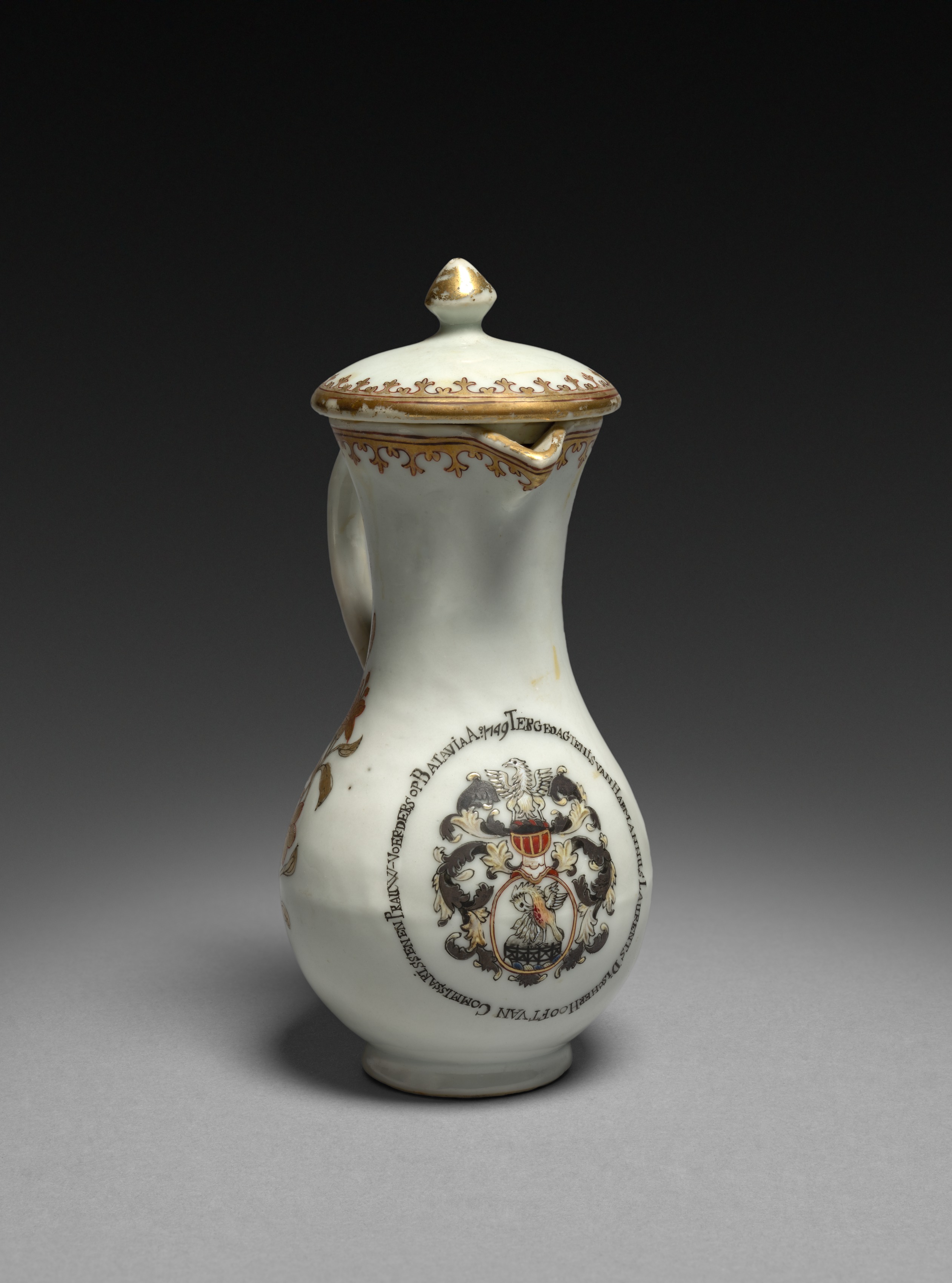
This technique — porcelain painted over the glaze, in the Canton workshops, for the foreign trade — bears a name: 广彩 guǎng cǎi, the “Canton enamels.” Who paints the Domburg crest? A Chinese workshop, after a European model. The piece arrives from the north white; it leaves the south painted.
The bilingual studio: two firings, two thousand kilometres, two hands
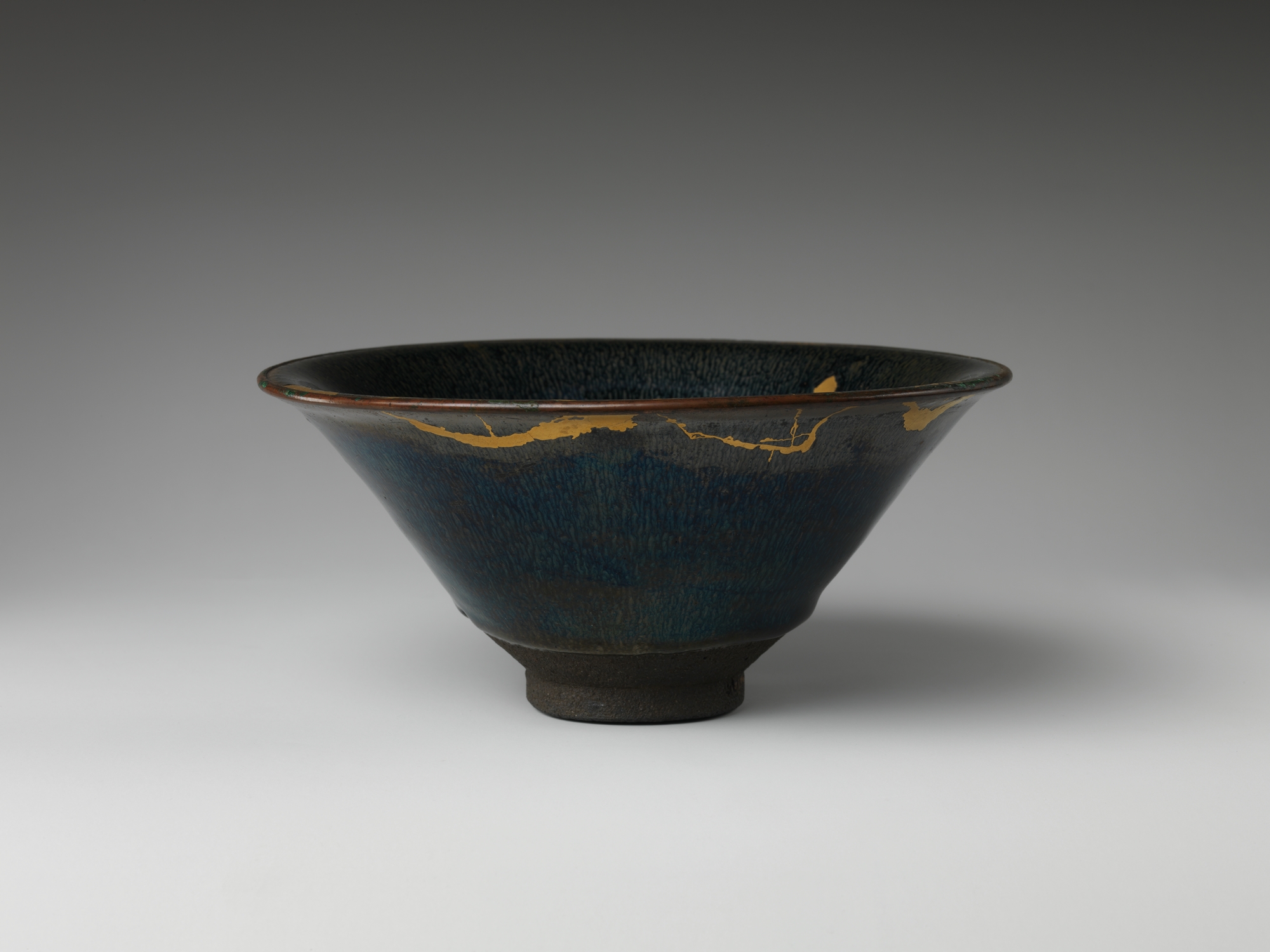
The white biscuit is fired at 景德镇 Jǐngdézhèn, in Jiangxi. It must travel 800 kilometres south to receive its colour. The route is intricate: the crates first reach Lake Poyang, ascend the Gan River toward Ganzhou, are carried on men’s backs over the Meiling pass for some thirty kilometres, then entrusted to the North River, which joins Canton. On arrival, the pieces wait for their painting. The Canton kilns fire only at low temperature (~900 °C), enough to fix enamels and gold over a glaze already proven at 1300 °C. A Canton porcelain is, to the letter, a piece that has been fired twice.
The enamelling workshops are set up in the immediate vicinity of the 十三行 shí sān háng, the “Thirteen Hongs” — the quarter of foreign factories where, under the Canton System (1757–1842), the only maritime-trade posts permitted on Chinese soil are concentrated. The British East India Company, the Dutch VOC, and Danish, Swedish and French factories stand side by side. Physical proximity is, in itself, the infrastructure of the commission: a captain brings a drawing, the hong merchant relays it, the workshop paints, the piece leaves again on the returning ship. The distance between the one who commissions and the one who paints is measured in streets, not months.
The Qing archives distinguish three terms for European-style painted enamel on porcelain, and each names an address. 珐琅彩 fà láng cǎi designates the enamel painted in the imperial workshops of the Forbidden City, in Beijing. 洋彩 yáng cǎi — “Western colours” — designates the enamel painted at Jingdezhen itself, on local biscuit, for the court. Guǎng cǎi, in turn, is the one painted at Canton, for the markets outside. Three related techniques, three addresses, three publics: the term names the street before the colour.
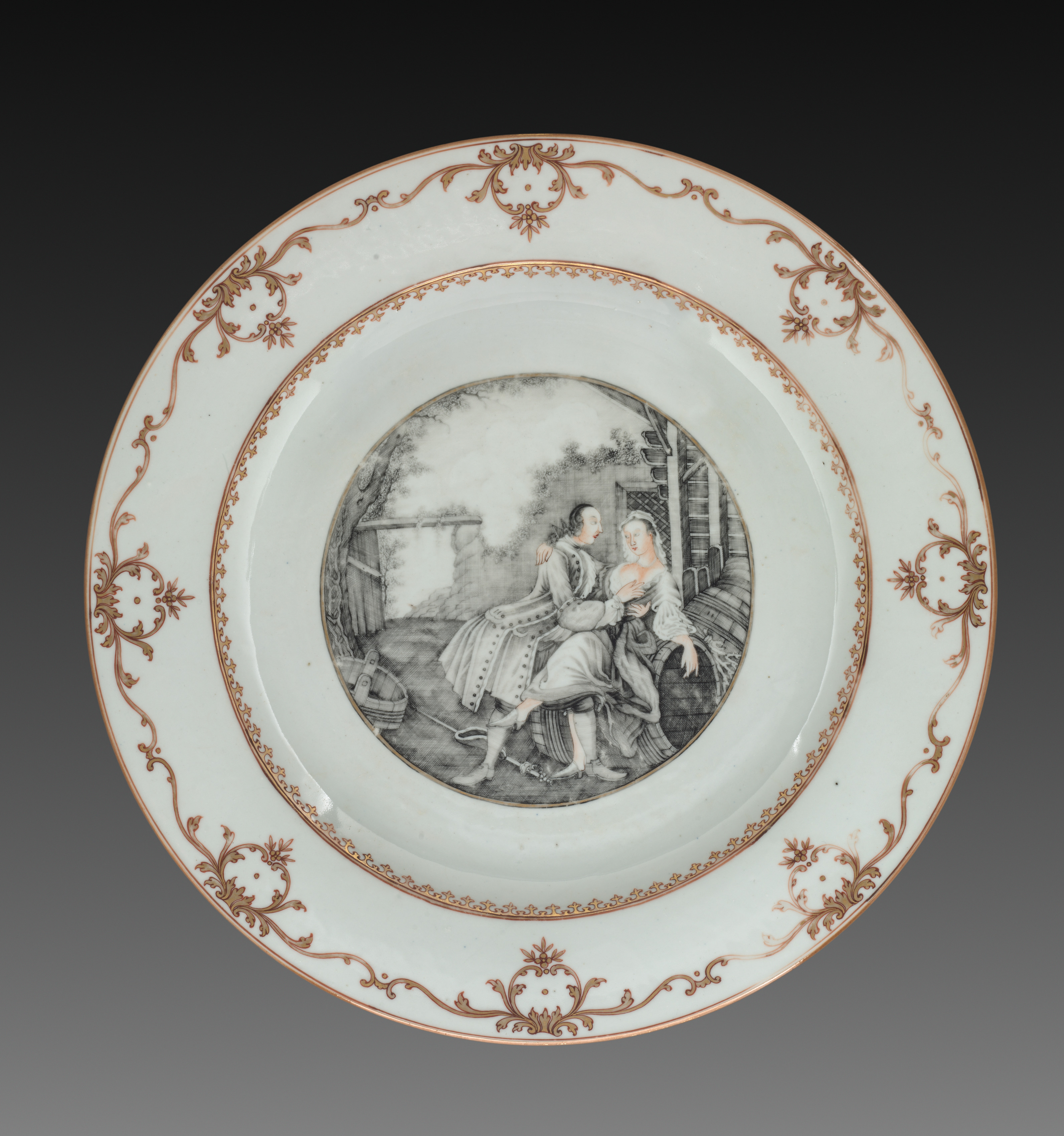
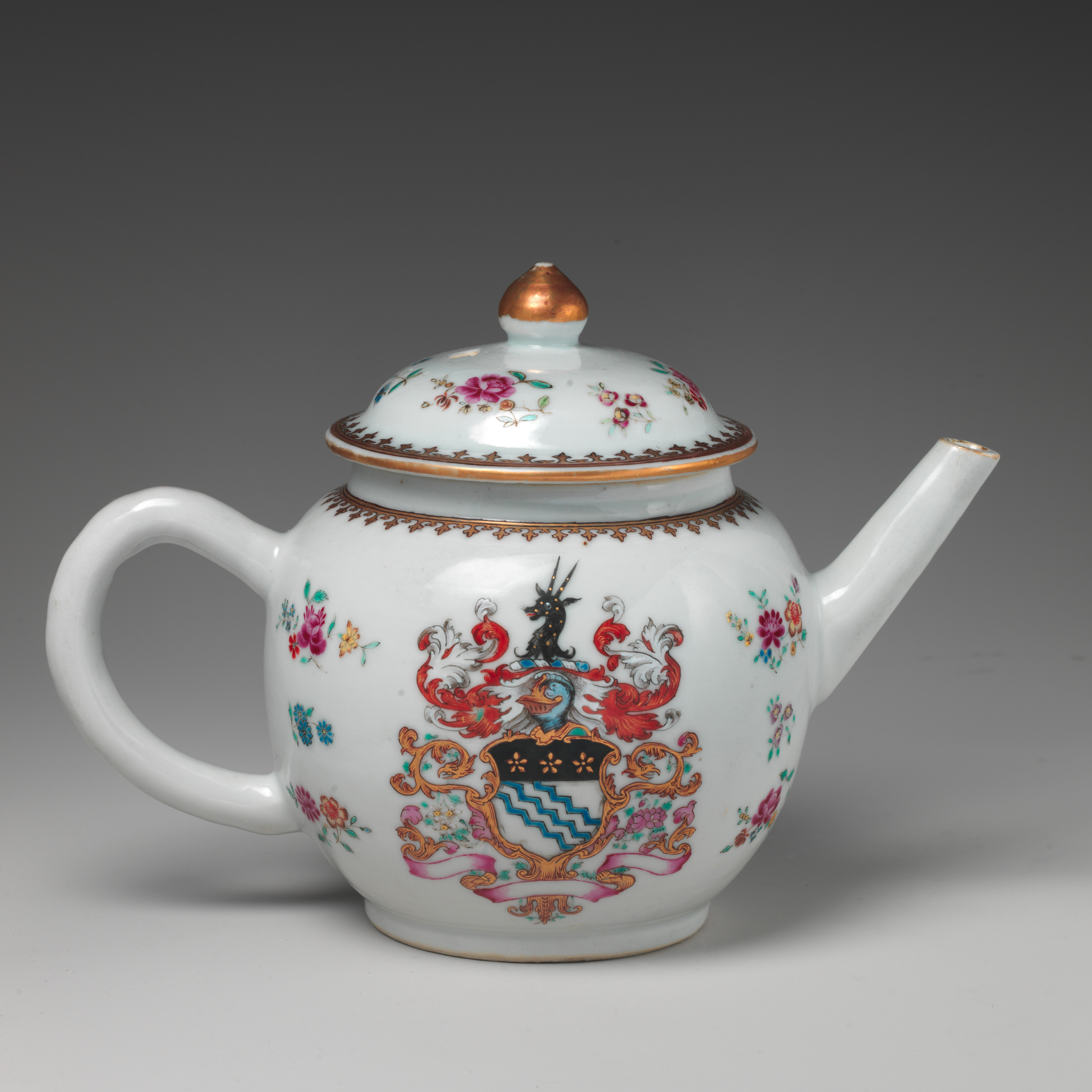
The armorial commission follows a known protocol, in four stages. The European client sends his captain an engraved drawing of his arms — often the ex-libris from his library, sometimes the matrix of his seal. The captain hands the model to the hong merchant at Canton, who orders the service in white from Jingdezhen. The biscuit, once arrived in the south, is painted after the drawing, together with the rococo or floral border in keeping with the taste of the moment. Patricia Ferguson counts more than six thousand armorial services painted at Canton for British families between 1725 and 1820, a fifth of them for families in Scotland. At the end of the relay, the Canton brush holds a European model; the studio speaks two languages because it repeats one dictated from elsewhere.
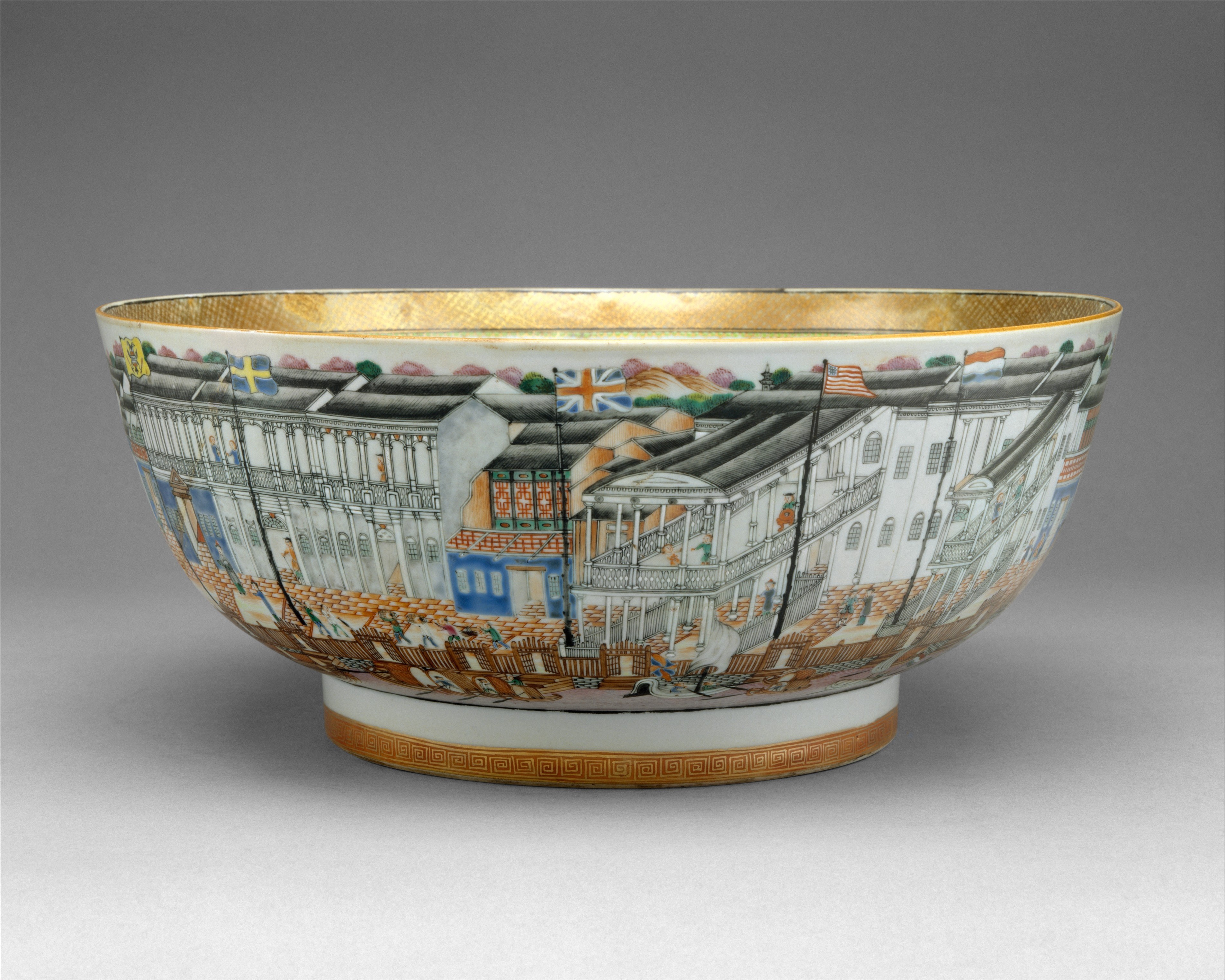
A punch bowl held at the Metropolitan, dated to the years 1785–1800, demonstrates it at its own scale. Around the body unfolds a panoramic view of the Thirteen Hongs themselves — each flying the flag of a nation. Denmark, France, Great Britain, the Netherlands, Sweden, the United States, depending on the known variants. The piece is no longer content to carry a foreign coat of arms: it depicts its own place of manufacture. The bilingual studio has learned to paint what it sees when it lifts its head from the table.
Repainting the question
The Canton brush does not imitate the foreign eye: it redraws its outline the better to serve it. “Canton” porcelain is neither a Chinese aesthetic put into circulation nor a European object made elsewhere. It is a third term, in which each patron receives what he himself sent, passed back through a hand that has learned to read his signs. The question is no longer “what does China export?” — it has become “at what distance, and through whose hands, does the image of a family become an object brought back to it?”
Sources
Textual sources
- 梁廷枏 (Liáng Tíngnán, 1796–1861), 粤海关志 (Yuè hǎi guān zhì) — “Treatise of the Guangdong Maritime Customs Bureau,” 30 卷, 1839. Critical annotated edition by 袁钟仁 (Yuán Zhōngrén), Guangzhou, Guangdong Renmin Chubanshe. Administrative framework of the tariffs and regulations of the Canton System — the institutional context in which the guǎng cǎi workshop operates.
Studies
- William R. Sargent (with an essay by Rose Kerr), Treasures of Chinese Export Ceramics: From the Peabody Essex Museum, New Haven, Yale University Press, 2012. Reference catalogue of Chinese export porcelain, fifteenth–twentieth centuries; Canton painted enamels and the Jingdezhen → Canton route.
- Stacey Pierson, Chinese Ceramics: A Design History, London, V&A Publishing, 2009. The “Intersections: trade and transfer, global trade” section — the emergence of export porcelain as a named category and the distinction of the European-influenced enamel families.
- Patricia F. Ferguson, “Armorial china, part 1 & 2,” National Trust for Scotland (online). The four-stage protocol of armorial commissions; a count of more than six thousand British services 1725–1820, a fifth of them for Scottish families.
- Christiaan J. A. Jörg & Jan van Campen, Chinese Ceramics in the Collection of the Rijksmuseum, Amsterdam: The Ming and Qing Dynasties, Amsterdam, Rijksmuseum / Philip Wilson Publishers, 1997. Reference for the VOC commissions, including the Domburg service.
Featured object
- Rijksmuseum, Amsterdam. Plate with the arms of the Domburg family, Canton workshops, about 1747–1757. Porcelain, polychrome overglaze enamels and gold. Accession AK-NM-13376. Public domain.
- The Cleveland Museum of Art. Covered Milk Jug, Canton, dated 1749. Porcelain, overglaze enamels. Accession 1955.345. Open Access (CC0).
- The Cleveland Museum of Art. Charger, Canton, about 1750. Porcelain, overglaze enamels. Accession 1970.48. Open Access (CC0).
- The Metropolitan Museum of Art, New York. Teapot from the Lee of Coton armorial service, about 1750–1760. Porcelain, enamels and gold, Helena Woolworth McCann Collection. Accession 51.86.45a,b. Open Access (CC0).
- The Metropolitan Museum of Art, New York. Hong Punch Bowl, Canton, 1785–1800. Jingdezhen porcelain, enamels painted at Canton and gold. Accession 1973.167. Open Access (CC0).
In Canton, the brush speaks two languages — the kiln, only one.
MOSAÏNK · July 3, 2026