Two clays — one pale, one dark. Knead, stretch, twist, draw the body out in spirals
or checkerboards: the pattern lives in the clay itself, running through the body
from one side to the other.
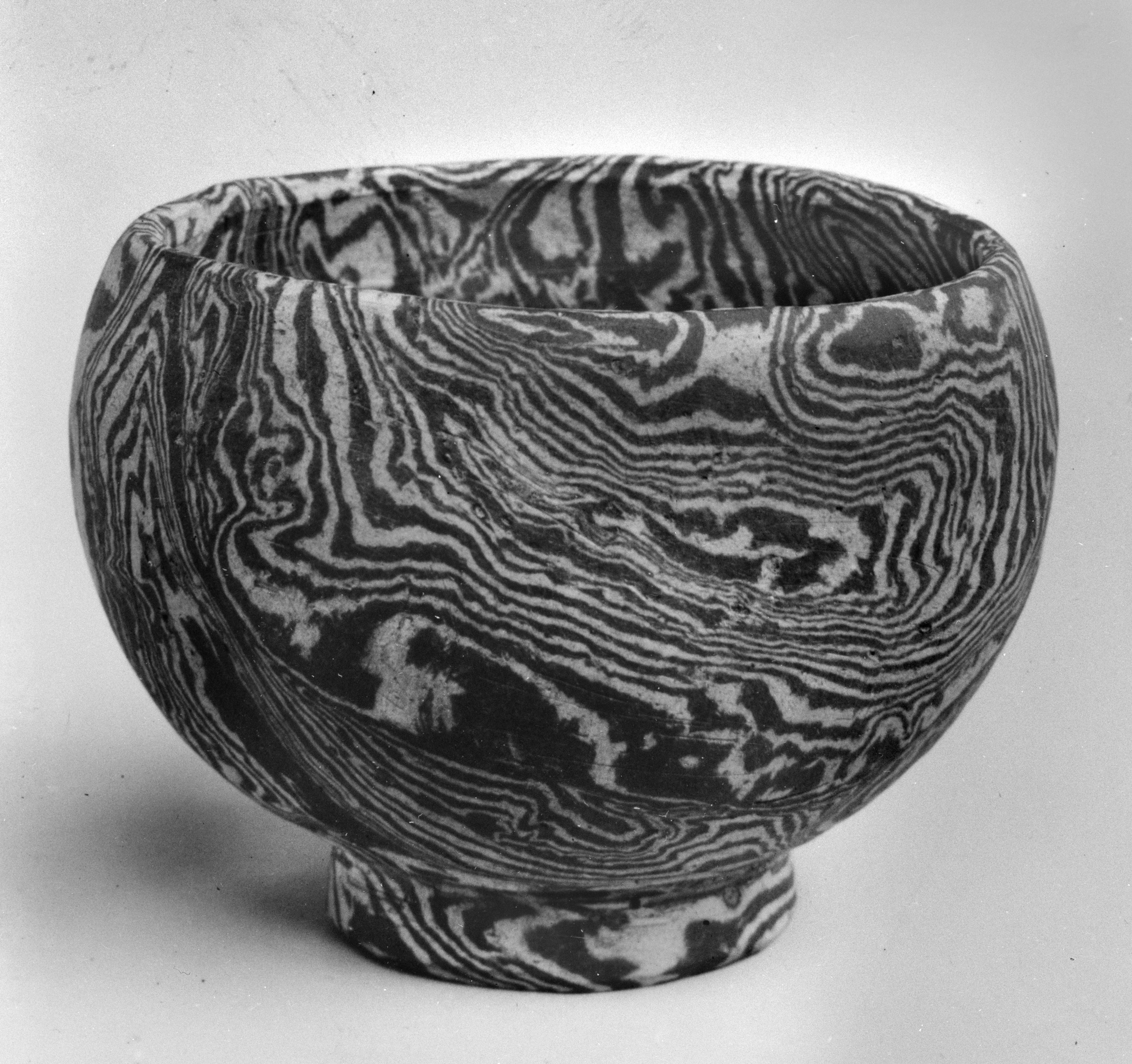
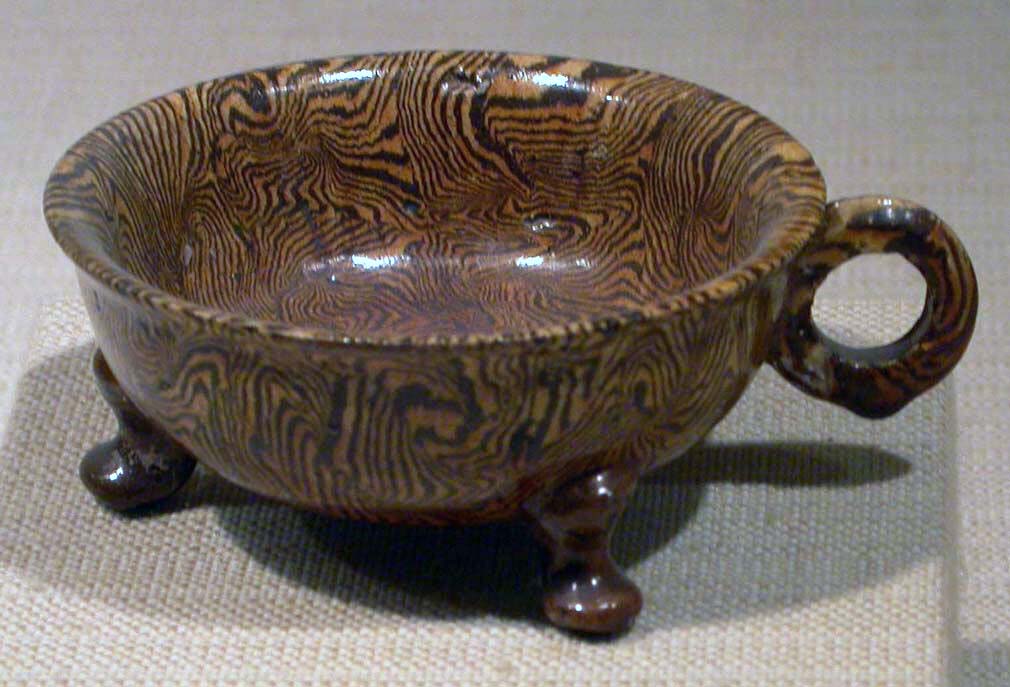
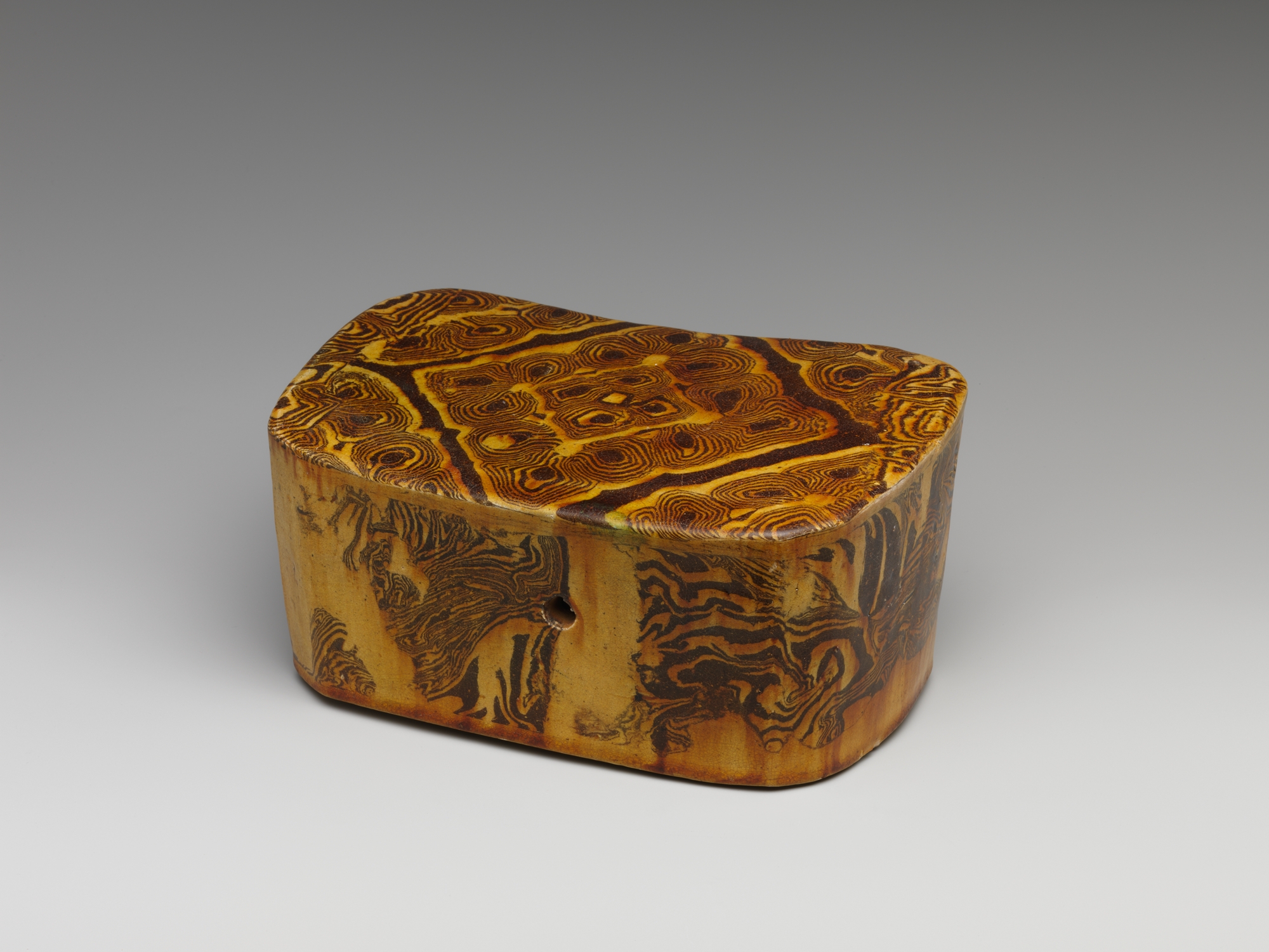
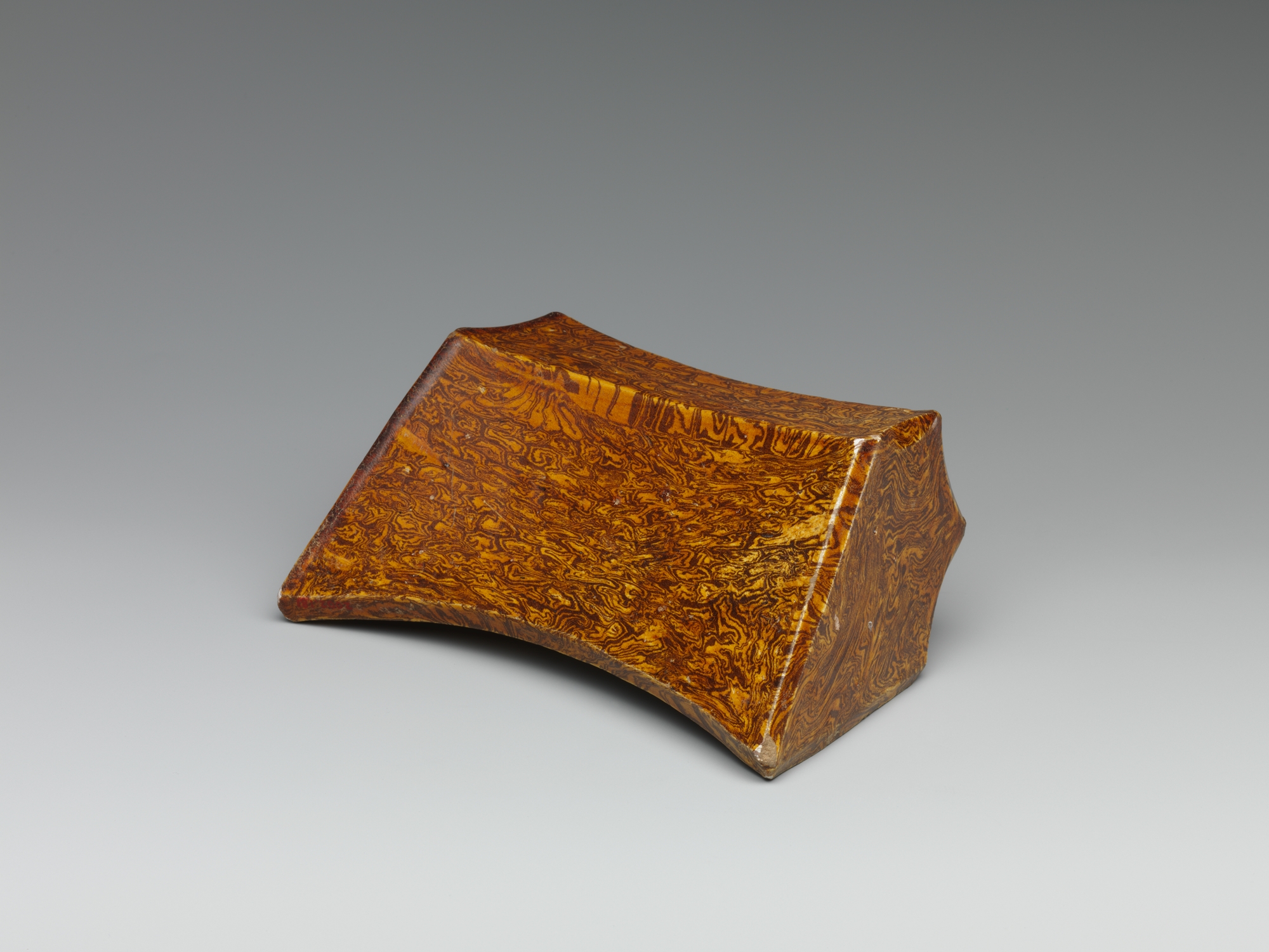
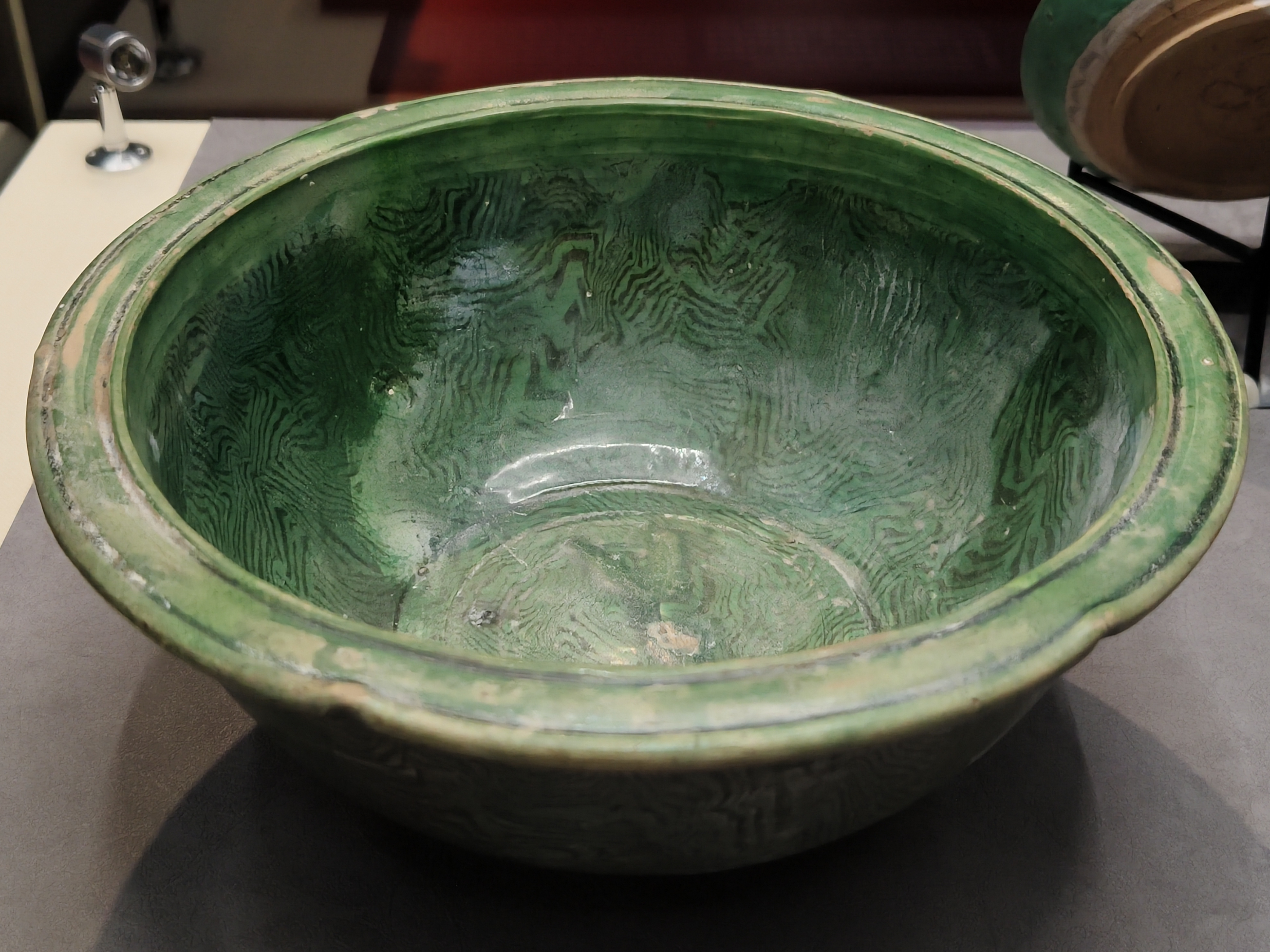
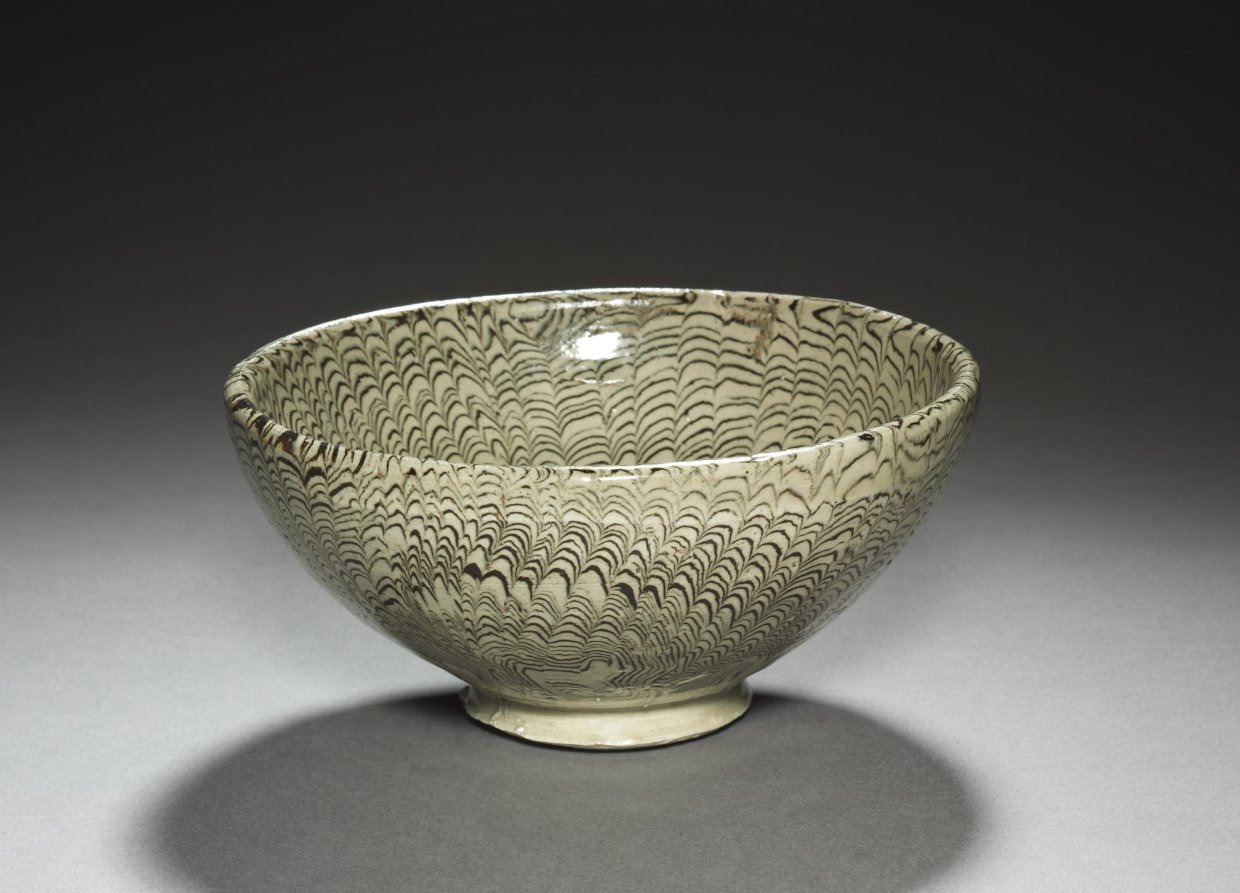
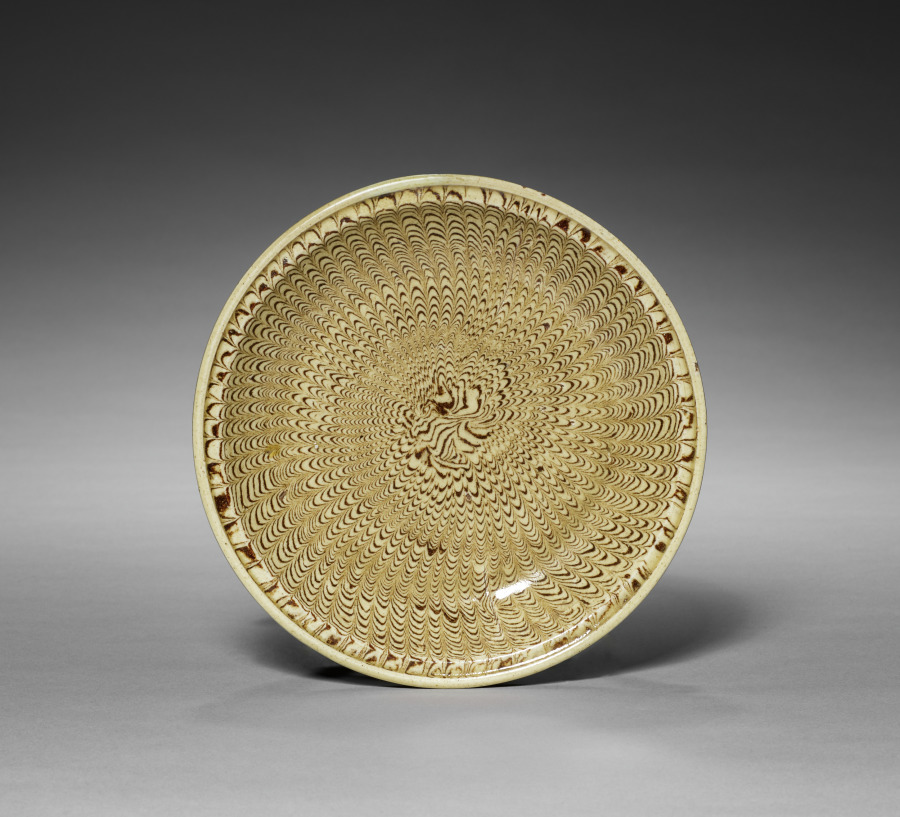
Small earthenware cup in marbled clay (jiǎo tāi绞胎) — two clays, pale and dark, kneaded together and drawn out in spirals —, Gongxian kiln (gǒng xiàn yáo巩县窑), Henan province, Tang dynasty (618–907), 7th–8th century. The Metropolitan Museum of Art, acc. 23.181. CC0.Tang dynasty, first half of the 8th century — tripod cup with ring handle, earthenware with marbled clay, Gongxian kiln, Henan province. The same technique applied to a distinct typology: three feet, a single lateral handle, the wall marbled through-body. The Metropolitan Museum of Art, acc. 50.221.15. CC0.Pillow in earthenware with marbled clay and yellow glaze, Tang dynasty (618–907), 8th century, Henan workshops. A reclining form, the upper face wide: the pattern runs through the body from face to side — a cross-section of the wall shows the same alternation as the surface. The Metropolitan Museum of Art, acc. 2001.342. CC0.Marbled clay applied to the surface (xiāng qiàn jiǎo tāi镶嵌绞胎) — cut marbled veneer laid onto a plain ground clay. Pillow in earthenware, Tang dynasty (618–907), ca. 700, Henan workshops. The surface-overlay sub-class is already present at the Tang horizon: it is its refinement, later, that will distinguish Dangyangyu. The Metropolitan Museum of Art, acc. 2002.181. CC0.Flat-mouth basin in earthenware with marbled clay and a black-painted accent, Tang dynasty (618–907). Held by the National Museum of History, Taipei (Henan collection transferred in 1956): the piece links the Tang Henan production envelope to a Taiwanese institutional deposit. Image shared on Wikimedia Commons, public-domain dedication. CC0.Dangyangyu kiln (dāng yáng yù yáo当阳峪窑), Xiuwu (xiū wǔ修武) region, Henan province, Northern Song dynasty (960–1127), 12th century — small bowl in stoneware with through-body marbled clay, finely marbled wall. Here, not invention, but refinement: finer alternation, controlled geometry, technique brought to its point of balance. The Cleveland Museum of Art, acc. 2012.449. CC0.Northern Song or Jin (960–1234), North or Central China — circular flat dish in stoneware with through-body marbled clay and transparent glaze. Workshop unlocalized, the panel's outer edge: the technique persists at the dynastic hinge, still legible, but the attribution blurs. The Cleveland Museum of Art, acc. 2020.187. CC0.
With each fragment, a letter on the table.
With each fragment we publish, a long-form read on Chinese ceramics
and mosaics. No fixed schedule:
the letter follows the fragment, never the other way around.
With nothing to sell for now.
One click to unsubscribe — GDPR, no resale, no invasive tracking.